"I never did give anybody hell. I just told the truth and they thought it was hell." Harry S. Truman
Saturday, September 14, 2013
Deficit Falls To Lowest Level Since 2008, Discrediting Argument For More Cuts
Monday, August 20, 2012
Unethical Commentary, Newsweek Edition
The president pledged that health-care reform would not add a cent to the deficit. But the CBO and the Joint Committee on Taxation now estimate that the insurance-coverage provisions of the ACA will have a net cost of close to $1.2 trillion over the 2012–22 period.
Tuesday, July 24, 2012
CBO: Repealing Obamacare would increase deficit by $109 billion
Monday, March 19, 2012
GOP’s Distortion Of New CBO Estimate Exposes The Weakness Of Their Arguments Against Health Reform
So, where did Republicans get their $1.76 trillion cost figure? That’s the gross cost for 11 years ending in 2022. Republicans inappropriately compare that figure to the original estimate of $938 billion for the 10-year period ending in 2019.The 11-year figure is much higher because it includes three additional years of full implementation of the coverage provisions of the law. The federal subsidies and expansion of Medicaid, which are by far the most costly elements of the coverage provisions, don’t go into effect until 2014. So, that 2010-2019 estimate includes four years of very low coverage costs (relatively speaking), and the 11-year estimate only includes two years of very low costs, plus three extra years of full implementation costs.
Wednesday, April 06, 2011
Paul Ryan’s Multiple Unicorns
By Paul Krugman
Gosh. For a plan that supposedly sets a new standard of seriousness, Paul Ryan’s vision (pdf) depends an awful lot on unicorn sightings — belief in the impossible. Let me review the top three unicorns.
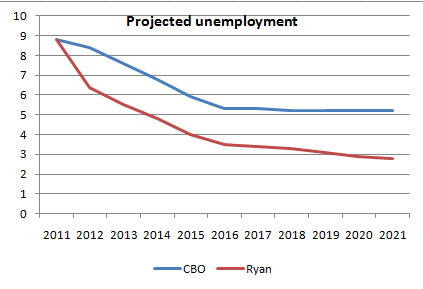
First, the plan assumes that tax cuts will set off a literally unprecedented boom. Here’s again, is what is assumed about unemployment:
House budget proposalSo Ryan is claiming that unemployment will plunge right away; that by 2015 it will be down to the levels at the peak of the 1990s boom (and far below anything achieved under the sainted Ronald Reagan); and that by 2021 it will be below 3 percent, a level we haven’t seen in more than half a century. Right.
Then there’s the Medicare business. According to the CBO analysis, a typical senior would end up spending more than twice as much of his or her own income on health care as under current law. As Dean Baker points out, this means that seniors would end up paying most of their income for health care. Again, right.
But in a way, the worst part isn’t the Medicare plan: it’s the fact — which so far has not penetrated the debate — that the biggest source of supposed savings in the plan isn’t actually health care, it’s an assumption that federal spending on everything except health and Social Security can somehow be squeezed, as a percent of GDP, to a small fraction of current levels. Here’s the table, from Ryan’s own report:

Notice the marked area at the bottom: Ryan is assuming that everything aside from health and SS can be squeezed from 12 percent of GDP now to 3 1/2 percent of GDP. That’s bigger than the assumed cut in health care spending relative to baseline; it accounts for all of the projected deficit reduction, since the alleged health savings are all used to finance tax cuts. And how is this supposed to be accomplished? Not explained.
This isn’t a serious proposal; it’s a strange combination of cruelty and insanely wishful thinking.
Thursday, January 06, 2011
New CBO Analysis: GOP’s Push For Health Law Repeal Would Increase Deficit By $230 Billion Over 10 Years
By Igor Volsky
Moments ago, the Congressional Budget Office released its cost estimate for the GOP’s health care repeal bill — H.R. 2, the Repealing the Job-Killing Health Care Law Act, introduced yesterday in the House by the new Republican majority: – 32 million Americans will lose coverage compared to current law: “Under H.R. 2, about 32 million fewer nonelderly people would have health insurance in 2019, leaving a total of about 54 million nonelderly people uninsured. The share of legal nonelderly residents with insurance coverage in 2019 would be about 83 percent, compared with a projected share of 94 percent under current law (and 83 percent currently).” (p. 8-9)
– Increases deficit by $230 billion over 10 years: “Consequently, over the 2012–2021 period, the effect of H.R. 2 on federal deficits as a result of changes in direct spending and revenues is likely to be an increase in the vicinity of $230 billion, plus or minus the effects of technical and economic changes to CBO’s and JCT’s projections for that period.” (p. 5)
– Huge deficit increases over next decade: “Correspondingly, CBO estimates that enacting H.R. 2 would increase federal deficits in the decade after 2019 by an amount that is in a broad range around one-half percent of GDP, plus or minus the effects of technical and economic changes that CBO and JCT will include in the forthcoming estimate. For the decade beginning after 2021, the effect of H.R. 2 on federal deficits as a share of the economy would probably be somewhat larger.” (p. 7)
– Individuals would pay more for health insurance: “Although premiums in the individual market would be lower, on average, under H.R. 2 than under current law, many people would end up paying more for health insurance— because under current law, the majority of enrollees purchasing coverage in that market would receive subsidies via the insurance exchanges, and H.R. 2 would eliminate those subsidies.” (p. 9-10)
– Average health care benefits would be worse: “In particular, if H.R. 2 was enacted… the average insurance policy in this market would cover a smaller share of enrollees’ costs for health care and a slightly narrower range of benefits.” (p.9)
– Premiums for employer-sponsored insurance would increase: “Premiums for employment-based coverage obtained through large employers would be slightly higher under H.R. 2 than under current law, reflecting the net impact of many relatively small changes.” (p. 10)
The GOP is excluding the vote from its new cut-go rule — under which increases in mandatory spending would have to be paid for but tax cuts would not — and dismissing the CBO’s estimates of savings in the health law by claiming that the initial savings from reform are largely imaginary. But this now places the new majority at odds with the ‘gods’ at the CBO — who they’ve routinely cited to bolster their own proposals — and its repeated pledges to lower spending in the new Congress.
Tuesday, November 30, 2010
Beck invents facts to attack food safety bill
From Media Matters:
Glenn Beck distorted a Congressional Budget Office cost estimate to claim that food-safety legislation would mean "higher taxes for you," baselessly claimed the bill would drive up food costs, and underplayed concerns about food safety. Beck demonized the legislation as a George Soros-backed effort to "control you."
Beck distorts CBO report to claim legislation means "higher taxes for you"
Beck: Food Safety Modernization Act "will mean higher taxes for you." During the November 29 edition of his Fox News show, Glenn Beck claimed that the Food Safety Modernization Act is "going to mean higher taxes for you as well. Congressional Budget Office estimates between $1.4 billion and up, between 2011 and 2015." Beck said the bill represented a George Soros-backed effort to "control your food" and "control you." [Glenn Beck, 11/29/10]
FACT: CBO said the bill would "increase spending subject to appropriation" -- not taxes. In its cost estimate of the Food Safety Modernization Act, the CBO wrote, "CBO estimates that implementing the bill with the manager's amendment would increase spending subject to appropriation, on net, by about $1.4 billion over the 2011-2015 period, assuming annual appropriation action consistent with the bill." [Congressional Budget Office, 8/12/10]
FACT: CBO said the bill would authorize collection of fees from food manufacturers -- not "higher taxes for you." In its cost estimate, CBO reported:
S. 510 would amend and modify the Federal Food, Drug, and Cosmetic Act to authorize the FDA to collect fees to help defray some of the FDA's costs of performing food safety activities. The bill would create new fee programs including: a facility reinspection and recall fee program for mandatory recalls, an importer fee program for voluntary qualified entities, and a fee program to support accreditation of third-party auditors.
The legislation also would authorize the FDA to collect fees for food (including animal feed) export certificates under the current export certification program. Fees are currently collected for drugs and devices that are issued export certifications.
Fees authorized by the bill would be collected and made available for obligation only to the extent and in the amounts provided in advance in appropriation acts. As a result, those collections would be credited as an offset to discretionary spending.[Congressional Budget Office, 8/12/10]
Beck baselessly claims bill will result in higher grocery prices
Beck: The cost to "you at the grocery story" is "expected to be hundreds of millions of dollars every year." From the November 29 edition of Fox News' Glenn Beck:
BECK: Cost to the private sector -- you know, you at the grocery store? Now, they haven't calculated that yet, but it is expected to be hundreds of millions of dollars every year.
FACT: Michigan State University professor says bill "isn't likely to make a huge dent" in food prices. As Media Matters documented, Craig Harris of the Food Safety Policy Center at Michigan State University reportedly said that the bill is unlikely to raise consumers' food costs:
Although costs of food production may rise as a result of the bill, the amount isn't likely to make a huge dent in most large food companies' profits, Harris said, so the added costs shouldn't trickle down to the consumers. For small companies and local farmers, the bill includes exemptions and special accommodations, recognizing that some companies may not be able to keep up with the costs of adopting new safety practices.
Beck underplays food-safety problem
Beck: "Is there a big problem" with food safety "that I don't know of?" From the November 29 edition of Fox News' Glenn Beck:
BECK: Congress is working hard to make sure that the food that you eat is completely safe. Now, you might be thinking to yourself, "Glenn, I think my food is already safe." But that's just how stupid you are. They know better in Washington.
Apparently, our food is very unsafe. That's why tonight, the Senate is scheduled to start voting on S510, the FDA Food Safety Modernization Act. It is fanta-- it's gonna be so modern, what they're doing. May I ask you, who on the planet has a safer food supply than we do while feeding 300 million people? Is it China? Is it India? Is it -- oh, is it Great Britain? Ooh, Sweden? Oh, no.
Is there a big problem that I don't know of? I mean, I know that, you know, we could always make things better here. There was a problem with spinach a couple of years ago, and then guacamole or avocados, or something. I think that was quickly resolved -- minimal to no interruption of our normal food supply.
[...]
BECK: We could always improve, but there will be never be a perfect system with zero problems, will there?
FACT: GAO declared federal oversight of food safety a "high-risk" problem. From a 2007 Government Accountability Office report that was part of its series on "high-risk problems":
Each year, about 76 million people contract a food-borne illness in the United States; about 325,000 require hospitalization; and about 5,000 die, according to the Centers for Disease Control and Prevention. In addition, agriculture, as the largest industry and employer in the United States, generates more than $1 trillion in economic activity annually, or about 13 percent of the gross domestic product. The value of U.S. agricultural exports exceeded $68 billion in fiscal year 2006. An introduction of a highly infectious foreign animal disease, such as avian influenza or foot-and-mouth disease, would cause severe economic disruption, including substantial losses from halted exports. Similarly, food contamination, such as the recent E. coli outbreaks, can have a detrimental impact on local economies. For example, industry representatives estimate losses from the recent California spinach E. coli outbreak to range from $37 million to $74 million.
A challenge for the 21st century is how several federal agencies can integrate the myriad food safety programs and strategically manage their portfolios to promote the safety and integrity of the nation's food supply. In numerous previous reports, we have described the fragmented federal food safety system in which 15 agencies collectively administer at least 30 laws related to food safety. The two primary agencies are the U.S. Department of Agriculture (USDA), which is responsible for the safety of meat, poultry, and processed egg products and the Food and Drug Administration (FDA), which is responsible for virtually all other foods. Among other agencies with responsibilities related to food safety, the National Marine Fisheries Service in the Department of Commerce conducts voluntary, fee-for-service inspections of seafood safety and quality; the Environmental Protection Agency (EPA) regulates the use of pesticides and maximum allowable residue levels on food commodities and animal feed; and the Department of Homeland Security (DHS) is responsible for coordinating agencies' food security activities.
The food safety system is further complicated by the subtle differences in food products that dictate which agency regulates a product as well as the frequency with which inspections occur. For example, how a packaged ham-and-cheese sandwich is regulated depends on how the sandwich is presented. USDA inspects manufacturers of packaged open-face meat or poultry sandwiches (e.g., those with one slice of bread), but FDA inspects manufacturers of packaged closed-face meat or poultry sandwiches (e.g., those with two slices of bread). Although there are no differences in the risks posed by these products, USDA inspects wholesale manufacturers of open-face sandwiches sold in interstate commerce daily, while FDA inspects closed-face sandwiches an average of once every 5 years.
This federal regulatory system for food safety evolved piecemeal, typically in response to particular health threats or economic crises. During the past 30 years, we have detailed problems with the fragmented federal food safety system and reported that the system has caused inconsistent oversight, ineffective coordination, and inefficient use of resources. [Government Accountability Office, January 2007]
Rep. Shadegg Scoffs At The Fact That Jobless Benefits Are A Benefit To The Economy: ‘No, They’re Not!’
By Pat Garofalo
Unless Congress acts today, unemployment benefits will expire for 2.5 million Americans, with unemployment above nine percent and five unemployed workers competing for every available job opening. If Congress, as expected, does nothing, this will be first time in the last forty years that benefits have expired with unemployment so high.
According to calculations by the Congressional Budget Office, Moody’s Economy, andmyriad other economists, unemployment benefits are the single best way to pump money into the economy and generate economic activity, as the unemployed are very likely to spend all of the benefits they receive (thus moving money into local businesses). But during an interview with MSNBC’s Mike Barnicle today, Rep. John Shadegg (R-AZ) scoffed at the notion that unemployment benefits help the economy. “Unemployed people hire people? Really? I didn’t know that,” Shadegg jeered:
BARNICLE: What about the fact that unemployment benefits pumped into the economy are an immediate benefit to the economy? Immediate…
SHADEGG: No, they’re not! Unemployed people hire people? Really? I didn’t know that.
BARNICLE: Unemployed people spend money Congressman, ’cause they have no money.
SHADEGG: Aha! So your answer is it’s the spending of money that drives the economy and I don’t think that’s right. It’s the creation of jobs that drives the economy…Actually, the truth is the unemployed will spend as little of that money as they possibly can. Job creators create jobs.
BARNICLE: Have you ever been unemployed? Have you ever been unemployed?
SHADEGG: Yes, I have.
BARNICLE: What did you do with the money? Save it?
Watch it:
At the same time that he was dumping on the unemployed, Shadegg called for extending all of the Bush tax cuts without paying for them, joining a slew of Republicanlawmakers who care more about tax cuts for the very wealthy than unemployed Americans about to lose the last strand of safety net that they have available.
Shadegg never managed to explain why all of the job creators he cites would create any jobs if households aren’t spending money. In that vein, MarketPlace noted today that “when unemployment checks stop, it’s felt right away by businesses like gas stations, apartment operators, and grocery stores.” And as the Center for American Progress’ Heather Boushey and Jordan Eizenga found, “the workers losing benefits have an average weekly benefit of a little over $290 per week, which translates into a total loss of about $2.5 billion dollars in benefits over December. This is equal to about one in seven dollars of the gain in retail sales seen between December 2008 and December 2009.”
As The Wonk Room noted, some economists estimate that allowing benefits to expire could cause economic growth to “fall by one half to nearly 1 percentage point,” as well as throw hundreds of thousands of people into poverty. And while Shadegg joked that he will be unemployed come January since he is retiring from Congress, next year he will be eligible for a federal pension (if he opted for one), as he is turning 62 and served on Capitol Hill for more than five years.
Thursday, March 18, 2010
Michael Steele Delivers Joe Wilson-Like Policy Analysis Of CBO Report: ‘That’s A Lie’
By Matt Corley
Earlier today, the Congressional Budget Office released a preliminary analysis of the health care reform reconciliation package, concluding that it would cost $940 billion over 10 years, reduce the deficit by $138 billion over 10 years and by $1.2 trillion over 20 years. Republicans, however, are either dismissing the numbers or asserting that the report shows that health care reform is not “gonna save the taxpayers’ money.”
On CNN today, RNC Chairman Michael Steele — who has previously said he doesn’t “do policy” — took a page out of Rep. Joe Wilson’s (R-SC) book and directly accused the CBO of lying:
STEELE: Can you just give me an honest number, Rick? How much do you really, legitimately think, adding, using the president’s number, 30 million people to a health care system that you just said doesn’t work is going to cost the American taxpayer? How much you think it’s really gonna? $940 billion dollars over ten years. So, you telling me an additional $940 billion dollars a year is going to make all of our problems go away?
SANCHEZ: According to the calculations that we did and according to the calculations the Democrats are announcing today, it’s going to save in the deficit for the United States citizens $1.2 trillion. Do you believe that’s not true?
STEELE: Ok, can I, I got two words for you — three words, three words.
SANCHEZ: Go, go.
STEELE: That’s a lie.
When Sanchez pointed out that Steele is “arguing with the CBO,” Steele responded by saying, “let me tell you about the CBO.” “Since they’ve been taken down to the woodshed at the White House last year, you can’t believe the numbers,” said Steele. “CBO is only as good as what you put into it.” “You’re saying the president of the United States is corrupted the CBO with a personal phone call or visit?” asked Sanchez. Steele then backtracked a bit, claiming that he was “just saying that, look, this whole process has not worked on behalf of the American people.” Watch it:
This isn’t the first time Steele has accused President Obama of intimidating the CBO into changing its numbers. In December, cited a July 2009 meeting at the White House with CBO head Douglas Elmendorf and other economists — which he said was the Obama taking Elemendorf “to the woodshed” — to dismiss a positive CBO score for health care legislation. “All of a sudden they’re getting these numbers that fall right within the framework of what they’re trying to do,” said Steele. White House Press Secretary Robert Gibbs called Steele’s claim “delusional.”
Additionally, it’s odd that Steele says “you can’t believe the numbers” ever since that July 2009 meeting because Steele and the RNC have cited CBO numbers since then to support their arguments. In fact, as recently as March 5, the RNC invoked the CBO to criticize Obama’s proposed bank fee.