Showing posts with label Donald Trump. Show all posts

Tuesday, October 02, 2018

Trump makes fun of Kavanaugh accuser Christine Blasey Ford at unhinged rally

FRANK DALE Via Think Progress
During a campaign rally in Mississippi on Tuesday evening, President Donald Trump mocked Dr. Christine Blasey Ford, who testified to Congress last week that Supreme Court nominee Brett Kavanaugh attempted to rape her in high school.
The audience — attending the event in support of Sen. Cindy Hyde-Smith (R-MS), the first woman to represent Mississippi in Congress  — loudly cheered as the president mimicked Dr. Ford’s testimony. “How did you get home? I don’t remember. How’d you get there? I don’t remember. Where is the place? I don’t remember. How many years ago was it? I don’t know.”
The video of Trump mocking Christine Blasey Ford’s testimony at his rally. Remember, aides were initially surprised at his restraint on the matter.

Trump then warned his supporters that men are the real victims, reminding them that the men in their lives could also be accused of sexual misconduct. He claimed he himself has faced “many false allegations” against him. Over a dozen womenhave credibly accused Trump of sexual assault and harassment; the president has never been able to reliably refute their allegations, other than to call them all liars.
Trump tonight seemed to tell the crowd that their husbands and sons and could be falsely accused of sexual misconduct. "Think of your son. Think of your husband." (via CBS)

Michael R. Bromwich, an attorney for Dr. Ford, responded to Trump’s remarks on Twitter, asking “Is it any wonder that she was terrified to come forward, and that other sexual assault survivors are as well?”
A vicious, vile and soulless attack on Dr. Christine Blasey Ford. Is it any wonder that she was terrified to come forward, and that other sexual assault survivors are as well? She is a remarkable profile in courage. He is a profile in cowardice.

Earlier on Tuesday, Trump claimed it’s a “very scary time for young men.”
Trump continues to support his Supreme Court nominee despite numerousallegations of sexual assault or misconduct.
The president reiterated his complaints about the perceived lack of “due process” for Kavanaugh — who is not on trial, but auditioning for a high-profile job with a lifetime appointment.
Several moments after Trump describes Kavanaugh’s treatment as “abuse” and decries guilty until proven innocent, the crowd goes into “Lock her up!”

The New York Times’ Maggie Haberman noted the crowd at the “Make America Great Again” rally revived its “lock her up” chant for Dr. Ford.

Christine Blasey Ford has not been contacted about FBI investigation into Kavanaugh allegations

LUKE BARNES VIA Think Progress
On the heels of reports that the FBI is pushing to wrap up its investigation into sexual assault allegations against Supreme Court nominee Brett Kavanaugh, lawyers representing his most prominent accuser, Dr. Christine Blasey Ford, said they are still waiting to hear from investigators.
Citing sources, NBC News reported Tuesday that federal agents would not interview Ford, who also goes by Dr. Blasey professionally, because the White House reportedly felt that Ford’s testimony in front of the Senate Judiciary Committee had already enough.
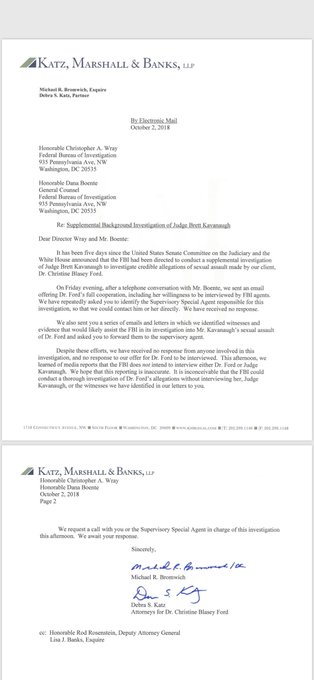
In response, Ford’s lawyers excoriated the FBI in a letter, saying they have heard nothing from the agency regarding their offer for an interview.
“We also sent [the FBI] a series of emails and letters in which we identified witnesses and evidence that would likely assist the FBI in its investigation into Mr. Kavanaugh’s sexual assault of Dr. Ford and asked you to forward them to the supervisory agent,” the letter from Michael Bromwich and Debra Katz read. “Despite these efforts, we have received no response from anyone involved in this investigation, and no response to our offer for Dr. Ford to be interviewed.”

The Wall Street Journal reported Tuesday that the FBI probe could conclude as early as Tuesday or Wednesday — several days ahead of the deadline — but will not be released to the public.
On Monday the White House authorized the FBI to conduct a broader review of the sexual misconduct claim against Brett Kavanaugh, with sources telling CBS Newsthat they can interview anyone deemed necessary. Donald Trump had seemingly confirmed this over the weekend, tweeting, “I want them to interview whoever they deem appropriate.”
So far, however, the FBI has only interviewed at least four potential witnesses, whereas Senate Democrats have asked them to interview at least two dozen. Julie Swetnick, the third woman to accuse Kavanaugh of sexual misconduct, will not be interviewed, despite repeated requests from Swetnick’s lawyer, Michael Avenatti.
“It is critically important that the public be informed of any hidden effort to limit the scope of the FBI investigation,” Avenatti said previously. “The scope should be unlimited and the FBI should be tasked with determining whether an allegation is credible—as they do every day in this country.”
Meanwhile, attorneys representing Deborah Ramirez, Kavanaugh’s second accuser who said that he exposed himself to her at a college party, said they’d provided investigators with more than 20 names of people who could corroborate her story. However, investigators have reportedly not reached out to any of them. Similarly, one unnamed classmate of Kavanaugh said the investigation into the Judge’s past was far too restrictive and was just being used as an alibi for Republicans to support the nomination.
The latest frustration about the FBI investigation comes on the same day The New York Times unearthed letters from Kavanaugh’s high school days showing he was a much harder drinker than he previously admitted, noting on one page that whoever arrived first at a rented house in Ocean City, Maryland, for a weeklong getaway should “warn the neighbors that we’re loud, obnoxious drunks with prolific pukers among us.”
According to the Times, one of Kavanaugh’s classmates has reached out to the FBI because they believe Kavanaugh had not been previously forthright about the extent of his drinking.

Tuesday, June 06, 2017

It’s time to bust the myth: Most Trump voters were not working class.

By Nicholas Carnes and Noam Lupu/Washington Post
Media coverage of the 2016 election often emphasized Donald Trump’s appeal to the working class. The Atlantic said that “the billionaire developer is building a blue-collar foundation.” The Associated Press wondered what “Trump’s success in attracting white, working-class voters” would mean for his general election strategy. On Nov. 9, the New York Times front-page article about Trump’s victory characterized it as “a decisive demonstration of power by a largely overlooked coalition of mostly blue-collar white and working-class voters.”
There’s just one problem: this account is wrong. Trump voters were not mostly working-class people.
During the primaries, Trump supporters were mostly affluent people.
The misrepresentation of Trump’s working-class support began in the primaries. In a widely read March 2016 piece, the writer Thomas Frank, for instance, argued at length that “working-class white people … make up the bulk of Trump’s fan base.” Many journalists found colorful examples of working-class Trump supporters at early campaign rallies. But were those anecdotes an accurate representation of the emerging Trump coalition?
There were good reasons to be skeptical. For one, most 2016 polls didn’t include information about how the people surveyed earned a living, that is, their occupations — the preferred measure of social class among scholars. When journalists wrote that Trump was appealing to working-class voters, they didn’t really know whether Trump voters were construction workers or CEOs.
Moreover, according to what is arguably the next-best measure of class, household income, Trump supporters didn’t look overwhelmingly “working class” during the primaries. To the contrary, many polls showed that Trump supporters were mostly affluent Republicans. For example, a March 2016 NBC survey that we analyzed showed that only a third of Trump supporters had household incomes at or below the national median of about $50,000. Another third made $50,000 to $100,000, and another third made $100,000 or more and that was true even when we limited the analysis to only non-Hispanic whites. If being working class means being in the bottom half of the income distribution, the vast majority of Trump supporters during the primaries were not working class.

But what about education? Many pundits noticed early on that Trump’s supporters were mostly people without college degrees. There were two problems with this line of reasoning, however. First, not having a college degree isn’t a guarantee that someone belongs in the working class (think Bill Gates and Mark Zuckerberg). And, second, although more than 70 percent of Trump supporters didn’t have college degrees, when we looked at the NBC polling data, we noticed something the pundits left out: during the primaries, about 70 percent of all Republicans didn’t have college degrees, close to the national average (71 percent according to the 2013 Census). Far from being a magnet for the less educated, Trump seemed to have about as many people without college degrees in his camp as we would expect any successful Republican candidate to have.
Trump voters weren’t majority working class in the general election, either.
What about the general election? A few weeks ago, the American National Election Study — the longest-running election survey in the United States — released its 2016 survey data. And it showed that in November 2016, the Trump coalition looked a lot like it did during the primaries.
Among people who said they voted for Trump in the general election, 35 percent had household incomes under $50,000 per year (the figure was also 35 percent among non-Hispanic whites), almost exactly the percentage in NBC’s March 2016 survey. Trump’s voters weren’t overwhelmingly poor. In the general election, like the primary, about two thirds of Trump supporters came from the better-off half of the economy.
But, again, what about education? Many analysts have argued that the partisan divide between more and less educated people is bigger than ever. During the general election, 69 percent of Trump voters in the election study didn’t have college degrees. Isn’t that evidence that the working class made up most of Trump’s base?
The truth is more complicated: many of the voters without college educations who supported Trump were relatively affluent. The graph below breaks down white non-Hispanic voters by income and education. Among people making under the median household income of $50,000, there was a 15 to 20 percentage-point difference in Trump support between those with a college degree and those without. But the same gap was present — and actually larger — among Americans making more than $50,000 and $100,000 annually.
To look at it another way, among white people without college degrees who voted for Trump, nearly 60 percent were in the top half of the income distribution. In fact, one in five white Trump voters without a college degree had a household income over $100,000.
Observers have often used the education gap to conjure images of poor people flocking to Trump, but the truth is, many of the people without college degrees who voted for Trump were from middle- and high-income households. That’s the basic problem with using education to measure the working class.
In short, the narrative that attributes Trump’s victory to a “coalition of mostly blue-collar white and working-class voters” just doesn’t square with the 2016 election data. According to the election study, white non-Hispanic voters without college degrees making below the median household income made up only 25 percent of Trump voters. That’s a far cry from the working-class-fueled victory many journalists have imagined.
Forget the narrative
A recent National Review article about Trump’s alleged support among the working class bordered on a call to arms against the less fortunate, saying that, “The white American underclass is in thrall to a vicious, selfish culture whose main products are misery and used heroin needles. Donald Trump’s speeches make them feel good. So does OxyContin” and that “the truth about these dysfunctional downscale communities is that they deserve to die.”
This kind of stereotyping and scapegoating is a dismaying consequence of the narrative that working-class Americans swept Trump into the White House. It’s time to let go of that narrative.
What deserves to die isn’t America’s working-class communities. It’s the myth that they’re the reason Trump was elected.

Trump Grows Discontented With Attorney General Jeff Sessions


WASHINGTON — Few Republicans were quicker to embrace President Trump’s campaign last year than Jeff Sessions, and his reward was one of the most prestigious jobs in America. But more than four months into his presidency, Mr. Trump has grown sour on Mr. Sessions, now his attorney general, blaming him for various troubles that have plagued the White House.
“They wholly undercut the idea that there is some rational process behind the president’s decisions,” said Walter E. Dellinger, who served as acting solicitor general under Mr. Clinton. “I believe it is unprecedented for a president to publicly chastise his own Justice Department.”
In his Twitter posts, Mr. Trump complained that his original executive order barring visitors from select Muslim-majority nations and refugees from around the world was revised in hopes of passing legal muster after it was struck down by multiple federal courts. The second version, however, has also been blocked, and last week the Justice Department appealed to the Supreme Court.
“The Justice Dept. should have stayed with the original Travel Ban, not the watered down, politically correct version they submitted to S.C.,” Mr. Trump wrote.
Then he added, “The Justice Dept. should ask for an expedited hearing of the watered down Travel Ban before the Supreme Court — & seek much tougher version!”
But the messages caused considerable head scratching around Washington since it was Mr. Trump who signed the revised executive order and, presumably, agreed to the legal strategy in the first place. His posts made it sound like the Justice Department was not part of his administration.
The White House had little to add to the president’s messages on Monday. Asked why Mr. Trump signed the revised order if he did not support it, Sarah Huckabee Sanders, a White House spokeswoman, said he did it only to convince a California-based appeals court. “He was looking to, again, match the demands laid out by the Ninth Circuit and, for the purpose of expediency, to start looking at the best way possible to move that process forward,” she said.

Alan M. Dershowitz, a professor emeritus at Harvard Law School who has frequently defended Mr. Trump on cable news, said the president was clearly voicing frustration with Mr. Sessions. But he said it was not clear to him that it was a personal issue as opposed to an institutional one with the office.
“What he’s saying is, ‘I’m the president, I’m the tough guy, I wanted a very tough travel ban and the damn lawyers are weakening it’ — and clients complain about lawyers all the time,” Mr. Dershowitz said. “I see this more as a client complaining about his lawyer. The lawyer in this case happens to be Jeff Sessions.”
David B. Rivkin Jr., a lawyer who served in the White House and Justice Department under Presidents Ronald Reagan and George Bush, said Mr. Trump clearly looked at the case from the lens of a businessman who did not get his money’s worth.
“He’s unhappy when the results don’t come in,” Mr. Rivkin said. “I’m sure he was convinced to try the second version, and the second iteration did not do better than the first iteration, so the lawyers in his book did not do a good job. It’s understandable for a businessman.”
Mr. Sessions and the Justice Department remained silent on Monday. But at least one lawyer close to the administration suggested that there was consternation in the department over the president’s messages. George T. Conway III, who until last week was Mr. Trump’s choice for assistant attorney general for the civil division and whose wife, Kellyanne Conway, is the president’s counselor, posted a Twitter message suggesting that Mr. Trump’s tweets “certainly won’t help” persuade five justices on the Supreme Court — the majority needed — to uphold the travel ban.
In subsequent posts, Mr. Conway said that “every sensible lawyer” in the White House Counsel’s Office and “every political appointee” at the Justice Department would “agree with me (as some have already told me).” Mr. Conway stressed that he strongly supports Mr. Trump — “and, of course, my wonderful wife” — and was making his points because the president’s supporters “should not be shy about it.”
The frustration over the travel ban might be a momentary episode were it not for the deeper resentment Mr. Trump feels toward Mr. Sessions, according to people close to the president. When Mr. Sessions recused himself from the Russia investigation, Mr. Trump learned about it only when he was in the middle of another event, and he publicly questioned the decision.
A senior administration official said Mr. Trump has not stopped burning about the decision, in occasional spurts, toward Mr. Sessions. Deputy Attorney General Rod J. Rosenstein, who was selected by Mr. Sessions and filled in when it came to the Russia investigation, ultimately appointed Robert S. Mueller III, a former F.B.I. director, as special counsel to lead the probe.
In fact, much of the past two months of discomfort and self-inflicted pain for Mr. Trump can be tied in some way back to that recusal. Mr. Trump felt blindsided by Mr. Sessions’s decision and unleashed his fury at aides in the Oval Office the next day, according to four people familiar with the event. The next day was his fateful tweet about President Barack Obama conducting a wiretap of Trump Tower during the campaign, an allegation that was widely debunked.
However, Mr. Trump is said to be aware that firing people now, on the heels of dismissing James B. Comey, the F.B.I. director, would be risky. He has invested care and meticulous attention to the next choice of an F.B.I. director in part because he will not have the option of firing another one. The same goes for Mr. Sessions, these people said.

Mr. Dershowitz said he thought any frustration over Mr. Sessions’s recusal, like the travel ban, was probably not personal. “I think that’s also institutional,” he said. “Almost any A.G. would recuse himself. I think he’s railing against lawyers.”