Showing posts with label anti-minimum wage. Show all posts

Thursday, January 05, 2017

The CEO of a chain that underpays and mistreats workers is about to lead the Labor Department

By Kira Lerner and Alice Ollstein/Think Progress 
Johaunna Cromer never thought she would work at a fast food restaurant. A college graduate, trained psychologist, and former member of the Air Force, she said she used to believe fast food employees were mostly teenagers trying to supplement their allowance.
But in 2014, when her family moved to Asheville, North Carolina to be close to relatives, Cromer ended up taking a position as a manager at a Hardee’s restaurant near her home. Counseling jobs were hard to find, and she needed quick money to support her two children.
The position proved far more trying than she’d ever imagined.
“I learned how hard the work was,” she told ThinkProgress. “And I never thought they would treat people the way they treat people for fighting for what’s right.”
Almost immediately after starting the job, Cromer realized that her $7.25 an hour salary was not sufficient to pay her bills and support her children. She became active in the Fight for 15 movement — a national network of fast-food and other low-wage workers demanding a $15 an hour minimum wage and the right to form a union. She traveled across the country to participate in strikes and protests, gave televised interviews, and encouraged her coworkers to join the movement.
Eight months later, she was fired.
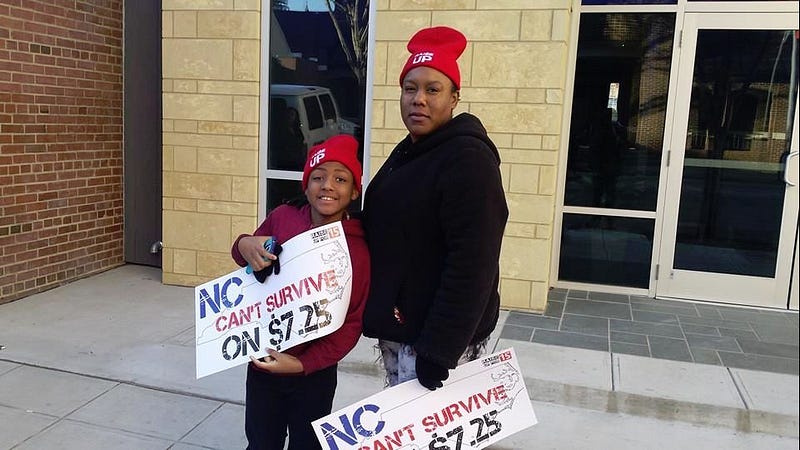
Cromer and her son protested the minimum wage in North Carolina. CREDIT: Johaunna Cromer
“I was making too much noise, and they were probably afraid of me putting Hardee’s name in a bad light,” she said, alleging that Hardee’s management pressured her coworkers into signing false statements about her workplace conduct.
Cromer says her termination is the product of an anti-union, anti-worker culture at CKE Restaurants, which operates Hardee’s and Carl’s Jr. and whose CEO Andy Puzder was recently nominated by President-elect Donald Trump to lead the U.S. Department of Labor.
Puzder has made his career on the backs of low-paid fast food workers like Cromer, and he has spent the last 16 years overseeing a fast food chain notorious for violating basic wage and hour laws. A review of federal and state court documents and Labor Department inspections paint a picture of a corporate culture that values profit over worker welfare.
People employed by Puzder have sued for discrimination, filed class action lawsuits over the denial of overtime pay, and alleged that they were fired for protesting the chain’s low wages.
Labor law experts have also spoken out against Puzder’s practices. Paul Secunda, director of the Labor and Employment Law Program at Marquette University, told ThinkProgress that Puzder has taken advantage of the fact that fast food workers are a vulnerable population that is easy to abuse.
“They are usually at the bottom of the pay scale, they usually don’t have the sophistication to know their rights under the law, and it’s hard for them to be collective in their approach because they’re moving around so much,” he said. “It’s really easy to manipulate them and exploit them, and that’s what we’ve seen.”
“It would be hard to pick someone who is more anti-labor than this guy for the Labor Department,” he added. And those with first-hand experience with his policies, like Cromer, believe he will lead the country’s workers in a terrifying direction.
“If he can’t even care for his own company, what makes you think he can care for anything else?” Cromer asked.

A thickburger of legal complaints

Cromer said she has filed legal action against the company for her termination, and the litigation remains pending. Many other workers and ex-workers have sued Puzder’s restaurants as well.
In 2009, in response to litigation, CKE Restaurants agreed to treat general managers like hourly, non-exempt employees, entitling them to overtime pay. But the restaurant chain refused to offer back pay to the thousands of workers who had been illegally denied overtime, prompting another class action lawsuit.
“Imagine if you worked for me for ten years and we said, ‘Oh we’ve gotten it wrong. It turns out you were entitled to overtime,’” said Andy Graves, a California attorney who’s representing the managers in two ongoing class actions. “And you said, ‘What about the last ten years?’ And I said, ‘Nah, we’re just changing it going forward.’”
Jose Cubias, who sued the company in 2010, worked at Carl’s Jr. branches around Los Angeles for nearly 30 years, including five years as a general manager. He says he and every other general manager in the state were denied back pay for hundreds of hours of overtime they worked between 2005 and 2009. The company also forced them to say they were on vacation on days they were actually working in order to meet the company’s labor budget, and made them work up to 12-hour shifts without legally-required meal and rest breaks.
“By deliberately failing to pay its employees wages to which they are entitled, CKE avoided substantial expenses and thereby enriched itself at the expense of its employees,” said Cubias’ lawsuit, filed in California state court.

CKE Restaurants CEO Andy Puzder speaks at a news conference on Wednesday, August 6, 2014 in Austin, Texas. CREDIT: Jack Plunkett/AP Images
Even after the CKE-owned restaurants changed their policies and agreed to pay managers overtime, they continued to force them to perform unpaid, off-the-clock work outside the restaurant, like reporting to their superiors, tracking down missing employees, and making calls about equipment. Without litigation, Graves explained, many managers had no way to stand up for their rights under California labor law.
“These are people who have eighth-grade educations, they came to the U.S. as teenagers, they’ve done nothing but work for this fast food company for 30 years and the company kind of has them now,” he said. “They can’t do anything else. They’ve given their whole lives to learning how to run a Carl’s Jr., that’s what they do, so they’re exceptionally vulnerable in that way.”
CKE Restaurants did not respond to a request for comment about the ongoing litigation.

Direct liability in an already toxic industry

Graves, who represents fast food workers at several different chains, said the types of violations documented at CKE Restaurants are common in the industry. Though the records of the Labor Department’s inspections are not publicly available, a spokesperson for the Wage and Hour Division described to ThinkProgress some of the most egregious violations the agency documented at CKE-branded facilities.
In 2012, the department discovered that a Hardee’s franchise in Nashville, Tennessee required workers to punch out for breaks when they continued to work, and refused to pay them for those and other hours in violation of minimum wage and overtime laws. They were forced to pay more than $7,500 to 29 employees.
Another investigation of a Hardee’s franchise in Tallassee, Alabama in 2012 and 2013 found that the store failed to pay 19 employees for hours they worked beyond their scheduled hours. They were forced to pay them $2,400.
And while Puzder’s chains are frequent violators of workers’ rights, they don’t appear to be among the worst offenders. The government found violations of the Fair Labor Standards Act more than 60 percent of the times they inspected Carl’s Jr. and Hardee’s restaurants over the past seven years, according to a Bloomberg analysis of Labor Department data. Most national fast food chains had even higher violation rates, with only Jack in the Box, Pizza Hut, and Chick-fil-A ranking better than Puzder’s companies.
“CKE’s record of compliance on wage policies is among the best when compared to our industry peers,” boasted the company’s Executive Vice President & General Counsel in a statement to ThinkProgress. “Bloomberg BNA recently reported that CKE has a ‘fairly clean record’ following their exhaustive analysis.”
A man walks past a sign for a Carl’s Jr. restaurant in San Bruno, Calif., Wednesday, May 25, 2011. CREDIT: AP Photo/Jeff Chiu
Yet the Bloomberg study found that fast food franchises violate their workers’ rights at alarming rates — in part because they operate like small businesses but are held to the same standards as large corporations.
“The franchise system is almost designed to create labor code violations,” Graves said, explaining that franchises operate without corporate legal departments or a human resources departments, but are under pressure to comply with state and federal law.
Puzder is a vocal proponent of franchising. A board member of the International Franchise Association, he has claimed that he and other CKE executives should not be held accountable for violations that occur at their franchises. This view has brought him into conflict with the Obama administration, which has pushed for joint-employer liability — a policy that makes CEOs like Puzder take responsibility for the actions of his franchises.
What makes Hardee’s and Carl’s Jr. stand out is where the abuses occur. The violations did not only happen at franchises, where the company has less liability, but they also happened at sites CKE directly owns.
“The problems in the CKE cases are unusual,” Graves said about his ongoing overtime class action lawsuits. “Usually the reason we see poor treatment of workers has to do with franchisees, and not the actual company… The only thing that stands out about Carl’s Jr. is that the home office did it.”
A Labor Department investigation of corporate-owned branches in St. Louis, Missouri in 2006 and 2007 found that the company failed to properly calculate overtime pay for 456 workers, stiffing them a total of $58,001, which they had to pay in back wages.
A smaller investigation of a Hardee’s-owned location in Birmingham, Alabama between 2013 and 2015 found that the employer made illegal deductions that dropped employees below the minimum wage. They had to pay 20 employees a total of $2,000.

The fox in the hen house

The official mission of the Labor Department is to “improve working conditions; advance opportunities for profitable employment; and assure work-related benefits and rights.” But if Puzder is confirmed to run the agency, he will be in charge of enforcing a host of laws his own company has broken, in addition to other policies he has publicly opposed.
While presiding over a company that has been repeatedly fined and sued for violating existing minimum wage and overtime laws, Puzder has written op-eds and given countless interviews criticizing efforts to expand these benefits.
Increasing the minimum wage is not the best solution,” he said on Fox News in May. “If we are going to increase the minimum wage at all, we’ve got to keep a lower minimum wage for entry-level workers, or these people are just going to be shut out of the workforce.” Even as a growing number of states and cities increase their minimum wages to $15 an hour, he said he believes it should be no higher than $9.
After President Obama signed an executive order making an additional 4.2 million workers eligible for overtime pay, Puzder wrote a scathing guest postfor Forbes calling the new rule a “harsh reality” for businesses.
“As with the Obama Administration’s other efforts to regulate their way to economic prosperity, it will not deliver as promised,” he said. “In practice, this means reduced opportunities, bonuses, benefits, perks and promotions.”
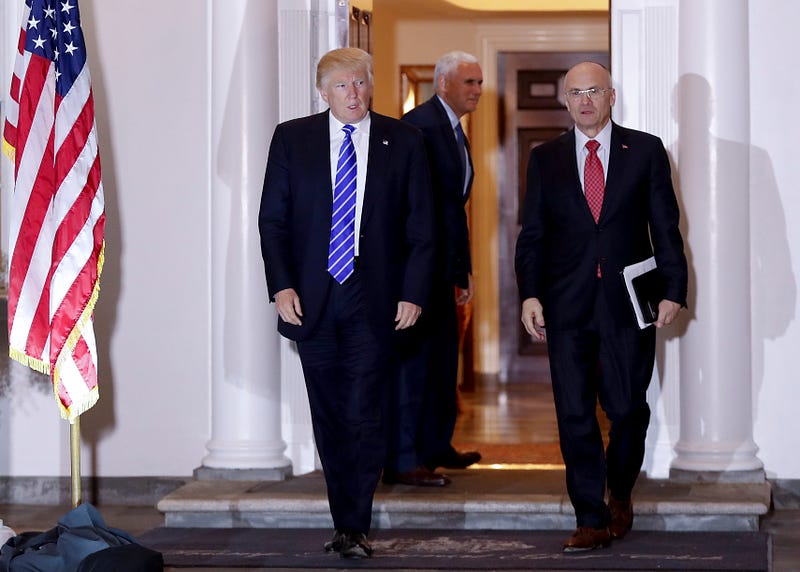
President-elect Donald Trump and Andy Puzder, chief executive of CKE Restaurants, walk from Trump National Golf Club Bedminster clubhouse in Bedminster, N.J., Saturday, Nov. 19, 2016. CREDIT: AP Photo/Carolyn Kaster
Puzder has also railed against President Obama’s joint-employer doctrine, which holds CEOs like him accountable for labor abuses committed by franchisees or contractors. He warned it would create “a lose-lose scenario” and “essentially destroy the business model.”
Graves, among others, has a cynical view of Puzder’s appointment. “It’s like putting the fox in charge of the hen house,” he said. “From our point of view, its very concerning.”
As Labor Secretary, Puzder could make sweeping changes impacting the nation’s workforce without ever having to go through Congress. He could scale back the department’s investigations into wage theft and other workplace violations, and ramp up investigations into union activity. He could make it more difficult for laid-off workers to collect unemployment insurance. He could weigh in against workers in lawsuits before the National Labor Relations Board or any federal court in the nation. He could change the government’s official view on who is classified as an employee versus who is an independent contractor, with widespread implications for workplace rights. He could change how many immigrants on temporary work visas are allowed into the United States.
Ironically, many of these changes would adversely impact the very people who voted Trump into office, Secunda predicted.
“The white working class who elected Trump are about to get screwed to a degree that is hard to fathom.”

Saturday, September 10, 2016

Trump’s New Jobs Adviser Doesn’t Understand Minimum-Wage Jobs

Bryce Covert/Think Progress
Up until recently, Andy Puzder has served only as Carl’s Jr. and Hardee’s CEO and a fundraising bundler for the joint Donald Trump and Republican National Committee fund. But now he has a new official role: job creation adviser to Trump.
Puzder has held some controversial views over the years, especially when it comes to low-wage jobs and pay, some of the jobs experiencing the strongest growth since the recession.
In 2014, after his company’s home state of California raised its minimum wage to $9 an hour, Puzder called government-mandated increases in the minimum wage “artificial.” Instead, he argued that it should be left to the free market. “When there’s a demand for labor, the cost of labor goes up,” he said. “When there’s no demand for labor, it goes down and you can’t solve that problem by having the government artificially mandate a wage increase when there’s no economic growth to support that.”
He also claimed that higher minimum wages lead companies like his to cut lower-paid entry-level jobs, which hurts teenagers looking to get a foothold into the workforce. But there is not a lot of compelling evidence that higher minimum wages lead to job losses, even among teens.
Meanwhile, the typical minimum-wage employee is over 25, working full time, and bringing home the largest share of her family’s income.
Puzder’s workforce is mostly low-wage; the average restaurant-level employee makes $9.28 an hour. He sees this as a positive thing, because inexperienced workers can get jobs at his restaurants and then work their way up. “There’s nothing more fulfilling than seeing new and unskilled employees work their way up to managing a restaurant,” he told a Senate committee hearing. And he recently told Bloomberg, “Low-skill jobs are important because that’s what gives you access to the high-level jobs,” adding, “If you focus on redistributing income, you’re not going to create growth.”
But that’s not the story for most fast food employees. Nearly 90 percent hold jobs at the bottom of the ladder; less than 9 percent move up to supervisor roles.
He also doesn’t think these jobs should be paid $15 an hour, as has been demanded by a powerful movement of fast food workers over the last four years. “[T]here’s no way in the world that scooping ice cream is worth $15 an hour, and no one ever intended it would ever be something that a person could support a family on,” he told Michael Hiltzik at the Los Angeles Times. “Those jobs just don’t produce that kind of value like a construction job or a manufacturing job does.”
Those blue-collar construction and manufacturing jobs have long been on the decline, however. Instead, service jobs like scooping ice cream or serving burgers have risen rapidly.
How should the government help create jobs, then? Puzder says it “needs to get out of the way.” He said in 2014, “If government gets out of the way, businesses will create jobs” and that wages will rise. For him, that likely means repealing the Affordable Care Act, which he has frequently and loudly criticized as a job-killer even though job growth has remained strongever since it went into effect.
Puzder is typical of Trump economic advisers, however, in both the fact that he was drawn directly from the pool of big donors and that he isn’t an economist. The first list of 13 advisers that Trump released was heavy on men named Steve as well as real estate and finance tycoons, and the follow up list that included some women had a number of big Republican donors and Wall Street players.

Friday, December 06, 2013

Congressman: ‘I Would Vote To Repeal The Minimum Wage’

BY BRYCE COVERT/Think Progress
Rep. Joe Barton (R-TX) told the National Journal that he thinks the country should get rid of the minimum wage. “I think it’s outlived its usefulness,” he said. “It may have been of some value back in the Great Depression. I would vote to repeal the minimum wage.”
Barton’s not the only lawmaker to hold such a view. In June, Sen. Lamar Alexander (R-TN) told a meeting of the Health Education Labor and Pensions Committee to mark 75 years since the signing of the Federal Labor Standards Act, which guaranteed a minimum wage, that he “do[es] not believe in it” and that he would abolish the minimum wage. And while he hasn’t called for the full repeal of the minimum wage, Sen. Marco Rubio (R-FL) has said, “I don’t think a minimum wage law works.”
The minimum wage historically helped many families stay out of poverty. Up until the early 1980s, making the annual minimum wage income lifted a family of two above the federal poverty line. At its peak in 1968, it was enough to lift a family of three out of poverty. Yet despite rising inflation and worker productivity since then, the minimum wage has failed to keep up. It would be over $10 an hour today if it had risen with inflation since that high, and if it had kept pace with gains in productivity it would be more than $20 an hour.
As it is, however, working a 40 hour week at minimum wage won’t bring in enough money to afford a two-bedroom apartment anywhere in the country — workers would have to put in at least 80 hours a week. Working 40 hours a week for 52 weeks each year at the minimum wage only brings a worker $15,080, below the federal poverty line for a family of two or more. But bringing the wage in line with inflation by increasing it to $10.10 an hour would lift nearly 6 million people out of poverty, many of them women and people of color.
While critics of raising the minimum wage, like Rubio and Rep. Paul Ryan (R-WI), claim that it will cost jobs, there’s little evidence to back that up. Several academic studies have shown that raising the wage doesn’t hurt employment, and one even found that states that raised their wages had slightly above average job growth. Perhaps that’s because a higher wage canbenefit businesses through increasing demand, lowering turnover, and increasing employee performance.

Republicans may have once recognized this, as they weren’t always against a raise. At least67 Republicans who are still serving in Congress today supported an increase under President George W. Bush, including Alexander and Ryan. Yet House Republicansunanimously voted down an increase in March.

Friday, August 02, 2013

REPORT: Fox's Month Of Inaccurate Minimum Wage Coverage

CHARLIE RAFKIN/Media Matters For America
Throughout the month of July, a majority of Fox News' segments discussing minimum wage policy pushed the myth that increasing the minimum wage forces businesses to cut jobs. In fact, multiple economic studies confirm that raising the minimum wage has no effect on employment.

Majority Of Fox's July Reports On Minimum Wage Argued Wage Hikes Lead To Job Losses

A Majority Of Fox News' July Coverage Of The Minimum Wage Claimed Wage Hikes Increased Unemployment.  A Media Matters count of Fox News segments covering the minimum wage during the month of July determined that 24 out of 37 segments -- 65 percent -- included the myth that increasing the minimum wage would cause job losses.
Only One Fox News Segment Acknowledged That Minimum Wage Raises Do Not Cause Unemployment. Only one segment, or just under three percent of Fox News' coverage, acknowledged the fact that minimum wage hikes are not correlated with unemployment.
68 Percent Of Fox News' Segments Focused On D.C.'s Effort To Enact A Living Wage. Twenty-five of the 37 segments concerning the minimum wage focused on the D.C. Large Retailer Accountability Act, a pending D.C. City Council bill to enact a living wage of $12.50 per hour for employees at big box retailers with annual incomes of at least $1 billion.  
Of Those Segments, 72 Percent Claimed D.C.'s Living Wage Bill Would Lead To Job Losses. Eighteen of Fox's 25 segments discussing the D.C. Large Retailer Accountability Act claimed that the bill would increase unemployment. 

Economic Studies Conclude Minimum Wage Increases Do Not Raise Unemployment Rates

CEPR Economist: Increasing The Minimum Wage Has "No Discernible Effect On Employment." In a Center for Economy and Policy Research report titled "Why Does the Minimum Wage Have No Discernible Effect on Employment?" senior economist John Schmitt determined that there is "little or no employment response to modest increases in the minimum wage." According to Schmitt, extensive research revealed that raising the minimum requirement has little or no statistically significant effects on employment at all. [Center for Economic and Policy Research, February 2013
IRLE Experts: "No Employment Effects Of Minimum Wage Increases." A 2010 Institute for Research on Labor and Employment study determined that minimum wage increases do not lower employment rates. The authors explained:
[O]ur results explain the sometimes conflicting results in the existing minimum wage literature. For the range of minimum wage increases over the past several decades, methodologies using local comparisons provide more reliable estimates by controlling for heterogeneity in employment growth. These estimates suggest no detectable employment losses from the kind of minimum wage increases we have seen in the United States. Our analysis highlights the importance of accounting for such heterogeneity in future work on this topic. [Institute for Research on Labor and Employment, November 2010]  
EPI: More Than 650 Economists Agree That "Modest Increases In The Minimum Wage Have Had Very Little Or No Effect On Employment." More than 650 economists -- including Nobel Laureates and former presidents of the American Economics Association -- signed a statement affirming that increasing the minimum wage would have little or no effect on employment but would improve workers' well-being:
We believe that a modest increase in the minimum wage would improve the well-being of low-wage workers and would not have the adverse effects that critics have claimed. In particular, we share the view the Council of Economic Advisors expressed in the 1999 Economic Report of the President that "the weight of the evidence suggests that modest increases in the minimum wage have had very little or no effect on employment." While controversy about the precise employment effects of the minimum wage continues, research has shown that most of the beneficiaries are adults, most are female, and the vast majority are members of low-income working families. [Economic Policy Institute, 2006]

The D.C. Living Wage Would Help Low-Income Workers Without Threatening Employment

D.C. Workers Require A High Minimum Wage Because Of D.C.'s High Cost Of Living. According to the MIT Living Wage Calculator, which uses 2012 data to scale hourly wages to living expenses, the hourly wage that supports one adult in D.C. is $13.68 -- over five dollars higher than the city's current minimum wage. According to MIT, an adult requires a pre-tax annual income of $28,454 to live in D.C., yet a person who works 40 hours for the entire 52 weeks a year at D.C.'s current minimum wage of $8.25 earns only $17,160 annually. [The Living Wage Calculator, accessed 7/30/13]
CLRE: A Living Wage Would Help Low-Income Families. In 2011, the UC Berkley Center for Labor Research and Education reviewed a metro area with a high cost of living and concluded that instituting a living wage at Walmart in that location would help low-income workers: 
Our analysis reveals that establishing a higher minimum wage for large retailers like Walmart would have a significant impact on workers living in poverty or near-poverty. We find that 41.4 percent of the pay increase would go to workers in families with total incomes below 200 percent of the federal poverty level (200 percent FPL). These poor and low-income workers could expect to earn an additional $1,670 to $6,500 a year in income for each Walmart employee in the family, before taxes. [Center for Labor Research and Education, April 2011]
Economist Mark Brenner: "To Date There Has Been No Evidence Of" Living Wage "Laws On The Books Leading To Systematic Job Losses." In an interview conducted by the Political Economy Research Institute, Brenner argued that living wage laws would not harm unemployment. According to Brenner, economists who argue otherwise rely on "weak" evidence and inaccurate models. [Political Economy Research Institute, accessed 7/30/13]
EPI: "There Have Been Either No Or Only Small Employment Losses As A Result Of Adopting Living Wages." In a comprehensive analysis examining how a living wage affected businesses, the Economic Policy Institute found an agreement among economists that instituting living wages, even in specific sectors, resulted in little to no employment loss:
A frequently expressed concern about living wage ordinances is that the increased cost might decrease employment opportunities for low-skilled workers by causing employers to hire fewer workers or even lay off employees. The employment impact of living wage ordinances is a primary focus of most recent living wage studies. In attempting to answer the question of whether or not living wage ordinances have a significant impact on employment, different researchers have used a variety of approaches, ranging from qualitative interviews with service contractors and affected workers, to detailed before-and-after analysis of impacted firms, to econometric analyses of readily available labor market data. Most of the available studies have concluded that there have been either no or only small employment losses as a result of adopting living wages. [Economic Policy Institute, 2/15/06]

Economists Find Presence Of Walmart Not Tied To Increased Prosperity, May Increase Poverty

Economists: "Each Wal-Mart Worker Replaces Approximately 1.4 Retail Workers." Many of Fox News' segments focused on Walmart's announcement that it would not move forward with plans to build at least three stores in D.C. because D.C.'s proposed living wage bill required big box retailers to pay workers a living wage. But according to a Journal of Urban Economics study by economists David Neumark, Junfu Zhang, and Steven Ciccarella, the presence of Walmart's stores would have increased unemployment in DC:
The employment results indicate that a Wal-Mart store opening reduces county-level retail employment by about 150 workers, implying that each Wal-Mart worker replaces approximately 1.4 retail workers. This represents a 2.7 percent reduction in average retail employment. [Journal of Urban Economics, July 2007
Economists Stephan Goetz And Hema Swaminathan: Presence Of Walmart Is Linked To Higher Poverty Rates. Contrary to the assertions by Fox News pundits that the D.C. living wage bill harmed low-income job seekers, a 2006 study published by the Social Science Quarterly found that counties with Walmarts are correlated with higher poverty rates. According to the economists Stephan Goetz and Hema Swaminathan, "counties with more initial (1987) Wal-Mart stores and counties with more additions of stores between 1987 and 1998 experienced greater increases (or smaller decreases) in family-poverty rates during the 1990s economic boom period." [Social Science Quarterly, 5/9/06]
For more information on how media ignore minimum wage facts, click here and here
METHODOLOGY: Media Matters searched internal video archives of all Fox News Channel recordings from 7/1/13 to 7/31/13 for the terms "wage" or "wages," and "wal-mart" or "walmart." Only segments that included discussion of minimum wage policy were included, and repeated shows and teases were excluded. Segments predicting a slowdown in future hiring from minimum wage increases were counted as segments describing job losses.

Wednesday, July 10, 2013

Billionaire Koch Brother Says Eliminating The Minimum Wage Will Help The Poor

By Rebecca Leber/Think Progress
A conservative mogul worth $43 billion says he knows the secret to helping poor people. According to Charles Koch, the U.S. needs to get rid of the minimum wage, which he counts as a major obstacle to economic growth.
On Wednesday, the Charles Koch Foundation launched a $200,000 media campaign in Wichita, Kansas, with a hint of expanding it elsewhere. It is the Kochs’ biggest media buy since they promised to do more to “persuade politicians” after suffering losses in the 2012 election.
In an interview with the Wichita Eagle published Tuesday, Koch said that the minimum wage is one policy he is working against:
We want to do a better job of raising up the disadvantaged and the poorest in this country, rather than saying ‘Oh, we’re just fine now.’ We’re not saying that at all. What we’re saying is, we need to analyze all these additional policies, these subsidies, this cronyism, this avalanche of regulations, all these things that are creating a culture of dependency. And like permitting, to start a business, in many cities, to drive a taxicab, to become a hairdresser. Anything that people with limited capital can do to raise themselves up, they keep throwing obstacles in their way. And so we’ve got to clear those out. Or the minimum wage. Or anything that reduces the mobility of labor.
The Kansas ad does not specifically mention the minimum wage, but it does claim that Americans earning $34,000 a year should count themselves as lucky, because that puts them in the top 1 percent of the world. “That is the power of economic freedom,” the ad concluded. Meanwhile, Charles and David Koch are the ones comfortably in the 1 percent, with a net worth of about 1 million times that figure. Watch the ad:

The ad cites a report from the Koch-funded Fraser Institute showing that “The United States used to be a world leader in economic freedom but our ranking fell. And it’s projected to decline even further.” (That same Fraser report interestingly ranks Hong Kong, Singapore, New Zealand, Switzerland, and Chile ahead of the U.S. Those places all have government-run health care, which the Kochs adamantly oppose.)
In the U.S., economic inequality has grown rapidly, and the lagging minimum wage is in large part to blame. Some states have moved to address the growing gap between what people earn and the rising cost of living, but nationally the minimum wage has barely moved in decades. Little to no evidence exists to support Koch’s claim that the minimum wage impedes companies or causes them to fire employees. In fact, raising the minimum wage to $9 would pump up to $48 billion into the economy by the next year and ease the income gap for 15 million low-wage workers.
Koch maintained his and his brother’s political efforts are not for their own benefit, but for the country’s greater good. “All the other large companies, or the great majority of them, are promoting some kind of special cronyism where they’re undermining economic freedom.” Although he deems low-wage workers part of a “culture of dependency” on the government, Koch Industries is on the receiving end of oil subsidies, government contracts, and bailouts.