If you showed up hungry for lunch with a friend on the understanding they’re picking up the tab, you’d probably feel swindled if they ordered the most expensive appetizer, unexpectedly asked you to cover the check, and then promised to pay you back later. But that’s the approach President-elect Donald Trump is taking with one of his signature campaign promises.
On Friday, CNN reported that Trump’s transition team “has signaled to congressional Republican leaders that his preference is to fund the border wall through the appropriations process as soon as April, according to House Republican officials.” Meanwhile, the AP reports that Trump’s “wall” will actually involve “fencing and other technology along the southern border.”
U.S. taxpayers footing the bill for “fencing and other technology” falls far short of the promise Trump repeatedly made during his campaign, when one of his signature pledges was that Mexico would pay the entire cost of a roughly $10 billion “great wall.” (One study concluded building a physical wall along the southern border would actually cost as much as $40 billion, which might explain why Trump’s “wall” is looking more of a high-tech fence these days.)
During the speech in which he launched his candidacy in June 2015, Trump said, “I will build a great wall — and nobody builds walls better than me, believe me — and I’ll build them very inexpensively. I will build a great, great wall on our southern border, and I will make Mexico pay for that wall. Mark my words.”
Then, during a town hall hosted by Sean Hannity in February 2016, Trump said, “we’re going to build a wall and it’s going to be a serious wall.” He urged listeners to “just remember — and you remember I said it. Mexico is going to pay for the wall.”
“If I’m wrong about this, you’re going to all come back, have another meeting and I’ll apologize to you, okay?” Trump added. “It’s going to be a serious wall, it’s going to be a great wall — it’s not going to be a wall that they just climb up.”
In August, Trump traveled to Mexico. Following the trip, Mexican President Enrique Peña Nieto released a statement vowing that his country would not pay for a border wall. But Trump was undeterred, telling an audience at a rally in Phoenix on the evening of his return that “we will build a great wall along the southern border… and Mexico will pay for the wall.”
“They don’t know it yet, but they’re going to pay for the wall,” Trump added. “On day one, we will begin working on an impenetrable, physical, tall, powerful, beautiful southern border wall.”
That was Trump’s line for almost his entire campaign. But at a rally in October, Trump floated the idea that American taxpayers would actually initially foot the bill for the wall, saying that his agenda for the first 100 days of his presidency included passage of an “End Illegal Immigration Act” that “fully funds the construction of a wall on our southern border… with the full understanding that the country of Mexico will be reimbursing the United States for the full cost of such a wall.”
In a tweet posted Friday morning, Trump reiterated that approach.
Mexico has signaled no willingness to play along. But during a CNN appearance Friday morning, Trump surrogate Rep. Chris Collins (R-NY) expressed confidence Trump will ultimately be able to strong-arm the Mexican government into ponying up.
“When you understand that Mexico’s economy is dependent upon US consumers, Donald Trump has all the cards he needs to play,” Collins said. “On the trade negotiation side, I don’t think it’s that difficult for Donald Trump to convince Mexico that it’s in their best interest to reimburse us for building the wall.”
During the campaign, Trump suggested that blocking billions of dollars in money transfers — known as remittances — that immigrants living in the United States send back to Mexico to support their family members would be one way the Mexican government could be coerced into paying for the wall.
But on Thursday night, former Mexican President Vincente Fox reiterated that his country won’t pay for Trump’s “racist monument.”
“Trump may ask whoever he wants, but still neither myself nor Mexico are going to pay for his racist monument. Another promise he can’t keep,” Fox tweeted.
While chants of “build the wall!” were a staple at Trump campaign rallies, polling conducted around the time of Trump’s Mexico trip indicates more than 60 percent of Americans oppose the idea. The new plan of having American taxpayers cover the bill certainly won’t help it become more popular, but if Republican members of Congress resist the idea of spending as much as $40 billion for a border wall, the Washington Post’s Robert Costa writes that the Trump team is considering “framing the wall as both infrastructure/jobs [and] border control, should there be GOP resistance.”
Dismantling Obamacare is at the top of Congress’ agenda. With a GOP-controlled Congress and an incoming president both eager to scrap health care reform, moving forward with Obamacare repeal this month may seem like a foregone conclusion. But that’s not necessarily the case.
A small handful of GOP senators are starting to express reservations about Congress’ current Obamacare repeal effort — raising questions about whether it will actually have enough support in the Senate.
Because Democrats are expected to present a united front against attacking the health law, Republicans can only afford to lose support from two senators in order to advance the measure being used to repeal Obamacare.
Rand Paul (R-KY), Bob Corker (R-TN), Tom Cotton (R-AR), and Susan Collins (R-ME) are all signaling a potential break from the rest of their party. Though it’s not yet clear whether these senators will cast a vote against Obamacare repeal, the growing unease in the Senate puts the GOP on shaky ground.
Working through a budget process known as “reconciliation” to sidestep a Democratic filibuster in the Senate, Republican lawmakers are trying to pass a resolution that will instruct several congressional committees to come up with legislation to repeal key parts of the health law by January 27.
Without a viable plan to replace Obamacare — a policy goal that the GOP has failed to deliver on for six years — Republican leaders are rallying behind a dubious tactic known as “repeal and delay.” They want to use the budget reconciliation bill to officially repeal Obamacare now, before figuring out what kind of new health care legislation to enact in its place. This strategy threatens to throw the insurance industry into chaos by creating widespread uncertainty among major insurers.
Even traditionally right-leaning players are worried that “repeal and delay,” which could jeopardize the coverage of at least 20 million people who gained insurance under Obamacare, is much too risky. Prominent libertarian think tanks like the American Enterprise Institute, lobbying groups like the American Medical Association, and leading conservative outlets like the Washington Examiner have all raised concerns that repealing Obamacare needs to wait until Congress has a real plan for what’s going to come next.
And a handful of Republican senators — particularly those representing states where large numbers of people have benefited from the reforms under Obamacare — appear to agree.
So far, Paul is the most forceful opponent of the GOP’s current budget resolution, arguing that his fellow conservative lawmakers should not support it because it will add too much to the national debt and because it doesn’t include an Obamacare replacement plan. “We need to think through how we do this, and it’s a huge mistake for Republicans if they do not vote for replacement on the same day as we vote for repeal,” Paul said this week.
Cotton, Corker, and Collins have been less definitive about whether they plan to withdraw their support from the resolution. But they have all expressed some doubts about rushing to repeal Obamacare before having a replacement plan ready to go, saying the GOP needs a different strategy.
“I don’t think we can repeal Obamacare and say we’re going to get the answer two years from now,” Cotton told MSNBC on Thursday.
“Repeal and replacement should take place simultaneously,” Corker told reporters on Friday morning.
If the people who don’t want Congress to pursue “repeal and delay” decided to flood their representatives’ offices with calls urging them to oppose the current budget resolution, it’s possible that could influence some of the moderate lawmakers who are teetering on the edge.
Just earlier this week, House Republicans reversed course on a deeply unpopular plan to gut the independent Office of Congressional Ethics after being overwhelmed with calls from angry constituents.
It's a new year, back home and bringing back Let it Derp.
Explaining Let it Derp: Every Thursday the Fox 2 station here airs a roundtable rapid-fire political discussion called Let it Rip. Where viewers can add their two cents via Twitter using the hashtag #LetItRip some are insightful and others fall in the dumb conservative area. So no further ado here's the dumb of the dumb.
#Letitrip Trump will prove all the dumb radical leftists wrong. Cry me a river
The framers of the U.S. Constitution famously warned against America getting involved in foreign entanglements, understood in George Washington’s farewell address to mean that the young nation should avoid getting bogged down in foreign conflicts. Less known, but equally critical, was their fear that foreign powers would attempt to influence the elections of their fledgling democratic republic. Indeed, James Madison quoted Alexander Hamilton as warning that: “Foreign powers also will not be idle spectators. They will interpose, the confusion will increase, and a dissolution of the Union will ensue.”
Numerous quotes from the various Founders offer similar warnings. Elbridge Gerry, a delegate to the Constitutional convention and James Madison’s vice president, expressed similar concerns: “Foreign powers will intermeddle in our affairs, and spare no expense to influence them. Persons having foreign attachments will be sent among us, and insinuated into our councils, in order to be made instruments for their purposes.” The Federalist Papers are replete with references to foreign powers nefariously injecting themselves into U.S. elections.
Centuries later, the framers’ fears are manifested like never before in the form of technology that they could not possibly have imagined. In her 2009 essay titled “Extraterritorial Electioneering and the Globalization of American Elections,” Fordham University law professor and former Democratic Congressional candidate (not to mention Bernie Sanderssupporter) Zephyr Teachout warned: “because of the Internet, governments, corporations, and citizens of other countries can now meaningfully participate in United States elections. They can phone bank, editorialize, and organize in ways that impact a candidate’s image, the narrative structure of a campaign, and the mobilization of base support.” Although she did not explicitly mention hacking, Teachout’s point was quite prescient.
Given the intensely private content of their own letters (many of which betrayed evidence of differing public and private views), the Founders would likely be appalled by a foreign power’s use of 21st-century technology to influence a U.S. election. Men of the 18th century, they were primarily concerned with meddling on the part of England and France, but their warnings apply just as well to Vladimir Putin, someone with a history of undermining liberal democracies to further Russia’s geopolitical interests.
It is tempting to view the alleged (at this point, highly likely) Russian hacking of the DNC and John Podesta’s emails, as well as the Obama administration’s belated response, through the lens of contemporary domestic politics. It is not surprising that Republicans, Trump supporters in particular, would seek to play down the significance of a cyber attack that further deprives their candidate, who lost the popular vote by almost 3 million, of a mandate.
More surprising is the apathy on the other end of the political spectrum.. Some on the left view the Russian hacks—to the extent that they acknowledge their occurrence—with skepticism, if not outright hostility. Rather than focusing on the bigger picture, in which a foreign power likely stole private information from one of America’s two major parties to use as ammunition against a candidate it didn’t like, they quibble over semantics, seizing upon minor discrepancies or word choices among 19 largely concurring intelligence agencies to cast doubt on their assessment. This, in spite of a 13-page joint report by the Department of Homeland Security and the FBI last week explicitly linking groups affiliated with Russian intelligence agencies to the DNC and Podesta hacks. The report described: “an ongoing campaign of cyber-enabled operations directed at the U.S. government and its citizens… In some cases, (the Russian intelligence services’) actors masqueraded as third parties, hiding behind false online personas designed to cause the victim to misattribute the source of the attack.”
Despite attempts by some on the right and the left to muddy the waters, the only real uncertainty surrounding the Russian hacks is whether they were explicitly conducted on Trump’s behalf or just benefited him by coincidence (Occam’s razor, for its part, supports the former conclusion, especially considering the Trump administration’s ties to Russia). In the grand scheme of things, this is a relatively meaningless distinction. Whether the Russians intended to hurt Hillary Clinton, boost Donald Trump, discredit U.S. democracy in general or some combination of the three, their actions constitute an unacceptable assault on an electoral system expressly designed to discourage foreign interference. Allowing a politically motivated cyber attack to go unpunished, regardless of what it revealed, opens up a perilous Pandora’s box in which foreign powers can feel free to meddle in U.S. elections with impunity.
This is not to say greater government transparency is a worthy goal (although it is one that must be weighed against the prerogative of public figures to enjoy some degree of privacy). However, the necessary reforms should derive from the American people and their chosen representatives, not hostile foreign powers selectively leaking damaging information about particular candidates while leaving the reputations of others untouched. It’s not just about Hillary Clinton. In a political environment in which norms against foreign interference are weak, all public figures are at the mercy of states equipped with the capacity to launch cyber attacks. Which begs the questions: Would Trump supporters have been so quick to “move on” had it been their candidate targeted? Would the far left be so quick to downplay the significance of a cyber attack on, say, Bernie Sanders or Jill Stein?
The dangerous precedent set by the Russian hacks far outweighs any public benefit. A small portion of the hacked emails are problematic in that they suggest inappropriate coordination between the DNC and the Clinton campaign. The vast majority of the emails, however, provide a glimpse under the hood of politics as usual, with all the accompanying warts and tumors. The fact is, opposition research and trash talking of the kind contained in the Clinton emails, while not pretty, represents the political process as it currently and has long existed. The same goes for frank conversations with wealthy donors and even attempts to obtain favorable media coverage.
The Clinton campaign’s conduct was not commendable, but it wasn’t singularly awful either. In fact, much of it was rather mundane. There is nothing remotely shocking, for instance, about the notion expressed by Hillary Clintonthat politicians must maintain both a “public and private” negotiating position. This is Politics 101, applying to such beloved figures as the framers of the Constitution, Abraham Lincoln, Teddy Roosevelt, John F. Kennedy, Lyndon Johnson, Ronald Reagan and even Bernie Sanders. Many politicians with private and public positions achieved great things precisely because they were willing to court multiple constituencies with different, even contradictory rhetoric and policy proposals.
And yet, in the heat of a presidential campaign, such quotes, taken out of context, furthered an unflattering narrative about Hillary Clinton. The hacks, in the broader context of the 2016 election, distorted the public view of the race far more than they illuminated it. They encouraged the media, with its tendency toward false equivalency, to cover relatively mundane examples of Clinton malfeasance as if they ascended to the same level of egregiousness as Trump’s truly unprecedented scandals. Real transparency on the part of Russia and Wikileaks would have revealed that Donald Trump was worse than Hillary Clinton according to every conceivable progressive standard: Wall Street regulation, climate change, universal healthcare, corruption, etc. And yet, the Russian hacks shined a black light on Clinton at a crucial moment of the 2016 campaign and helped Trump to avoid accountability for scandals that made Hillary Clinton look like a paragon of ethics by comparison. The Russian did not offer “transparency” by any honest definition of the term; rather, they were likely attempting to weaponize information for the sake of boosting Donald Trump, a candidate with pro-Russian sympathies.
It is difficult to determine the extent to which the leaked DNC and Podesta emails discouraged support for Hillary Clintonamong key demographics; perhaps they never would have voted for her anyway. Democrats would be foolish to use the Russian hacks as an excuse to ignore other factors that led to Clinton’s defeat: poor messaging, insufficient attention to key states and demographics and, of course, Hillary Clinton’s impressive collection of baggage amassed over decades in the public eye. By the same token, leftists should not dismiss the impact or implications of Russian hacking simply because they would prefer a more ideologically convenient explanation (likely revolving around the failures of neoliberalism) for what went wrong. If anything, reforming the electoral primary process and protecting U.S. elections against foreign interference serve the same end of restoring faith in the democratic process. Progressives need not choose between acknowledging the reality of Russian hacks and moving the country in a more progressive direction. We can and should do both.
In the meantime, President Obama was absolutely justified in mounting a proportional response to Russia’s hacks, which included the imposition of sanctions and the expulsion of 35 Russian diplomats, for the purpose of deterring future interference in our elections. Defending American democracy, currently under assault on multiple fronts from within (in the form of voter suppression) and without, should be a priority for the American people. If we allow our partisan and ideological enmities to shift the focus away from external threats to our most sacred civic traditions, America could be well on the road to becoming a democratic republic in name only, an illiberal democracy presided over by foreign-backed authoritarian demagogues like Donald Trump.
UPDATE: Greta Van Susteren's MSNBC show "For The Record" will reportedly begin January 9.
After running a proto-fascist campaign, President-elect Donald Trump will bring his hate, misogyny, and bigotry to the White House at the end of the month. And when he does, NBC will have a machine ready to normalize him. Morning Joe host Joe Scarborough is cozying up to Trump, the network is literally paying Trump through Celebrity Apprentice, and MSNBC is reportedlyin talks to hire Greta Van Susteren, a longtime Fox News host with a history of treating Trump with kid gloves. And now Megyn Kelly, who famously buried the hatchet with Trump by lobbing him a softball interview and then withheld information about him until after the election, is also going to work for NBC.
By any measure, the Trump normalization effort at NBC begins at the top, with the network actuallypaying money to Trump as a result of his Celebrity Apprentice executive producer credit. The problem here is simple: NBC will have a fiduciary relationship with the president of the United States. The network now has an incentive to weigh aggressive reporting about the president-elect against what it might lose in revenue if Trump’s reputation is damaged. NBC, after all, is the network that had the hot mic tape of Trump bragging about sexual assault -- but it’s not the outlet that broke that news.
The tangles of the Trump-NBC connection were reflected in Matt Lauer’s recent interview with new Celebrity Apprentice host Arnold Schwarzenegger, in which the two downplayed the conflict of interest posed by Trump’s role in the show. Far from raising concerns about a financial arrangement between a network and the president, Lauer instead teased the increasing personal involvement Trump could have on the show as the season goes on. That’s normalization, and it’s driven by a desire for profit margin, plain and simple. As the Trump administration draws nearer, we’re seeing signs that this approach could repeat itself in the news division.
Megyn Kelly
Megyn Kelly announced her move to NBC on Tuesday. Kelly’s schtick is old hat for those who watch Fox News closely. She’ll have one good moment that gets an absurd amount of press and defines the narrative, and she’ll follow it up by making numerous terrible remarks -- often involving bigotry or race baiting of some kind -- that mainstream journalists just seem to forget in the long run. In fact, promoting bigotry was something of a specialty for Kelly at Fox News, as she helped build her name by obsessively pushing the baseless conspiracy that the Obama administration had declined to pursue voter intimidation charges against the New Black Panther Party for racial and political reasons. She would later infamously declare that both Santa Claus and Jesus were white. As Gawker’s Sam Biddle put it, “To Megyn Kelly, black rage is pervasive when she wants you scared, insignificant when she wants you ignorant.”
The thing is, with a certain crowd of media elites, Kelly’s terrible remarks never stick the way the good moments do. Just look at all the mainstream positivepuffpieces on Kelly. One is left to wonder how many of these people regularly watched her show.
Her experience with Trump during the 2016 election is typical Megyn Kelly: In the first presidential primary debate, she confronted Trump about his track record of insulting women. With that query, she cemented her reputation among two crowds: the media elites who lovedit, and the “alt-right” misogynists who are railing against Kelly to this day.
But despite her very public feud with Trump, during the campaign, Kelly’s Fox News show was a perfect example of normalization. Even though she posed a tough question to Trump during the debate (and asked the occasional tough question to his surrogates), she also gave Trump a welcoming platform and reinforced the bigoted tropes that he built his campaign on.
Even weeks before the debate, Kelly had set the tone for her campaign, defending Trump’s racist remarks about immigrants by positively citing Ann Coulter’s book Adios America.
And then, just days after being showered with mainstream praise for her debate question, Kelly turned to disgraced former detective Mark Fuhrman for analysis about protests in Ferguson, MO. (Fuhrman is so racist that even Fox News host and Daily Caller founder Tucker Carlson has called him a bigot.) And in the weeks and months following the debate, while Trump raged about Kelly and the press ate it up, Kelly was mainstreaming a hate group, pushing bigotry against transgender people, complaining about a “thug mentality” in black communities, sneering at black protesters, and attacking a Department of Justice plan to address anti-Muslim rhetoric. Kelly blamed African-Americans who were the victims of police violence and even lashed out at one black protester for looking a police officer in the eyes. And all this was just in 2015, not to mention 2016. None of this behavior got the press that her big moment confronting Trump did.
And even when Kelly failed, it didn’t stick. Her prime-time show on Fox Broadcasting Co. last May was supposed to be a huge breakout moment. It was her chance to show she could be a “star” without the lower expectations that come with being a journalist on Fox News. Instead, the show was roundly considered a disaster, and it contained one of the worst Trump interviews of the entire election, up there with anything Sean Hannity aired. And yet, when news broke of Kelly moving to NBC, this catastrophe was largely forgotten.
That’s not all. Kelly met with Trump before the taping of that special and then withheld details about the meeting in order to make news with her book, Settle For More, released November 15. It was only after the election that Kelly revealed Trump was trying to bribe journalists behind the scenes. If Kelly’s secretive meeting with Trump sounds familiar, it’s because her new colleague Joe Scarborough is playing the same game.
Joe Scarborough
Scarborough spent a good part of the election season carrying water for Trump. He questioned whether the timing of sexual assault allegations against Trump were “a coincidence.” He defended a Trump ad that the ADL condemned as anti-Semitic. He lied about Trump’s prior foreign policy positions. He mocked David Fahrenthold’s reporting for The Washington Post about the Trump Foundation. He called Trump’s racism and bigotry just part of a “character” that Trump was playing. He ignored Trump scandals. He excused Trump’s rhetoric, claiming Trump was “exhausted” from being on television. He credited Trump with a “dominating” debate performance. He dismissed Trump’s history of birtherism. He sneered at the idea that Trump was graded on a curve. He downplayed a comprehensive New York Times report on Trump’s treatment of women.
Like Kelly, when Scarborough and his co-host were given a high-profile prime-time interview with Trump, they completely dropped the ball, conducting a friendly chat rather than pressing him on any issue. (The casual tone continued when the cameras were off.) It’s no wonder that even a conservative radio host declared thatScarborough had “turned his show into a Trump Super PAC for six months.” An NBC pollster made a similar point. And Morning Joedevolved into a screaming match when Bill Kristol called out Scarborough for “rewriting history.”
From time to time, Scarborough waslucid about the danger Trump poses, even as late as August when Scarborough demanded the GOP ditch Trump as its nominee. Famously, Scarborough told viewers that Trump had allegedly asked during a security briefing why America cannot use its nuclear weapons. But Scarborough’s occasional Trump skepticism never lasted.
Since the election, Scarborough and Brzezinski have been all in for Trump. They have met with him in person and even boasted on air that they “speak frequently” with the president-elect. Scarborough said that he personally thinks Trump believes in climate science, despite evidence to the contrary. He also downplayedpro-Trump fake news, and he and Brzezinski both tried to whitewash the racism and bigotry out of Trump’s campaign.
Along with meeting with Trump and defending him on air, Scarborough and Brzezinski also regularly get scoops on his transition. In December, the pair, dressed in pajamas for their holiday show, broke the newsthat Trump was willing to start a nuclear arms race.
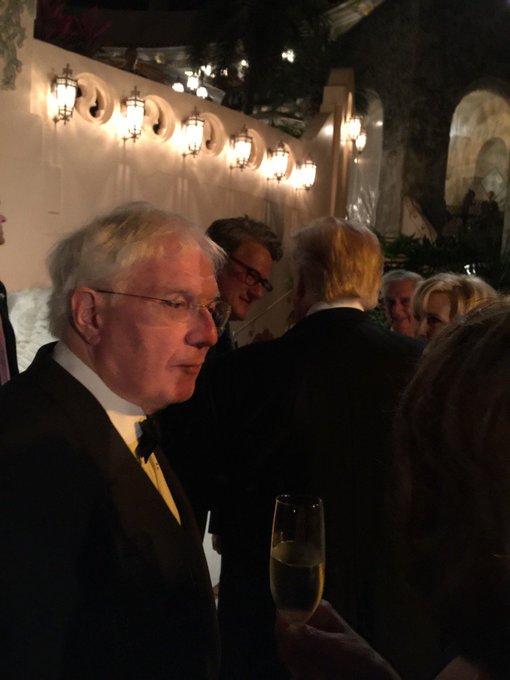
Scarborough also recently met with Trump at Mar-A-Lago during Trump’s New Year's’ Eve party.
Scarborough denied being there for a party, telling CNN’s Brian Stelter that he was meeting with Trump to lobby for an on-air interview and that he was surprised to see people in tuxedos when he arrived. On Monday, he spoke with CNN’s Dylan Byers about the uproar over the incident, repeatedly invoking other reporters’ relationships with various politicians to defend himself.
Scarborough’s defensive answers to Byers give away one major problem with his close relationship with Trump: The need to protect Trump’s reputation can cloud Scarborough’s judgment. Morning Joe’s absurddefense of Trump’s position on climate change is a perfect example. With no proof in his favor, Scarborough simply asserted that Trump believes in climate science, ignoring mountainsofevidence to the contrary.
Greta Van Susteren
Trump’s increasingly gushing coverage on MSNBC may soon not be limited to Morning Joe. MSNBC reportedly may hire former Fox News host Greta Van Susteren for its 6 p.m. hour (Update: Van Susteren's move is now official). Van Susteren has given Trump a welcoming platform for years. Before the Republican primary, Trump appeared more times on Van Susteren’s On The Recordthan on the rest of the Fox News prime-time shows combined. During the Republican primary, Van Susteren had Trump on for over five hours, dwarfing other candidates. During these appearances, Trump pushed birtherism, claimed Obama didn’t write his own memoir, and made bigoted remarks about refugees. And Andrew Kaczynski chronicledmore ofTrump’smoments from Van Susteren’s show.
To be fair, On The Record was not the worst on Fox News, and Van Susteren may well have been playing to the conservative audience. But the absolute worst Trump hagiographic moment during his campaign came during her “documentary” interview with his campaign. Here’s how the special looks when you take out the Trump family’s answers.
Onlookers harshly criticized the special, with MSNBC host -- and potential future colleague -- Chris Hayes declaring that it was reminiscent of state media under a dictator.
As of now, Van Susteren’s hiring is still a rumor and may not come to pass. But either way, a likely factor in MSNBC’s desire to add her to its lineup is her established track record of getting access to Trump, which she certainly didn’t accomplish because she subjected him to tough interviews.
MSNBC’s prime-time voices like Chris Hayes, Rachel Maddow, and Lawrence O’Donnell are resisting efforts to normalize Trump. But it’s unclear whether they can win that fight with the leading voices at MSNBC and NBC News pushing the other way, much less with the network itself in bed with Trump. And if Trump puts net neutrality rules on the table, NBC’s parent company, Comcast, would surely have an interest.
All of this bears close watching. But the long and short of it is that the network seems primed to become a Trump normalization machine.