Tuesday, June 06, 2017

BOMBSHELL: Leaked NSA Report Confirms Russian Hack Reached Into Voting Systems

By Karoli Kuns/Crooks and Liars
The Intercept just published a bombshell report based upon a leak of a classified report by the NSA, indicating that Russians had attempted to hack into voter databases using phishing schemes against vendors of software used for electronic polling books.
The Intercept based their reporting on a leaked NSA document created in May, 2017, which was more specific about the methods and targets used by the Russians than anything previously known. There was no doubt in the mind of the analysts that the Russian government was behind the hacks.
The NSA has now learned, however, that Russian government hackers, part of a team with a “cyber espionage mandate specifically directed at U.S. and foreign elections,” focused on parts of the system directly connected to the voter registration process, including a private sector manufacturer of devices that maintain and verify the voter rolls. Some of the company’s devices are advertised as having wireless internet and Bluetooth connectivity, which could have provided an ideal staging point for further malicious actions.
VR Systems, a vendor to several states -- some of which were swing states -- was a specific target.
So on August 24, 2016, the Russian hackers sent spoofed emails purporting to be from Google to employees of an unnamed U.S. election software company, according to the NSA report. Although the document does not directly identify the company in question, it contains references to a product made by VR Systems, a Florida-based vendor of electronic voting services and equipment whose products are used in eight states.
While there's no evidence that any machines were breached, there are still major concerns about the complicated efforts to access the voter database and possibly other systems.
Although the NSA report indicates that VR Systems was targeted only with login-stealing trickery, rather than computer-controlling malware, this isn’t necessarily a reassuring sign. Jake Williams, founder of computer security firm Rendition Infosec and formerly of the NSA’s Tailored Access Operations hacking team, said stolen logins can be even more dangerous than an infected computer. “I’ll take credentials most days over malware,” he said, since an employee’s login information can be used to penetrate “corporate VPNs, email, or cloud services,” allowing access to internal corporate data. The risk is particularly heightened given how common it is to use the same password for multiple services. Phishing, as the name implies, doesn’t require everyone to take the bait in order to be a success — though Williams stressed that hackers “never want just one” set of stolen credentials.

↓ Story continues below ↓
There's much more in the report, which you can read here.
Just after the report was published, the FBI announced they arrested the woman they believe leaked it to The Intercept.
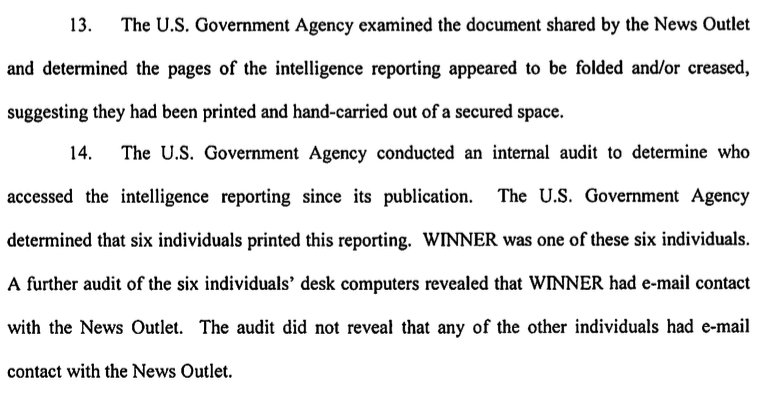
Apparently they found a trail which included email communication from Ms. Winner to The Intercept, which led to an arrest. Via the DOJ release:
Winner is a contractor with Pluribus International Corporation assigned to a U.S. government agency facility in Georgia. She has been employed at the facility since on or about February 13, and has held a Top Secret clearance during that time. On or about May 9, Winner printed and improperly removed classified intelligence reporting, which contained classified national defense information from an intelligence community agency, and unlawfully retained it. Approximately a few days later, Winner unlawfully transmitted by mail the intelligence reporting to an online news outlet.
Once investigative efforts identified Winner as a suspect, the FBI obtained and executed a search warrant at her residence. According to the complaint, Winner agreed to talk with agents during the execution of the warrant. During that conversation, Winner admitted intentionally identifying and printing the classified intelligence reporting at issue despite not having a "need to know," and with knowledge that the intelligence reporting was classified. Winner further admitted removing the classified intelligence reporting from her office space, retaining it, and mailing it from Augusta, Georgia, to the news outlet, which she knew was not authorized to receive or possess the documents.
The arrest confirms the validity of the NSA report. At the same time, it seems strange and bizarre that the leaker of the report is arrested within minutes of the publication of key parts of it in The Intercept, because she emailed them from her work computer.
Still, take this NSA report and combine it with the possibility of collusion between the Trump campaign and Russia. Winner's arrest confirms the report is authentic and true. If the campaign is shown to have been colluding with Russia, there are a lot more folks in need of arrest, trials, and long prison sentences, including the guy who occupies the White House.

It’s time to bust the myth: Most Trump voters were not working class.

By Nicholas Carnes and Noam Lupu/Washington Post
Media coverage of the 2016 election often emphasized Donald Trump’s appeal to the working class. The Atlantic said that “the billionaire developer is building a blue-collar foundation.” The Associated Press wondered what “Trump’s success in attracting white, working-class voters” would mean for his general election strategy. On Nov. 9, the New York Times front-page article about Trump’s victory characterized it as “a decisive demonstration of power by a largely overlooked coalition of mostly blue-collar white and working-class voters.”
There’s just one problem: this account is wrong. Trump voters were not mostly working-class people.
During the primaries, Trump supporters were mostly affluent people.
The misrepresentation of Trump’s working-class support began in the primaries. In a widely read March 2016 piece, the writer Thomas Frank, for instance, argued at length that “working-class white people … make up the bulk of Trump’s fan base.” Many journalists found colorful examples of working-class Trump supporters at early campaign rallies. But were those anecdotes an accurate representation of the emerging Trump coalition?
There were good reasons to be skeptical. For one, most 2016 polls didn’t include information about how the people surveyed earned a living, that is, their occupations — the preferred measure of social class among scholars. When journalists wrote that Trump was appealing to working-class voters, they didn’t really know whether Trump voters were construction workers or CEOs.
Moreover, according to what is arguably the next-best measure of class, household income, Trump supporters didn’t look overwhelmingly “working class” during the primaries. To the contrary, many polls showed that Trump supporters were mostly affluent Republicans. For example, a March 2016 NBC survey that we analyzed showed that only a third of Trump supporters had household incomes at or below the national median of about $50,000. Another third made $50,000 to $100,000, and another third made $100,000 or more and that was true even when we limited the analysis to only non-Hispanic whites. If being working class means being in the bottom half of the income distribution, the vast majority of Trump supporters during the primaries were not working class.

But what about education? Many pundits noticed early on that Trump’s supporters were mostly people without college degrees. There were two problems with this line of reasoning, however. First, not having a college degree isn’t a guarantee that someone belongs in the working class (think Bill Gates and Mark Zuckerberg). And, second, although more than 70 percent of Trump supporters didn’t have college degrees, when we looked at the NBC polling data, we noticed something the pundits left out: during the primaries, about 70 percent of all Republicans didn’t have college degrees, close to the national average (71 percent according to the 2013 Census). Far from being a magnet for the less educated, Trump seemed to have about as many people without college degrees in his camp as we would expect any successful Republican candidate to have.
Trump voters weren’t majority working class in the general election, either.
What about the general election? A few weeks ago, the American National Election Study — the longest-running election survey in the United States — released its 2016 survey data. And it showed that in November 2016, the Trump coalition looked a lot like it did during the primaries.
Among people who said they voted for Trump in the general election, 35 percent had household incomes under $50,000 per year (the figure was also 35 percent among non-Hispanic whites), almost exactly the percentage in NBC’s March 2016 survey. Trump’s voters weren’t overwhelmingly poor. In the general election, like the primary, about two thirds of Trump supporters came from the better-off half of the economy.
But, again, what about education? Many analysts have argued that the partisan divide between more and less educated people is bigger than ever. During the general election, 69 percent of Trump voters in the election study didn’t have college degrees. Isn’t that evidence that the working class made up most of Trump’s base?
The truth is more complicated: many of the voters without college educations who supported Trump were relatively affluent. The graph below breaks down white non-Hispanic voters by income and education. Among people making under the median household income of $50,000, there was a 15 to 20 percentage-point difference in Trump support between those with a college degree and those without. But the same gap was present — and actually larger — among Americans making more than $50,000 and $100,000 annually.
To look at it another way, among white people without college degrees who voted for Trump, nearly 60 percent were in the top half of the income distribution. In fact, one in five white Trump voters without a college degree had a household income over $100,000.
Observers have often used the education gap to conjure images of poor people flocking to Trump, but the truth is, many of the people without college degrees who voted for Trump were from middle- and high-income households. That’s the basic problem with using education to measure the working class.
In short, the narrative that attributes Trump’s victory to a “coalition of mostly blue-collar white and working-class voters” just doesn’t square with the 2016 election data. According to the election study, white non-Hispanic voters without college degrees making below the median household income made up only 25 percent of Trump voters. That’s a far cry from the working-class-fueled victory many journalists have imagined.
Forget the narrative
A recent National Review article about Trump’s alleged support among the working class bordered on a call to arms against the less fortunate, saying that, “The white American underclass is in thrall to a vicious, selfish culture whose main products are misery and used heroin needles. Donald Trump’s speeches make them feel good. So does OxyContin” and that “the truth about these dysfunctional downscale communities is that they deserve to die.”
This kind of stereotyping and scapegoating is a dismaying consequence of the narrative that working-class Americans swept Trump into the White House. It’s time to let go of that narrative.
What deserves to die isn’t America’s working-class communities. It’s the myth that they’re the reason Trump was elected.

Trump Grows Discontented With Attorney General Jeff Sessions


WASHINGTON — Few Republicans were quicker to embrace President Trump’s campaign last year than Jeff Sessions, and his reward was one of the most prestigious jobs in America. But more than four months into his presidency, Mr. Trump has grown sour on Mr. Sessions, now his attorney general, blaming him for various troubles that have plagued the White House.
“They wholly undercut the idea that there is some rational process behind the president’s decisions,” said Walter E. Dellinger, who served as acting solicitor general under Mr. Clinton. “I believe it is unprecedented for a president to publicly chastise his own Justice Department.”
In his Twitter posts, Mr. Trump complained that his original executive order barring visitors from select Muslim-majority nations and refugees from around the world was revised in hopes of passing legal muster after it was struck down by multiple federal courts. The second version, however, has also been blocked, and last week the Justice Department appealed to the Supreme Court.
“The Justice Dept. should have stayed with the original Travel Ban, not the watered down, politically correct version they submitted to S.C.,” Mr. Trump wrote.
Then he added, “The Justice Dept. should ask for an expedited hearing of the watered down Travel Ban before the Supreme Court — & seek much tougher version!”
But the messages caused considerable head scratching around Washington since it was Mr. Trump who signed the revised executive order and, presumably, agreed to the legal strategy in the first place. His posts made it sound like the Justice Department was not part of his administration.
The White House had little to add to the president’s messages on Monday. Asked why Mr. Trump signed the revised order if he did not support it, Sarah Huckabee Sanders, a White House spokeswoman, said he did it only to convince a California-based appeals court. “He was looking to, again, match the demands laid out by the Ninth Circuit and, for the purpose of expediency, to start looking at the best way possible to move that process forward,” she said.

Alan M. Dershowitz, a professor emeritus at Harvard Law School who has frequently defended Mr. Trump on cable news, said the president was clearly voicing frustration with Mr. Sessions. But he said it was not clear to him that it was a personal issue as opposed to an institutional one with the office.
“What he’s saying is, ‘I’m the president, I’m the tough guy, I wanted a very tough travel ban and the damn lawyers are weakening it’ — and clients complain about lawyers all the time,” Mr. Dershowitz said. “I see this more as a client complaining about his lawyer. The lawyer in this case happens to be Jeff Sessions.”
David B. Rivkin Jr., a lawyer who served in the White House and Justice Department under Presidents Ronald Reagan and George Bush, said Mr. Trump clearly looked at the case from the lens of a businessman who did not get his money’s worth.
“He’s unhappy when the results don’t come in,” Mr. Rivkin said. “I’m sure he was convinced to try the second version, and the second iteration did not do better than the first iteration, so the lawyers in his book did not do a good job. It’s understandable for a businessman.”
Mr. Sessions and the Justice Department remained silent on Monday. But at least one lawyer close to the administration suggested that there was consternation in the department over the president’s messages. George T. Conway III, who until last week was Mr. Trump’s choice for assistant attorney general for the civil division and whose wife, Kellyanne Conway, is the president’s counselor, posted a Twitter message suggesting that Mr. Trump’s tweets “certainly won’t help” persuade five justices on the Supreme Court — the majority needed — to uphold the travel ban.
In subsequent posts, Mr. Conway said that “every sensible lawyer” in the White House Counsel’s Office and “every political appointee” at the Justice Department would “agree with me (as some have already told me).” Mr. Conway stressed that he strongly supports Mr. Trump — “and, of course, my wonderful wife” — and was making his points because the president’s supporters “should not be shy about it.”
The frustration over the travel ban might be a momentary episode were it not for the deeper resentment Mr. Trump feels toward Mr. Sessions, according to people close to the president. When Mr. Sessions recused himself from the Russia investigation, Mr. Trump learned about it only when he was in the middle of another event, and he publicly questioned the decision.
A senior administration official said Mr. Trump has not stopped burning about the decision, in occasional spurts, toward Mr. Sessions. Deputy Attorney General Rod J. Rosenstein, who was selected by Mr. Sessions and filled in when it came to the Russia investigation, ultimately appointed Robert S. Mueller III, a former F.B.I. director, as special counsel to lead the probe.
In fact, much of the past two months of discomfort and self-inflicted pain for Mr. Trump can be tied in some way back to that recusal. Mr. Trump felt blindsided by Mr. Sessions’s decision and unleashed his fury at aides in the Oval Office the next day, according to four people familiar with the event. The next day was his fateful tweet about President Barack Obama conducting a wiretap of Trump Tower during the campaign, an allegation that was widely debunked.
However, Mr. Trump is said to be aware that firing people now, on the heels of dismissing James B. Comey, the F.B.I. director, would be risky. He has invested care and meticulous attention to the next choice of an F.B.I. director in part because he will not have the option of firing another one. The same goes for Mr. Sessions, these people said.

Mr. Dershowitz said he thought any frustration over Mr. Sessions’s recusal, like the travel ban, was probably not personal. “I think that’s also institutional,” he said. “Almost any A.G. would recuse himself. I think he’s railing against lawyers.”

Kellyanne Conway’s husband tears into Trump

Ian Millhiser/Think Progress

Monday morning, President Donald Trump sent out a series of four tweets attacking the courts, his own Justice Department, and what he described as “the watered down, politically correct version” of his Muslim ban.


It is, to say the least, highly unusual for a president to comment in such a belligerent way about a matter that is currently before federal courts — the Trump administration asked the Supreme Court to reinstate the most recent version of his Muslim ban last week. It is even more unusual for a president to blame the Justice Department for a policy shift that was made, not by DOJ, but by the president himself.
In any event, Trump’s tweetrage did not go over well with one high-powered New York attorney: George Conway, husband of Trump adviser Kellyanne Conway.
An accomplished attorney who recently took himself out of the running to lead the Justice Department’s Civil Division, Mr. Conway is in a position to know something about how not to win five votes on the Supreme Court.

Conway is a partner at Wachtell, Lipton, Rosen & Katz — a firm where profits per partner are about $6 million per year, and a Yale law graduate. He has argued in front of the Supreme Court, and frequently appears in appeals courts.

Trump blatantly lies while smearing London’s mayor for second straight day

Aaron Rupar/Think Progress

On Monday morning, President Trump told a blatant lie while smearing London Mayor Sadiq Khan for the second straight day.


Trump’s tweet takes out of context a comment Khan made following an attack in London on Saturday that left seven dead and dozens wounded. During a TV interview Sunday morning, Khan said, “My message to Londoners and visitors to our great city is to be calm and vigilant today. You will see an increased police presence today, including armed officers and uniformed officers. There is no reason to be alarmed by this.”

Khan’s “no reason to be alarmed” comment clearly referred to the extra police presence in London, not the weekend’s attacks themselves. But on Sunday, Trump distorted Khan’s words to suggest he’s is taking a laissez-faire approach to acts of violence.


Trump’s tweet was echoed by his White House social media director.

And Trump’s mischaracterization of Khan was amplified by his favorite morning TV showFox & Friends, which devoted a segment on Monday to criticizing the London mayor. (Trump live-tweeted another part of Monday’s show.)


The president’s decision to smear the mayor of London in the immediate aftermath of an attack on his city was widely condemned. Khan‘s spokesperson responded with a statement saying that the mayor “has more important things to do than respond to Donald Trump’s ill-informed tweet that deliberately takes out of context his remarks urging Londoners not to be alarmed when they saw more police — including armed officers — on the streets.”
Later Sunday, Lew Lukens, chargé d’affaires ad interim of the U.S. Embassy in London, contradicted Trump and tweeted that London’s response to the attack was “extraordinary” while praising Khan’s leadership.
 
But instead of walking his comments back or echoing what the top American diplomat in the U.K. had to say, Trump on Monday elected to double down on smears and lies.
This isn’t the first time the Trump family has taken Khan’s words out of context in an effort to smear him. Following an attack in London in March that killed, Donald Trump Jr. tweeted this:
But when the quote is read in context, it’s clear Khan was simply encouraging Londoners to be vigilant.
“Part and parcel of living in a great global city is you have to be prepared for these sorts of things, you have to be vigilant, you have to support the police doing an incredibly hard job, you have to support the security services,” Khan said.
Khan become London’s first Muslim mayor in May 2016. As ThinkProgress wrote at the time, he triumphed “after a nasty campaign in which his opponents tried to use his faith to tie him to ‘radical’ and ‘extremist’ figures.”
Shortly after becoming mayor, Khan criticized Trump’s proposed Muslim ban, saying Trump’s “ignorant view of Islam could make both our countries less safe — it risks alienating mainstream Muslims around the world and plays in to the hands of the extremists.”
“I want Donald Trump to come to London so I can introduce myself to him as a mainstream Muslim, very, very comfortable with Western liberal values, but also introduce him to hundreds of thousands, dare I say millions of Muslims in this country, who love being British, love being Western,” Khan added.
Trump responded by calling Khan “ignorant” and challenging him to an IQ test.
“I think they were very rude statements and, frankly, tell him I will remember those statements. They are very nasty statements,” Trump said. “When he won I wished him well. Now, I don’t care about him.”
In February, Khan publicly advocated for denying Trump a state visit, characterizing the new president’s immigration policies as “cruel” and his Muslim ban proposal as a particular outrage.
Trump used the latest attack in London to once again agitate for his Muslim ban, which is currently mired in federal courts. Instead of extending his condolences or offering help, Trump’s first public comment following Saturday’s violence in London said: “We need to be smart, vigilant and tough. We need the courts to give us back our rights. We need the Travel Ban as an extra level of safety!”

House Republican calls for mass killing of ‘radicalized Islamic’ suspects

Laurel Raymond/Think Progress
Louisiana Rep. Clay Higgins (R) responded to an attack in downtown London over the weekend by calling for a mass extrajudicial killing of people suspected of adhering to “radicalized” Islam.
“Not one penny of American treasure should be granted to any nation who harbors these heathen animals. Not a single radicalized Islamic suspect should be granted any measure of quarter,” he wrote. “Hunt them, identify them, and kill them. Kill them all. For the sake of all that is good and righteous. Kill them all.”
Notably, Higgins advocated for the killing of anyone even suspected of having links to terrorism, and gave no definition of how that should be determined. He described the fight as a “war” between Christendom and “Islamic horror,” echoing a rallying cry of the far-right.
Such black-and-white rhetoric also dovetails with one of ISIS’ stated goals:To divide the world into two camps, those who believe their ideology and everyone else. In so doing, they aim to eliminate the “grey zone” and convince other Muslims that their faith is unwelcome and incompatible with the West, radicalizing them.
The statement also hedges close to allowing ISIS and other militant groups to represent Islam as a whole, even though the group is deeply unpopular in huge swaths of the Muslim world, and scores of prominent Muslim leaders have condemned them.
Higgins shared his message alongside an image of the terror attack in downtown London on Saturday, which left seven civilians dead and 48 hospitalized. ISIS has claimed responsibility for the attack.
The full text of his Facebook post is below:
Captain Clay Higgins
on Sunday
The free world... all of Christendom... is at war with Islamic horror. Not one penny of American treasure should be granted to any nation who harbors these heathen animals. Not a single radicalized Islamic suspect should be granted any measure of quarter. Their intended entry to the American homeland should be summarily denied. Every conceivable measure should be engaged to hunt them down. Hunt them, identify them, and kill them. Kill them all. For the sake of all that is good and righteous. Kill them all.
-Captain Clay Higgins
A spokesman from Higgins’ office confirmed to Mother Jones that the Facebook post is authentic. In an email to Jezebel, a spokesperson said, “Rep. Higgins is referring to terrorists. He’s advocating for hunting down and killing all of the terrorists. This is an idea all of America & Britain should be united behind.”
Higgins is a first term Congressman, and has been a strong supporter of President Trump and his attempts to ban travelers from several Muslim-majority countries from the United States. Higgins resigned from his previous post as the public information officer in the St. Landry Parish Sheriff’s office after being instructed by his boss, the sheriff, to tone downhis “disrespectful and demeaning” comments.

Saturday, June 03, 2017

Conservatives forget their wishing harm on Obama past.

The one thing the Kathy Griffin whole holding a fake Trump head stunt highlights is that conservatives really believe the rest of the country is just as dumb and forgetful as the people they lied to every day.  So when this whole thing with Kathy Griffin went down Tomi Lahern, Donnie little hands junior and insert every brain-dead right-winger on Twitter made the comment "well, what would liberals say if conservatives said did that with Obama?"

When I saw these tweets the first thing that popped in my head are these people serious? Because all you have to do is Google image Obama+Noose or Obama lynched or Obama and death and you'll see pictures of conservatives making up signs with Obama hanging or making Obama dolls then hanging them, and you'll see pictures of them burning effigies of Obama. Shit at the start of the Obama presidency conservatives was passing around a pray that hoped he would die. Their spin at the time was they claimed they only wanted the first half was never mind the prayer went on to say "Let his children be fatherless; and his wife a widow. Let his children wander about and beg; and let them seek sustenance far from their ruined homes. Let the creditor seize all that he has; and let strangers plunder the product of his labor. Let there be none to extend lovingkindness to him; nor any to be gracious to his fatherless children. Let his posterity be cut off; in a following generation let their name be blotted out.”

I guess no one was worry about how Sasha and Malia felt when conservatives prayed for their father's death. On my local sewer water of a Fox News station debated what happen to political civility? My question what do we only have these discussions when a liberal cross a line regarding what is said about a Republican president? Ted Nugent threaten the lives of both President Obama and Secretary Clinton yet he shows up at the White House doing photo ops with President Orange fuckface.

Yes, what Griffin did was beyond stupid and she shouldn't have done it but let's keep it fucking real when it comes to conservatives and Democratic presidents all they want is that Democratic President to do is die.

Watch an economist call out CNN for hosting a Koch-backed Trump surrogate to lie about the Paris accord

From Media Matters


JEFFREY SACHS: It's just unbelievable. Every word has been a lie for the last two days. So much ignorance. And you have Stephen Moore and he is from the Heritage Foundation, paid for by the Koch brothers have engineered the whole story here. So it's just endless. Big money of the Koch brothers is behind this. And Mr. Moore and his Heritage Foundation is a Koch brothers-financed operation and this is corruption. And it's so clear and it's disgusting after a while because they are all lying.
ANA CABRERA (HOST): Jeffrey, this study was the National Economic Research Associates study that Stephen was just citing that we've heard from the Trump administration. Why do you not believe that's a credible source?
SACHS: There are about 20,000 coal miners in this country out of 150 million people. This is so bogus, it's unbelievable. Everything that Trump has said is bogus. And the idea that he has given to the American people that somehow this is an agreement that is against America, that's biased against America. This is a completely symmetrical agreement in which all 193 countries have agreed to the same thing. They have agreed to submit national plans of action under a common framework. And so it's all a lie. And the important thing for your viewers to understand is this is the future of their children and their grandchildren. And this man is wrecking the planet and it's because of the oil, gas, and coal interests that have funded the Heritage Foundation, that have funded Stephen Moore, and that have funded the 22 senators that wrote to the president last week saying to do this. This is a game and it's a game against my children and my grandchildren. And it's disgusting.
CABRERA: Stephen, I'll give you a chance to respond.
STEPHEN MOORE: Well, Jeff just needs to get his facts straight. We get less than three percent of our budget from the Kochs. So, Jeff I don't know where you're getting your facts from, but what you just said is a lie.
SACHS: I know where I'm getting my facts from. You're on the take.
[...]
SACHS: I'm shocked that you are a [contributor] for this network.

Paul Krugman: Trump is prepared to destroy the planet out of sheer spite


Donald Trump’s decision to pull out of the Paris Agreement has drawn near-universal opprobrium from leaders across the globe. In perhaps the most forceful rebuke of the United States thus far, French president Emmanuel Macron addressed the world in English Thursday, urging American scientists to come to France where their talents can better serve humanity. For the New York Times’ Paul Krugman, Trump’s withdrawal from a climate pact signed by 195 countries is even more blinkered, malicious and cynical than it might first appear.
In his Friday column, Krugman debunks the president’s claim that the Agreement is a hindrance to the U.S. economy. The country’s energy future is not in the coal industry, which has been in steep decline for decades and is now beyond revival, but in nonpolluting sources like wind turbines and solar panels. The transition would take time and likely require the construction of a massive power grid to transport electricity across the country, as well as dynamic pricing to incentivize customers to consume less energy, he argues, but its effect on our day-to-day existence would be virtually nil.
“What would life in an economy that made such an energy transition be like?” Krugman asks. “Almost indistinguishable from life in the economy we have now.”
In fact, there’s every reason to believe that adopting clean energy would save the country money by dramatically reducing the health costs associated with air pollution, to say nothing of potentially preserving human life on Earth. Environmentalists unanimously urged the president to honor the Paris Agreement, however toothless its regulations have proven; even major corporations like ExxonMobil, Shell and Wal-Mart wanted him to stick with it.
So what compelled Trump to act so recklessly?
The answer, incredibly, appears to be “sheer spite”—aimed at Barack Obama, who helped broker the accord, and the entire liberal establishment that supports it.
“If all this sounds too petty and vindictive to be the basis for momentous policy decisions, consider the character of the man in the White House,” Krugman concludes. “Need I say more?”


Read Paul Krugman’s column at the New York TImes.