Showing posts with label Paul Ryan budget plan. Show all posts
Showing posts with label Paul Ryan budget plan. Show all posts
Thursday, April 03, 2014


Wednesday, April 02, 2014
Paul Ryan’s Budget Makes Wild New Claims About Obamacare
BY IGOR VOLSKY/Think Progress

As Obama administration moves closer to meeting it original goal of enrolling 7 million people in the Affordable Care Act’s new insurance marketplaces, Rep. Paul Ryan (R-WI) has released a budget that repeals the law and asks Congress to “pursue patient-centered health-care reforms that actually bring down the cost of care by empowering consumers.”
And while this new Fiscal Year 2015 budget borrows heavily from previous versions, the April 1st release is far more critical of Obamacare. In a possible preview of the GOP’s election-year rhetoric, this year, Ryan warns — in almost apocalyptic terms — that the law “will undermine the private insurance” and “the competitive forces of the marketplace.” He even argues that it would “eventually lead to a single-payer system.” Here is a comparison between last year’s blueprint and Tuesday’s release:
Fiscal Year 2014: Repeal the health-care law’s exchange subsidies
The new law couples these subsidies with a mandate for individuals to purchase health insurance and bureaucratic controls on the types of insurance that may legally be offered. Taken together, these provisions will weaken the private-insurance market. Exchange subsidies take the health-care market in the wrong direction, breaking what’s working at a time when policymakers need to fix what’s broken. Government mandates will drive out all but the largest insurance companies. Punitive tax penalties will force individuals to purchase coverage whether they want it or not. Further, the law does not condone any policy that would require entities or individuals to finance activities or make health decisions that violate their religious beliefs.This budget repeals the President’s onerous health-care law. Instead of putting health-care decisions into the hands of bureaucrats, Congress should pursue patient-centered health-care reforms that actually bring down the cost of care by empowering consumers.Fiscal Year 2015: Repeal the Exchange Subsidies Created by the New Health-Care Law.
The new law couples these subsidies with a mandate for individuals to purchase health insurance and bureaucratic controls on the types of insurance that may legally be offered. Taken together, these provisions will undermine the private insurance market, which serves as the backbone of the current U.S. health-care system. Exchange subsidies will undermine the competitive forces of the marketplace. Government mandates will drive out all but the largest insurance companies. Punitive tax penalties will force individuals to purchase coverage whether they choose to or not. Further, this budget does not condone any policy that would require entities or individuals to finance activities or make health decisions that violate their religious beliefs. This budget provides for the repeal of the President’s onerous health-care law for this and many other reasons.Left in place, the health law will create pressures that will eventually lead to a single-payer system in which the federal government determines how much health care Americans need and what kind of care they can receive. This budget recommends repealing the architecture of this new law, which puts health- care decisions into the hands of bureaucrats, and instead allowing Congress to pursue patient centered health-care reforms that actually bring down the cost of care by empowering consumers.
Interestingly, while Ryan goes to great lengths to criticize the ACA’s “government mandates” and and the supposed decision to leave “health- care decisions into the hands of bureaucrats,” he praises this very same kind of government-control elsewhere in the budget.
For instance, in discussing his plan to allow future retirees the choice of private insurance through his “premium support” proposal, Ryan promises that “the Medicare program and its benefits will remain as they are, without change.” For future retirees, Ryan proposes an Obamacare-like exchange that will feature private insurers providing Medicare-like plans. However, Ryan tasks the government with policing the plans private insurers offer “to avoid cherry-picking, and to ensure that Medicare’s sickest and highest-cost beneficiaries receive coverage.” Just four pages earlier, Ryan criticizes such government intervention in the exchanges.
Republicans have already voted to repeal the Affordable Care Act in full or in part at least 51 times and on Monday, House Speaker John Boehner (R-OH) doubled down on his commitment to hold more repeal votes. “House Republicans will continue to work to repeal this law and protect families and small businesses from its harmful consequences,” he said. “We will also continue our work to replace this fundamentally-flawed law with patient-centered solutions focused on lowering health care costs and protecting jobs.” House leadership has also pledged to introduce a unified alternative to the health care law, although they have not provided a timeline for drafting or debating that measure.
Tuesday, July 09, 2013
GOP May Hold Debt Ceiling Hostage To Enact Paul Ryan’s Budget
By Igor Volsky/Think Progress
House Republicans will hold the national debt ceiling increase hostage until President Obama agrees to mandatory spending cuts to Social Security, Medicare, and Medicaid, the National Journalreports, and will seek to use the leverage of default to force Democrats to enact the policies in Rep. Paul Ryan’s (R-WI) budget.
Since slashing discretionary spending to historic lows — the discretionary side of the ledger has grown at a slower rate than inflation since 2007 and now makes up a smaller share of the economy than it did before the Great Recession — the GOP has shifted from demanding dollar-for-dollar immediate spending cuts and is now focusing on drafting a range of options to significantly restructure mandatory benefit programs.
The idea is to throw in the “kitchen sink” and allow Obama to pick and choose the cuts. “If what makes it easier to find the deal is to go in and pick and choose among a dozen different programs and just grab a little bit from all 12 — instead of a lot from one them — then that works just fine,” Rep. Rob Woodall (R-GA), who heads the Republican Study Committee’s budget and spending task force, told the Journal:
For a long-term deal, one that gives Treasury borrowing authority for three-and-a-half years, Obama would have to agree to premium support. The plan to privatize Medicare, perhaps the most controversial aspect of the Ryan budget, is the holy grail for conservatives who say major deficit-reduction can only be achieved by making this type of cut to mandatory spending. “If the president wants to go big, there’s a big idea,” said Rep. Steve Scalise, chairman of the Republican Study Committee.For a medium-sized increase in the debt-limit, Republicans want Obama to agree to cut spending in the SNAP food stamp program, block-grant Medicaid, or tinker with chained CPI.For a smaller increase, there is talk of means-testing Social Security, for example, or ending certain agricultural subsidies.While the menu includes plenty of variables, the underlying strategic goal is to reduce mandatory spending — whatever the scope of the deal. Even at the smallest end of the spectrum — another months-long extension of debt-limit — there is talk of pushing back the eligibility age for Social Security by an equal number of months.
For 50 years, Congress routinely increased the debt ceiling as needed, including seven timesunder President George W. Bush. But in 2011, Republicans decided the debt ceiling was “a hostage worth ransoming. The brinksmanship caused the first-ever downgrade of the U.S. credit rating by Standard & Poor’s and cost the country a million jobs and $19 billion.
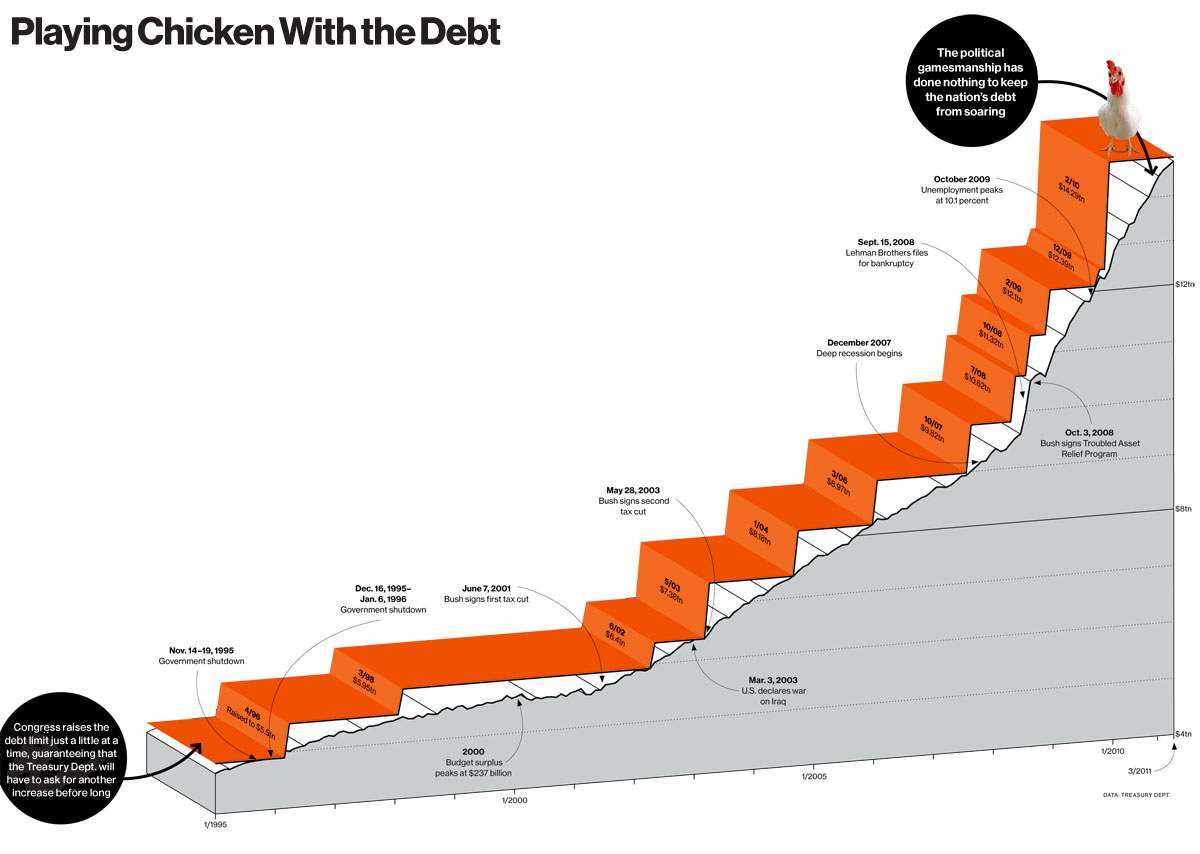
The Treasury Department has not yet said when the nation will hit its debt ceiling and has repeatedly moved back the deadline as a result of “lower spending levels and higher tax revenues.”
Saturday, March 16, 2013
Rachel Maddow and Bill Maher: proposed Ryan budget is ‘laughable’
By Emily Mullen/Raw Story
MSNBC’s Rachel Maddow joined Bill Maher on Real Time Friday night to discuss the two conflicting budgets released by Republicans and Democrats earlier this week.
Maddow and Maher both took issue with Rep. Paul Ryan’s (R-WI) “laughable” budget proposal, saying he’s offering the same measures he and Mitt Romney introduced last year during their failed 2012 presidential run.
“The Ryan budget says that the big problems in America are that rich people do not have enough money…and poor people have too much access to affordable health care,” MSNBC’s Rachel Maddow said. “We need to invest in things that are going to make us more competitive in the long run.”
Watch the full segment below, uploaded to Mediaite.com on March 15:
Friday, August 24, 2012
MDP Statement: Pete Hoekstra Doesn’t Think Romney-Ryan Plan Goes Far Enough
From The Michigan Democratic Party
LANSING – Michigan Democratic Party Chair Mark Brewer today issued the following statement on Tea Party Senate candidate Pete Hoekstra’s belief that the anti-middle class Romney-Ryan Plan for America actually doesn’t go far enough:
“If you asked Pete Hoekstra how he feels about Romney and Ryan’s plan to raise taxes on the middle class and end Medicare as we know it, he’d tell you it doesn’t go far enough,” said Mark Brewer, Chair of the Michigan Democratic Party. “If elected to the Senate, Hoekstra will stop at nothing to make birth control illegal, give millionaires and billionaires massive tax breaks, reward corporations that ship Michigan jobs to China and end Medicare as we know it. The Romney-Ryan-Hoekstra plan is great for the special interests backing his campaign, but a very bad thing for everyday folks all across our state.”
Immediately after leaving Congress in 2010, Peter Hoekstra went to work at a high-powered Washington lobbying firm where he could keep fighting for special interests and against middle-class families. Not only does he support Herman Cain’s infamous 9-9-9 tax plan that would raise taxes on middle-class families by $4,400 a year, but he wants to entrust Social Security to Wall Street bankers and turn Medicare into a risky voucher program.
See below for background on Hoekstra’s outrageously anti-middle class agenda — it’s even worse than Romney and Ryan’s.
Hoekstra Supported Romney-Ryan Plan To Essentially End Medicare. In 2012, Hoekstra said he would have “obviously” voted for Rep. Ryan’s budget proposal had he been in Congress. [ITPP Candidate Forum, 5/08/12]
Wall Street Journal: [Ryan’s Budget] Would Essentially End Medicare. According to the Wall Street Journal, Ryan’s budget proposal “would essentially end Medicare, which now pays most of the health-care bills for 48 million elderly and disabled Americans, as a program that directly pays those bills.” [Wall Street Journal, 4/04/11]
The Ryan Budget Proposal Would Turn Medicare into a Voucher System and Force Seniors To Pay $6,400 More For Medicare Coverage. According to the Congressional Budget Office, under the Ryan budget proposal, seniors would have to pay $6,400 more per year for Medicare coverage. [New York Times, 8/11/12]
Hoekstra Supported Privatizing Social Security. According to the Grand Rapids Press, Hoekstra said “he supports private accounts” for Social Security. [Grand Rapids Press, 4/05/05]
Hoekstra Said Social Security Reform Must Include Privatization. In 2005, Hoekstra said, “I have a bias in favor of some portions of Social Security going into private accounts.” According to the Grand Rapids Press, Hoekstra said, “Any solution would have to include private accounts.” [Grand Rapids Press, 3/03/05]
Hoekstra Advocated For Social Security Privatization. In 2001, Hoekstra signed a letter from members of Congress to the President’s Commission to Strengthen Social Security that advocated for the privatization of Social Security.
From the letter: “Social Security reform must offer younger workers the opportunity to improve their rates of return using personal retirement accounts. Personal retirement accounts will transform Social Security from a government IOU into personal property and real assets that workers can own and pass along to their children.” [Letter To President’s Commission to Strengthen Social Security, 5/24/01]
Hoekstra Co-Sponsored Personhood Legislation Seven Times. From 1996-2000, Hoekstra co-sponsored seven bills that declared life begins at fertilization. [HR 881, co-sponsored on 2/04/09; HR 618, co- sponsored on 1/22/07; HR 552, co- sponsored on 2/02/05; HR 3069, co-sponsored on 5/05/04; HR 639, co-sponsored on 2/09/99; HR 641, co-sponsored on 2/06/97; HR 1625, co-sponsored on 1/03/96]
Personhood Legislation Would Make Abortions Illegal In Cases Of Rape Or Incest. According to the New York Times, personhood legislation would ban nearly all abortions, including those resulting from rape or incest. [New York Times, 10/25/11]
Personhood Legislation Would Make Contraception Illegal. According to the Washington Post, “personhood” legislation would not only outlaw abortion, but also hormonal birth control, IUDs and emergency contraception. [Washington Post, 10/28/11]
Hoekstra Supported Herman Cain’s 9-9-9 Tax Plan. In February, Hoekstra campaigned with Herman Cain in Michigan and said he supported Herman Cain’s “9-9-9 Tax Plan.” According to The Hill, “Hoekstra [was] one of the only candidates to have signed on as supportive of the plan.” [The Hill, 2/16/12]
9-9-9 Proposal Would Raise Taxes On Middle-Class Families By $4,400. Cain’s 9-9-9 tax proposal would raise taxes on middle-class households by an average of $4,400. [Associated Press, 10/18/11]
Millionaires Would Receive an Average Tax Cut of Nearly $500,000. According to PolitiFact, under Cain’s 9-9-9 proposal, millionaires would see an average tax cut of $487,300. [PolitiFact, 10/18/11]
Hoekstra Voted Repeatedly to Protect Tax Breaks for Companies Who Ship Jobs Overseas. Hoekstra voted three times to protect tax breaks for companies who ship jobs overseas. [HR 4213, Vote #324, 5/28/10; HR 1586, Vote #518, 8/10/10; HR 4520, Vote #258, 6/17/04]
Michigan Has Lost 79,868 Jobs Due To Trade Deficit With China. According to the Economic Policy Institute, between 2001 and 2010 Michigan lost 79,868 jobs due to the trade deficit with China. [Economic Policy Institute, 9/20/11]
Hoekstra: The Problem Isn’t Anything That The Chinese Are Doing At All. In a CNN interview, Hoekstra said, “The problem is American public policy, American domestic policy; the problem here is not anything that the Chinese are doing at all.” [CNN, 2/06/12]
Tuesday, August 21, 2012
Friday, August 17, 2012
Paul Ryan's budget plan would destroy the middle class

Michael Hiltzik/LA Times
It certainly hasn't taken long for the blue-eyed, smiling visage to be scrubbed off Paul Ryan's putative policy masterwork, a federal budget proposal that supposedly would cut the government deficit to a shadow of its former self, as if by magic.
Within hours of the Wisconsin congressman's anointing as Mitt Romney's vice-presidential running mate, the budget plan's salient features were being widely publicized: It would deliver a handsome tax cut to the richest Americans while eviscerating the programs and services the rest of the country depends on. These include healthcare services, banking and clean water regulations, road repair and education assistance.

Yet all the discussion has overlooked the real damage the Ryan budget would do to an important segment of the American public. We're not talking about the very poor and the near poor. Their lives would be made immeasurably worse, to be sure, by a budget that would shrink Medicaid and force cutbacks in food stamp, educational and law enforcement services, among so many other things. Ryan at least pays lip service to maintaining the national safety net, ineffective as his proposals to do so may be.
But the middle class would be destroyed. The Ryan budget's impact on middle-income Americans comes in many forms, some of them exceedingly disingenuous. Let's look at a few.
Start with the revenue side. Here, as in other respects, the Ryan plan is silent on specifics, beyond asserting that "the key to pro-growth tax reform is lowering tax rates while broadening the tax base."
Ryan advocates cutting the top income tax rate to 25% (from 39.6%, the pre-Bush top marginal rate scheduled to take effect Jan. 1).
The only way to do so while keeping overall tax revenues at 19% of gross domestic product, Ryan's stated goal, is to eliminate a wide range of tax breaks. On the surface, this might look palatable to a middle-class taxpayer convinced that the fat cats get all the breaks anyway. In fact, the most popular breaks save billions for the middle class.
More than 70% of the mortgage interest payments claimed as deductions ($240 billion) appear on returns filed by people in the income range of $60,000 to $200,000, according to the IRS. Many of these middle-class homeowners base their annual financial planning on tax breaks such as the mortgage deduction. Only about 1.4% of the total is claimed by taxpayers earning $1 million or more.
This is among the reasons that, as the nonpartisan Tax Policy Center recently calculated, sharply lowering marginal rates while cutting out the most popular tax breaks results in net tax cuts for the wealthy and increases for everyone else. (This is what Ryan means by "broadening the tax base" — it means he's coming for you.)
The more insidious assault on the middle class comes from program cuts. Most of the commentary on Ryan's budget has focused on his master plan for Medicare and Medicaid, both of which he would gut. But it's a mistake to think the burden would be shouldered exclusively, or even chiefly, by the poor.
Ryan would replace the existing Medicare system of guaranteed treatment (with a nominal individual premium) with one providing vouchers for service through private commercial insurance plans. By design, the vouchers wouldn't cover all costs, and because their value would rise in accordance with a standard inflation measure, not with medical inflation, the gap would widen over time.
The Kaiser Family Foundation calculated that in 2022, the out-of-pocket medical expenses of the typical 65-year-old would come to half his or her Social Security income — double the level under traditional Medicare. There are two reasons. First, private insurers would deliver benefits at a higher administrative cost, and second, the vouchers would low-ball the retirees' real costs.
As a device to reduce the growth in healthcare costs, which is the principal component in government spending going forward, this is pure sleight of hand. Costs will keep rising, and at a faster rate than before (Ryan would also repeal the healthcare reform act, including its cost-reducing provisions). Less of the increase would show up on the government's ledgers only because more would show up in family budgets. The average American would be poorer for it.
Ryan contends that shifting the delivery of care from the Medicare bureaucracy to private insurers will wipe out waste. Everyone who has contact with Medicare, his plan states, "has stories about waste in the system — unnecessary tests, redundant treatments, and the cost ... of mistaken billings and misplaced records." Now, I've never come directly in contact with Medicare, but I've experienced all those things — at the hands of the private insurers Ryan thinks have the magic answer to rising medical costs.
Who are these Medicare beneficiaries? For the most part, their economic status tracks that of America's elderly as a whole (as it should, as the program is open to almost all Americans over 65). Some 60% get sizable portions of their income from private pensions, more than a third get at least 10% from investment income. On average they get 39% of their income from Social Security.
What happens if medical costs start taking up half their Social Security? Much of the burden might shift to their children and grandchildren. Keeping in mind that Social Security and Medicare always have aimed to remove this burden from the next generation, that's a real leap backward.
A tsunami of pain for the middle class comes from the Ryan plan's treatment of Medicaid. (In California, this joint federal-state program for the infirm and destitute is known as Medi-Cal).
Ryan would push more of the expense of Medicaid onto the states. Repealing the Affordable Care Act would remove funding for a Medicaid expansion that would have covered 17 million people. It would also replace the current open-ended federal subsidy to states with block grants keyed to population growth and standard inflation. In other words, completely unconnected to the real drivers of healthcare costs, which are the aging of the population and medical inflation.
States will be able to relieve the resulting pressure on their budgets only by cutting Medicaid enrollments, providing enrollees with fewer services, raising taxes or covering the shortfall out of budgets straining to keep up with road repair, K-12 education and public safety.
The Ryan budget won't do much to help states with those other items; his insistence on reducing non-defense federal spending outside the health programs and Social Security by more than one-fifth starting in 2014 implies unprecedented cuts for state and local governments, which today get one-third of those dollars. That's money spent today on education, law enforcement, roads, clean air and water programs, and disaster response.
When payment for those services is demanded at the point of sale, as in a post-Ryan world, it's the middle class that will pay. They've reached into their pockets to pay for school arts and enrichment programs lopped out of state budgets and carried the burden of tuition hikes at state universities. Teachers of middle- class students — stalwart members of the middle class themselves — will lose their jobs by the thousands. Under Ryan's budget, they'll pay higher federal taxes for the privilege.
What accounts for the Washington establishment's tolerance for policymaking that delivers so little of what it claims? For no one impolite enough to examine the Ryan plan's assumptions and numbers, as opposed to taking Ryan's word for it, believes that it would cut the budget deficit, either according to its own terms or in the world of practical politics.
Perhaps it's that American politicians have become so notorious for dodging tough questions that in a hick town like Washington anyone who produces a plan, no matter how nebulous and flawed, will be hailed as an intellectual giant. ("At least it's something," goes the refrain.)
Now that Ryan's in a national race, his budget will get nationwide scrutiny. It's about time. People will learn that the strangest thing about Paul Ryan's vision of America is how distant it is from the reality they face on the ground.
Ryan calls for eliminating consumer-friendly financial reforms enacted after the 2008 crash, removing environmental oversight of oil and gas production, and eroding legal protection for unionized workers. With a straight face, he lists these initiatives under the heading, "Ending Cronyism and Corporate Welfare." The original version of his plan envisioned the national economic safety net as "a hammock that lulls able-bodied citizens into lives of complacency and despondency." (He removed this Ayn Randian phrase from the 2012 revision.)
What's frightening about the rise of Ryanesque policymaking isn't merely that in today's Washington, the man with the plan is supposed to have credibility even if the plan is incoherent and destructive. It's that Ryan has credibility because he's amiable and earnest.
In a recent article, Peter Orszag, the former Obama budget director and current executive at Citigroup, dismantled the Ryan plan but felt constrained to mention, twice, "I like Paul Ryan."
How very Washington of Orszag. Outside the beltway, no one is talking about Paul Ryan because he's likable. They're talking about him because he is now up for an important national office, and he got there by promoting a vision of policy that the average American should find repellent.
Wednesday, August 15, 2012
"We Haven't Run The Numbers:" A Startling Ryan Admission That's Getting Little Attention
SIMON MALOY/Media Matters for America
Last night, newly ensconced Republican vice presidential nominee Paul Ryan sat down for his first solo interview with Fox News' Brit Hume and let slip an admission about Mitt Romney's budget plan -- an admission that's receiving surprisingly little press attention. Asked by Hume when the Romney plan would balance the budget, Ryan said he didn't know because "we haven't run the numbers on that specific plan."
Thus far only a few media outlets have noted Ryan's comments. They include MSNBC's Morning Joe, which aired the clip three times, prompting Mika Brzezinski to quip that she hates it when people "don't run the numbers on the budget they propose." CNN aired a clip of them last night on Anderson Cooper 360, and this morning on Starting Point host Soledad O'Brien said of Ryan's remarks: "He doesn't want to get wonky because he hasn't run the numbers because the plan is very vague."
But there's been no print coverage, and no coverage on network news. Ryan's comments really should be getting more attention, for a number of reasons.
First, Mitt Romney has been going around telling everyone that, if elected, he intends to balance the federal budget by the end of his second term, or shortly thereafter. Ryan says that they don't know when Romney's plan will balance the budget. If Ryan is right, then what is Romney basing that claim on?
Second, the narrative that Ryan has cultivated among the press is that he's a budget wonk who understands fiscal issues and is allergic to deficits (this despite having voted for all the Bush-era policies that saddled us with high debt and ballooning deficits). Embracing the Romney budget and then saying that he doesn't know when it will balance because the campaign "hasn't run the numbers" runs counter to his reputation as a Serious Fiscal Hawk.
Third, as Ezra Klein of the Washington Post detailed yesterday, the Romney campaign's rhetoric about their budget goals butts up hard against fiscal realities. The campaign argues that their budget will cut spending to 20 percent of GDP by 2016. That's unlikely enough, but they've also announced that cuts to Medicare are off the table. As Klein put it, Romney's stated goal of balancing the budget in 8-10 years is "a fantasy, and it will never happen." Ryan's remarks yesterday would seem to confirm that.
Fourth, how can you claim to have a budget and also to have not "run the numbers?" Isn't that all a budget is? Numbers that have been run?
The bottom line is that, by Ryan's admission, the Romney campaign is promoting a budget plan despite not knowing what it actually accomplishes. If that's not grist for the media grinder, then what is?
Monday, August 13, 2012
ROMNEY OFFICIALLY EMBRACES RYAN’S PLAN FOR MEDICARE
By Annie-Rose Strasser/Think Progress
Mitt Romney’s presidential campaign sought to distance the former Massachusetts governor from Paul Ryan’s controversial Medicare privatization plan on Saturday, but by Monday, Romney fully embraced his running mate’s proposal. During a press availability in Miami, Romney turned down three opportunities to explain how his vision would differ from Ryan’s, telling reporters, “my plan for Medicare is very similar to his plan for Medicare.” Watch it:
Wednesday, June 20, 2012
Study: House Republican Budget Would Raise Taxes On The Middle Class, Cut Them For Millionaires

According to a study prepared by the congressional Joint Economic Committee and verified by independent experts, the House Republican budget authored by Budget Committee Chairman Paul Ryan (R-WI) would raise taxes on families making less than $200,000, even while it gives millionaires a tax cut:
So although households earning $100,000 to $200,000 a year would save about $7,000 from the lower tax rates in the GOP plan, those savings would be swamped by eliminating major deductions, according to the report by the Democratically controlled congressional Joint Economic Committee.The net result: Married couples in that income range would pay an additional $2,700 annually to the Internal Revenue Service, on top of the tax increases that are scheduled to hit every American household when the George W. Bush-era cuts expire at the end of the year.Households earning more than $1 million a year, meanwhile, could see a net tax cut of about $300,000 annually.
“Ryan seems to want to have his cake and eat it, too, and this report shows that you can’t,” added Sen. Charles E. Schumer (D-NY). “If you want to cut taxes on the rich and not raise the deficit, you’re going to have to basically clobber the middle class.”
According to the non-partisan Tax Policy Center, the Republican budget would also slam thosemaking less than $30,000 per year, because it doesn’t extend some of the tax cuts for low-income Americans that President Obama has signed into law:

Republicans, meanwhile, contend that these analyses are unfair because they have yet to lay out their entire plan, including exactly which tax deductions and loopholes they plan to do away with. But as the Tax Policy Center’s Roberton Williams said, “unless [Republicans] go after the tax preferences that benefit the wealthy, it’s really hard to undo the regressivity of the rate changes. You’ll be shifting the burden of the tax code toward the middle class.”
Friday, April 20, 2012
Wednesday, April 18, 2012
Republicans Advance Ryan Budget Using An ‘Unconstitutional Legislative Trick’
By Igor Volsky/Think Progress
In 2010, Republicans accused Democrats of “rushing their massive government takeover of health care through Congress” and considering an “unconstitutional legislative trick” called deem and pass for advancing the measure.
“We’ve seen all week, Speaker Pelosi, Majority Leader [Harry] Reid continuing to scheme and plot trying to find some way to get their big government takeover of health care enacted,” then-Republican Minority Leader John Boehner (R-OH) said in January of 2010, setting the tone for the Republican outrage. Shortly thereafter, Rep. Eric Cantor (R-VA) introduced a resolutionstating “that the House disapproves of the malfeasant manner in which the Democratic Leadership has thereby discharged the duties of their offices” and Rep. Paul Ryan (R-WI) took to the floor and accused Democrats of “greasing the skids for an abuse of the budget procedure.” “The arrogance, the paternalism, the condescension to the American people is just breathtaking,” Ryan declared. “This is not just a simple fixer bill either. This is the linchpin for healthcare.”
Well, what a difference two years make. Despite vociferously opposing “deem and pass” in 2010 — a tactic the Democrats ultimately abandoned — Republicans are now relying on the procedure to advance their budget resolution. Yesterday, the GOP claimed that “deem and pass” was necessary to “set in motion a 2013 fiscal plan in the absence of an action or agreement with the other chamber” and approved the measure in a vote of 228-184:
GOP leaders are advancing the House Republican budget and its proposed changes to Medicare despite opposition in the Democratic-led Senate by using used a relatively obscure procedural move — tucking it alongside an unrelated bill that would allow the importation of trophy polar bears.In considering the sportsmen’s hunting legislation, the House approved a provision Tuesday that essentially “deems” the budget from Rep. Paul D. Ryan (R-WI) passed, even though the blueprint with its tax breaks and cuts to domestic programs was dead on arrival in the Senate.
Public opinion surveys show that Americans overwhelmingly oppose the House budget blueprint and its changes to the Medicare program. A United Technologies/National Journal poll from March found that 64 percent believe that “Medicare should continue as it is today, with the government … paying doctors and hospitals directly for the services they provide to seniors,” including “a solid 56 percent to 30 percent majority of Republicans.”
Thursday, April 12, 2012
Religious Leaders Slam Ryan For Using Catholic Faith To Justify Cutting Programs That Help The Poor

By Travis Waldron/Think Progress
House Budget Committee Chairman Paul Ryan (R-WI) told Christian Broadcast Network earlier this week that the House GOP’s budget, which he wrote, was driven by his Catholic faith. “A person’s faith is central to how they conduct themselves in public and in private,” Ryan said, and Catholic principles are what led him to cut programs for the poor so as to keep people from becoming “dependent on government.”
As ThinkProgress noted Tuesday, Ryan’s budget seems toignore Catholic social teaching that calls for protecting the poor and improving access to food, jobs, health care, housing, and the social safety net. And now religious leaders are making the same case. The founder of the PICO National Network, the largest national coalition of religious congregations, slammed Ryan’s claim of adherence to Catholic teaching as “the height of hypocrisy” in a release circulated Wednesday:
“It’s the height of hypocrisy for Rep. Ryan to claim that his approach to the budget is shaped by Catholic teaching and values,” said Fr. John Baumann, S.J., founder of PICO National Network. [...] “A central moral measure of any budget proposal is how it affects “the least of these” (Matthew 25). The needs of those who are hungry and homeless, without work or in poverty should come first.”
“By these measures,” the release says, “the Ryan budget is a severe failure,” noting that it cutsMedicare, Medicaid, Pell Grants, food stamps, and “other programs that help vulnerable working families make it through tough times and live better lives,” while giving massive tax breaks to the wealthiest Americans and corporations. Overall, 62 percent of Ryan’s budget cuts come from programs that benefit the poor. “The mission of the Church is to ‘bring good news to the poor’ and to protect the vulnerable, not to justify the impoverishment of the very young, the very old and the sick in order to enrich the wealthy,” the release says.
This isn’t the first time religious leaders have criticized the House GOP budget. When Ryan released the budget in March, Bishop Gene Robinson called it an “immoral disaster” that “robs the poor,” and Father Thomas Kelly, a constituent of Ryan’s, said he was “outraged” that Ryan defended the budget “on moral grounds.” Last year’s Ryan budget faced similar criticism, as religious leaders blasted it for adhering more closely to the policies of anti-religion, anti-government author Ayn Rand than to the teachings of the Bible.
Wednesday, April 11, 2012
Republican Congressman Scolded And Mocked By Senior Citizens For Embrace Of Ryan Budget
By Adam Peck/Think Progress
Rep. Dan Benishek’s (R-MI) embrace of the Republican Party’s platform ran into stiff opposition at a town hall meeting in Saulte Sainte Marie, Michigan when at least a dozen constituents, many of them senior citizens, pushed back against Benishek’s claims on Medicare, Social Security, oil subsides and health care reform.
Rep. Dan Benishek’s (R-MI) embrace of the Republican Party’s platform ran into stiff opposition at a town hall meeting in Saulte Sainte Marie, Michigan when at least a dozen constituents, many of them senior citizens, pushed back against Benishek’s claims on Medicare, Social Security, oil subsides and health care reform.
Benishek couldn’t even get through his opening remarks before attendees began criticizing his support for Rep. Paul Ryan’s (R-WI) proposed budget that would increase the cost of health care for seniors by providing “premium support” vouchers to eligible senior citizens.
“If you have a better idea as how to keep Medicare sustainable over the long term, I’d be happy to hear it,” offered Benishek.
He may have regretted those words after the event, because for half an hour, Benishek fielded several suggestions on how to increase funding for Medicare, ranging from ending oil subsidies to increasing taxes on the wealthiest two percent, suggestions that Benishek summarily dismissed.
Benishek also displayed a shocking lack of self-awareness about his level of knowledge of some key facts. “There are no government subsidies for oil,” he told one woman who suggested ending the very real subsidies given to oil corporations to help defray the cost of Medicare. Watch a portion of the town hall:
At one point, the discussion turned to health care reform. Benishek, who served as a medical doctor before he was elected to Congress in 2010, was thrust onto the national stage after his predecessor Bart Stupak cast the deciding vote in favor of the Affordable Care Act in 2010. He told the audience that the United States has the best health care system in the world, before he was literally laughed at by several attendees.
“We have the highest life spans in the world,” argued Benishek. Several women in the audience quickly pointed out that in fact, many countries with universal health care place higher than the United States in terms of life expectancy, including Canada, Sweden, Norway and the Netherlands. The United States ranks 50th, just behind South Korea and Bosnia and Herzegovina.
“I don’t believe that’s true,” said Benishek. “How can you not know that, you’re a medical doctor?” one woman replied.
The confrontational town hall meeting almost didn’t even happen, after a member of the public, armed with a camera, refused to stop recording. A representative from the Chamber of Commerce, which sponsored the event, threatened to shut down the entire proceedings.
Thursday, March 29, 2012
HOUSE REPUBLICANS PASS PAUL RYAN’S RADICAL BUDGET
By Pat Garofalo/Think Progress
The House of Representatives today passed the radical Republican 2013 budget, authored by Budget Committee Chairman Paul Ryan (R-WI), by a vote of 228-191. The budget would gut the social safety net, but give so much in tax cuts to the rich and corporations that it would still increase the national debt. 10 Republicans joined all the Democrats in voting no.

Subscribe to:
Posts (Atom)