Showing posts with label debt ceiling. Show all posts

Wednesday, October 16, 2013

The Conservative Media Can't Lose

MATT GERTZ/Media Matters For America:

On the morning of October 14, after two weeks of the GOP's government shutdown had cratered the party's standing in the polls and with the debt ceiling looming, Fox News contributor Erick Erickson sent his daily email to subscribers. "Keep Fighting" was the message from the conservative media mogul, whose strategies are frequently adopted by his party's right wing.
Erickson's daily briefing urged readers to press Senate leaders not to accept a deal that didn't defund or delay Obamacare. He also demanded House leaders pass a debt limit increase while holding firm on refusing to pass a bill to fund the government unless it is tied to defunding health care reform. And crucially, he wrote that he had just donated to two conservative PACs "at the forefront of the fight" and to primary opponents of John Boehner and Mitch McConnell and urged his readers to do the same.
The conservative wing of the party has been dictating its strategy since at least mid-August, when vocal minorities in both houses implored congressional leadership not to defund the health care law as the price for passing short-term government funding legislation. To outside observers, it seems clear that the strategy has been an abysmal failure. And yet, prominent right-wing media figures not only want to double down on that strategy, but punish members of the party who seem the least bit hesitant to pursue it.
How to explain these wildly disparate assessments? A large faction of the right-wing media -- Erickson, Rush Limbaugh, Sean Hannity Breitbart News, and a host of others -- has become trapped in the political embodiment of a variant of the "no true Scotsman" fallacy.
Under that logical fallacy, adherents shift definitions and appeal to purity when confronted with evidence that disproves their beliefs rather than accepting reality. In this case, the right-wing media has become convinced that a central pillar of modern conservatism is that it cannot lose. Any evidence suggesting that a conservative strategy has failed is thus rejected on the grounds that either the strategy didn't really lose, or its implementers weren't true conservatives and thus betrayed the plan by failing to promote it with quite enough fervor. That mindset has locked the right-wing media and through it many activists and lawmakers into a seemingly endless pattern of crisis politics with potentially devastating consequences for the country.
We've seen this same cycle play out over the past few election cycles. Conservatism "did not lose last night"said Limbaugh the day after President Obama defied a years-long assault by the conservative media to win re-election.
The conservative media's explanation for the 2012 defeat was that Mitt Romney wasn't a real conservativeand hadn't run a campaign that sufficiently energized the conservative base. It's the same explanation they gave for John McCain's loss in 2008. It didn't matter that Romney and McCain had each moved to the right to win primary votes in ways that would end up costing them in the general election -- a true conservative would have been victorious.
Meanwhile, the party's post-mortem on the 2012 election warned that the " Republican Party needs to stop talking to itself. We have become expert in how to provide ideological reinforcement to like-minded people, but devastatingly we have lost the ability to be persuasive with, or welcoming to, those who do not agree with us on every issue." That may be good advice for a national party that needs to win a majority of voters. But the right-wing noise machine that feeds on the attention of the base has much influence and money to make in that "ideological reinforcement to like-minded people," and thus immediately rejected that advice.
Instead, they've doubled down on the type of rhetoric that failed in the last election and targeted the GOP stalwarts who point out that the party is mired in a demographic death spiral. They could not be true conservatives, because they have acknowledged that a strategy has failed for reasons other than insufficient conservatism.
This same rationale is the heart of the strategy that much of the conservative media has been promoting for the past few months. Yes, Obama was re-elected even though his health care law was a major issue during the campaign. But the GOP's failure to win that election only means that true conservatives need to push back against Obamacare with even more fervor. Tie it to funding the government, tie it to raising the debt ceiling, repeal, defund, delay, defeat the law by any means necessary and the votes will come. Only by failing to be true conservatives can the GOP truly lose.
House and Senate Republicans may respond to the last few weeks' devastating poll numbers by turning their backs on the right-wing strategy that brought both their party and their country to the precipice of disaster. But as Erickson's commentary shows, no one should expect the right-wing media to be chastened, or to admit that the strategy that they promoted was at fault. After all, ratings and pageviews are up, donations to right-wing groups are through the roof, and people like Erickson have reinforced their roles as major party players. .
Instead, we'll hear cries that if only their party's congressional leaders had been true conservatives, they would have won. We'll see the willingness to accept government shutdowns and even debt defaults become a major issue in GOP primaries and leadership fights.
It's a vicious cycle that will likely move the country closer and closer to disaster each time it is played out. Because the conservative media does not know how to admit defeat, it does not know how to accept defeats for the hope of future victories. And if it doesn't learn how to lose, sooner or later we all will.

Monday, October 14, 2013

IMF Chief Calls Out Republican Debt Ceiling Truthers

BY REBECCA LEBER/Think Progress
As the U.S. nears the final date to raise the debt ceiling, a chorus of Republicanshave downplayed the hard deadline and insisted the Treasury can “prioritize” its commitments to debt interest payments and to critical programs. But on Meet the Press with David Gregory, International Monetary Fund managing director Christine Lagarde debunked the claim that “creative accounting” would solve anything.
Lagarde likened the consequences to the financial market crash in 2008, warning that failure to increase the ceiling by October 17 would send the U.S. economy into a tailspin. “That lack of certainty, that lack of trust in the U.S. signature, it would mean massive disruption the world over and we would be tipped again into massive rupture,” she said.
GREGORY: You know, there are some figures in our government and congress, Senator Rand Paul, others who say, you know, this is overstated. The treasury can do things and that the concept of default is hyperbole.
LAGARDE: But creative accounting is not the solution. And markets know that. The counterparts to the United States know that. And when you are the largest economy in the world, when you are the safe haven in all circumstances, as has been the case, you can’t go into that creating accounting business. You have to honor your signature, you have to give certainty to the rest of the world, and you have to make sure that your own economy is consolidating that welcome recovery that we have seen in the last few days because it impacts the entire economy.
Thirteen days of the government shutdown have already cost the economy more than $1.6 billion. But playing games with the debt ceiling stalemate threatens to contract the American economy even further and cost taxpayershundreds of billions of dollars.

Tuesday, September 10, 2013

Republicans Threaten To Push Nation Into Default Unless Obama Agrees To Delay Obamacare For One Year

BY IGOR VOLSKY/Think Progress
While Republicans are stillbickering over whether to allow House Republicans to hold a face-saving vote to defund the Affordable Care Act in the short-term funding resolution that is designed to keep the government operating through December, House Majority Leader Eric Cantor (R-VA) is already preparing for the next fiscal fight.
On Tuesday, during a closed-door meeting with Republicans, Cantor announced that the party won’t support raising the nation’s $16.7 trillion borrowing limit unless President Obama agrees to a one-year delay of the health care law.
Obama has repeatedly said that he would not negotiate over the debt ceiling extension, though Republican leadership insists that any increase must be accompanied by cuts to the “the mandatory side” of the ledger, impacting programs like Medicare, Medicaid, Social Security, and the Affordable Care Act. Tuesday marks the first time Republicans attached a specific policy request to the ceiling vote, proposing to effectively repeal the ACA for a full year — a proposition that could actually increase the deficit by more than $20 billion dollars.
A Congressional Budget Office report from July 2012 found that repealing the ACA in its entirety would increase the federal deficit by $109 billion over 10 years and $24 billion in FY 2014. Undoing certain coverage provisions but maintaining the revenues and cuts in the law — a tactic Republicans have used in the past, most prominently in Rep. Paul Ryan’s (R-WI) budget — would decrease the deficit anywhere between $35 billion and almost $50 billion. Doing so, however, would maintain billions of dollars in cuts to the Medicare program and taxes on various sectors of the health care system, which Republicans say they oppose. It would also undermine the GOP’s criticism of Obama for not delaying the law for all Americans.
Seven million people are expected to sign up for insurance in the health care exchanges between October and March, the overwhelming majority of whom will receive tax credits that could lower their health care costs.

Tuesday, July 09, 2013

GOP May Hold Debt Ceiling Hostage To Enact Paul Ryan’s Budget

By Igor Volsky/Think Progress
House Republicans will hold the national debt ceiling increase hostage until President Obama agrees to mandatory spending cuts to Social Security, Medicare, and Medicaid, the National Journalreports, and will seek to use the leverage of default to force Democrats to enact the policies in Rep. Paul Ryan’s (R-WI) budget.
Since slashing discretionary spending to historic lows — the discretionary side of the ledger has grown at a slower rate than inflation since 2007 and now makes up a smaller share of the economy than it did before the Great Recession — the GOP has shifted from demanding dollar-for-dollar immediate spending cuts and is now focusing on drafting a range of options to significantly restructure mandatory benefit programs.
The idea is to throw in the “kitchen sink” and allow Obama to pick and choose the cuts. “If what makes it easier to find the deal is to go in and pick and choose among a dozen different programs and just grab a little bit from all 12 — instead of a lot from one them — then that works just fine,” Rep. Rob Woodall (R-GA), who heads the Republican Study Committee’s budget and spending task force, told the Journal:
For a long-term deal, one that gives Treasury borrowing authority for three-and-a-half years, Obama would have to agree to premium support. The plan to privatize Medicare, perhaps the most controversial aspect of the Ryan budget, is the holy grail for conservatives who say major deficit-reduction can only be achieved by making this type of cut to mandatory spending. “If the president wants to go big, there’s a big idea,” said Rep. Steve Scalise, chairman of the Republican Study Committee.
For a medium-sized increase in the debt-limit, Republicans want Obama to agree to cut spending in the SNAP food stamp program, block-grant Medicaid, or tinker with chained CPI.
For a smaller increase, there is talk of means-testing Social Security, for example, or ending certain agricultural subsidies.
While the menu includes plenty of variables, the underlying strategic goal is to reduce mandatory spending — whatever the scope of the deal. Even at the smallest end of the spectrum — another months-long extension of debt-limit — there is talk of pushing back the eligibility age for Social Security by an equal number of months.
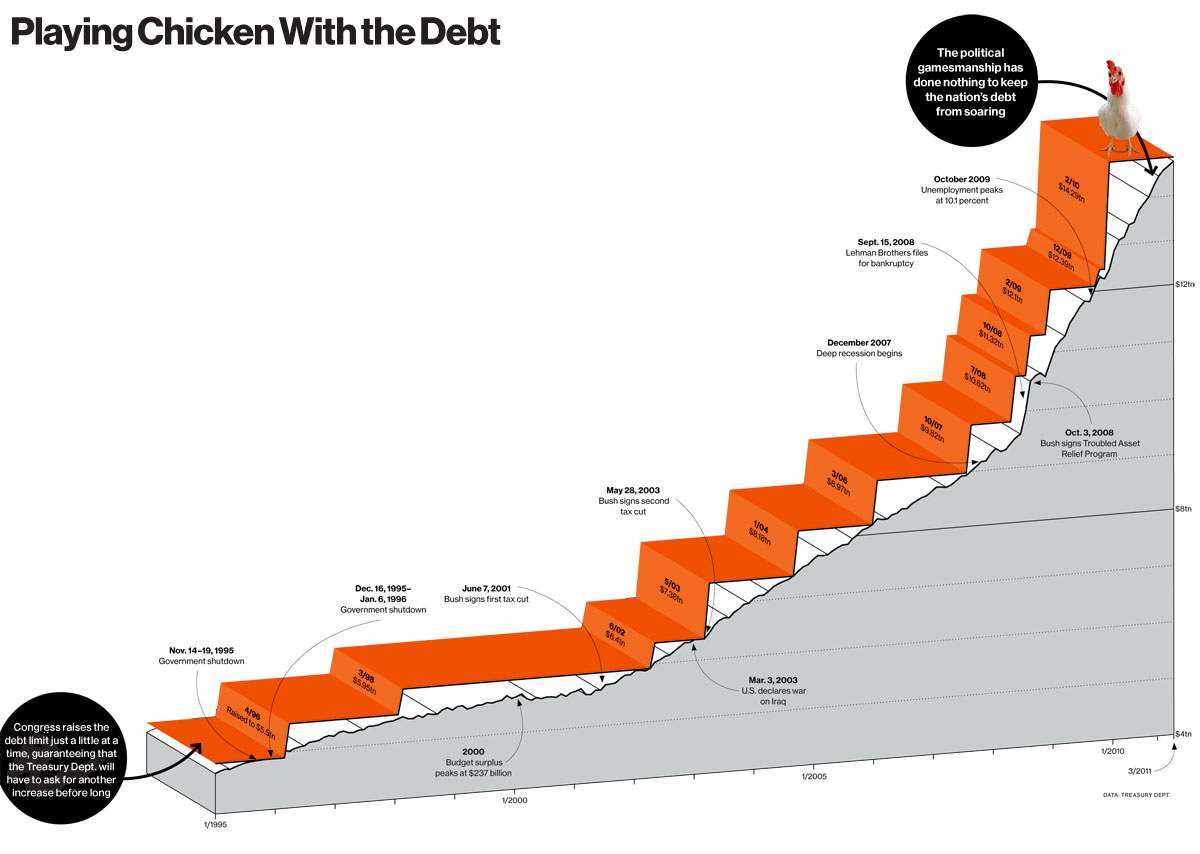
For 50 years, Congress routinely increased the debt ceiling as needed, including seven timesunder President George W. Bush. But in 2011, Republicans decided the debt ceiling was “a hostage worth ransoming. The brinksmanship caused the first-ever downgrade of the U.S. credit rating by Standard & Poor’s and cost the country a million jobs and $19 billion.
The Treasury Department has not yet said when the nation will hit its debt ceiling and has repeatedly moved back the deadline as a result of “lower spending levels and higher tax revenues.”

Friday, January 18, 2013

Obama Brings GOP to Its Knees, Debt Ceiling Hostage Freed

by Deaniac83/The People's View

We told you so. Forgive me for quoting myself, but here's what I wrote in my last piece about the debt ceiling, explaining why the President was not going to give Congress an easy out on this:
 The president does not want to make the Republicans in Congress irrelevant in this conversation; he wants them to come to their senses - or more likely, to their knees - and raise the debt limit without being able to keep their hostage.
Well, the Republicans have come to their knees.
 Backing down from their hard-line stance, House Republicans said Friday that they would agree to lift the federal government’s statutory borrowing limit for three months, with a requirement that both chambers of Congress pass a budget in that time to clear the way for negotiations on long-term deficit reduction.
What? No government shutdown? No making the United States into a deadbeat nation? No crashing the global economy? Nope. The House GOP, at their aptly named 'retreat', seems to have come up with a strategy to retreat from their threats to shoot the debt ceiling hostage. I seem to have predicted this just as their 'retreat' was starting.

Not to toot my own horn, but, you know.

Basically, Republicans have backed themselves into a corner, then negotiated with themselves, and came up with what the New York Times calls a "tactical retreat," but I think it's pretty clear what it is: surrender.

The bigger deal here is not just that it's a face-saving 3-month extension for the debt ceiling that will keep our government from defaulting on obligations Congress already racked up, but something most observers I don't see mentioning: with this offer, the Republicans have essentially permanently rescinded their threat to hold the debt limit hostage to collect as ransom draconian cuts to the social safety net and programs that give ordinary people a hand up. Their new trump card is an enforcement mechanism to get both sides to the table to actually pass a budget.
 The Republicans’ new tack is designed to start a more orderly negotiation with Mr. Obama and Senate Democrats on bipartisan ways to shrink the government’s trillion-dollar deficit. To add muscle to their efforts to bring Senate Democrats to the table, House Republicans will include a provision in the debt ceiling legislation that says lawmakers will not be paid if they do not pass a budget blueprint.
I would much rather have members of Congress paid by the days they actually work, given the House GOP majority's propensity to keep the House in vacation two out of every three days of the year. But that's beside the point. Watch what just happened here: The threat to use the nation's ability to pay its bills as a bargaining chip has now disappeared from the GOP, now or in three months. Republicans just went from end the safety net or we collapse the global economy to pass a budget or members of Congress risk not getting paid!

I don't think anyone can honestly disagree with the idea that Congress should pass a budget. Furthermore, this threat, if it works at all, will force Republicans to the table to compromise rather than hold to their Paul Ryan path-to-poverty type budgets. In other words, it would diminish the power of the radicals in the House. If one didn't know any better, one would almost be tempted to think that this is John Boehner's way of emasculating the House Tea Party caucus after he was himself emasculated by President Obama.

The Republicans thought that they could pretend to hold the hostage and collect a ransom. They thought that because the president negotiated with them in 2011 (in which, by the way, he completely rolled them over without them knowing), that he would do it again. What they didn't know is the strategic plan the president has been following methodically since the start to break the extremists' back: first, rescue the hostages. Then, leave no way out for the hostage takers to escape. Then, bring them to their knees.

Barack Obama is no one's fool. He cares about this country more deeply than any president in most of our lifetimes. But he is also a consummate political genius. He will work with the opposing side for the good of the country; he will meet them more than half way if necessary to make progress. But you will not get away with trying hurt the country he loves. He will make you cry uncle. America's enemies abroad already know that. It's time our domestic politicians learned it, too. Let the following sum it up: