Tuesday, July 09, 2013

Limbaugh: Being Unemployed "Is Not What It Used To Be" Because They Have "Flat-Screens And Food"

From the July 8 edition of Premiere Radio Networks' The Rush Limbaugh Show:


00:00
 
00:00


PoliticsNation:Dead Person voter fraud debunked in new report


Visit NBCNews.com for breaking news, world news, and news about the economy

A cowardly move from the new Gov. Ultrasound

By Steve Benen/The Maddow Blog
Every conceivable element of this story is offensive.
Wisconsin Governor Scott Walker signed into law on Friday new abortion restrictions that opponents said could lead to the closing of two of the state's four abortion clinics. [...]
The law requires women to undergo an ultrasound before they get an abortion and doctors who perform abortions to have admitting privileges at a hospital within 30 miles of their clinics.
So, in addition to forcing two of the state's four abortion providers to shut down, Walker will now require women undergo a medically unnecessary procedure before exercising their constitutional rights. What if a woman doesn't want the ultrasound? Too bad; her governor is imposing one on her anyway. What if her physician says there's no need for an ultrasound? It doesn't matter; Republican politicians in Wisconsin have decided to put themselves between patients and their doctors.
This, we're told, is the result of sensible policymaking from advocates of limited government.
But the way in which the Wisconsin governor signed this legislation into law adds insult to injury (in this case, almost literally). Scott Walker could have approved the measure in any number of ways, but he chose to do so privately, over the course of a holiday weekend, when the governor apparently thought it'd generate less attention.
There is, in other words, a degree of cowardice here -- if Walker thought he was doing the right thing, signing a measure with broad support into law, he wouldn't have been reduced to hiding.
The new state law takes effect today. Planned Parenthood Federation of America and the American Civil Liberties Union have filed suit in federal court. "The purpose and effect of the requirement, which is wholly unnecessary and unreasonable, is to impose a substantial obstacle in the path of women seeking abortion prior to viability, in violation of their constitutional right to privacy," lawyers for the groups said in the complaint.

How the media outrageously blew the IRS scandal: A full accounting

BY /Salon 
The first few days of the IRS scandal that would consume Washington for weeks went like this: Conservatives were indignant, the media was outraged, the president had to respond, his allies turned on him … and only then, the Treasury Department’s inspector general released the actual report that had sparked the whole controversy — in that order. It’s a fitting microcosm of the entire saga, which has gone from legacy-tarnishing catastrophe to historical footnote in the intervening six weeks, and a textbook example of how the scandal narrative can dominate Washington and cable news even when there is no actual scandal.
While the initial reports about the IRS targeting looked pretty bad, suggesting that agents singled out tax-exempt applications for Tea Party and conservative groups for extra scrutiny, the media badly bungled the controversy when supposedly sober journalists like Bob Woodward and Chuck Todd jumped to conclusions and assumed the worst from day one. Instead of doing more reporting to discover the true nature and context of the IRS targeting, or at least waiting for their colleagues to do some, the supposedly liberal mainstream press let their eagerness to show they could be just as tough on a Democratic White House as a Republican one get ahead of the facts. We expect politicians to stretch reality to fit a narrative, but the press should be better.
And they would have gotten away with it, too, had their narrative had the benefit of being true. But now, almost two months later, we know that in fact the IRS targeted lots of different kinds of groups, not just conservative ones; that the only organizations whose tax-exempt statuses were actually denied were progressive ones; that many of the targeted conservative groups legitimately crossed the line; that the IG’s report was limited to only Tea Party groups at congressional Republicans’ request; and that the White House was in no way involved in the targeting and didn’t even know about it until shortly before the public did.
In short, the entire scandal narrative was a fiction. But it had real consequences, effectively derailing Obama’s agenda not long after a resounding reelection, costing several people their careers, and distracting and misinforming the public. It’s not that nothing went wrong at the IRS, but that the transgression merited nowhere near the media response it earned. But instead of acknowledging its error or correcting the record, the mainstream political press has simply moved on to the next game. Now that the emperor has been revealed to have no clothes, it’s worth looking back at what went wrong.
The pace at which the scandal went from zero to Watergate was breathtaking, with the narrative of a Nixonian plot to sic the feds on political enemies forming in the immediate hours after the IRS’ initial apology for the targeting on Friday, May 10. On NBC’s “Nightly News” that day, the first words out of White House correspondent Chuck Todd’s mouth were: “It harkens back to a Nixonian-type tactic, if you will, a political tactic here in the White House.”
Coming at the end of a week of renewed media interest in the Benghazi attack — another scandal that was at least two-parts hype to one-part reality — the two scandals reinforced each other and together created a narrative more powerful than either could possibly hope to be on its own. By Sunday morning, the hosts, guests and pundits on the morning political talk shows easily connected the two and soon there was a cloud of scandal hanging over the White House that every serious person on cable news agreed could doom Obama’s entire second term. David Gregory invoked the “second term curse,” George Will read the portion of Richard Nixon’s Articles of Impeachments that focused on the IRS, David Brooks pointed out that “second terms are generally hit with scandal.” Heading into that week, the “compromised second term” narrative was already cemented and would prove impervious to contradicting information for weeks.
Brendan Nyhan, a Dartmouth political scientist who studies the media’s role in creating scandals, wasn’t particularly surprised. “In other circumstances, the first reports might not have immediately turned into a media firestorm, but the context was very favorable for a scandal to develop and so the media largely embraced the targeting story before all the facts were known,” he told Salon.
What’s often important in scandals is not that someone violated ethical norms, but that “a public figure or institution are successfully construed as violating ethical norms,” he wrote in a recent research paper. Scandals are social constructions and how big one gets often has little to do with the actual severity of the ethical transgression in question, and a lot to do with the political and media context.  ”In some cases, it will only take a spark from a relatively flimsy allegation to set off a significant controversy, while other environments will be much less prone to scandalous conflagrations.”
In other words, it takes two to scandal — the opposition party needs the media (Fast and Furious didn’t work because the press mostly ignored it) and the press needs the opposition party’s furor to advance the scandal narrative and provide political cover. Only when both groups’ interests align in favor of scandal do they emerge. There is where the “second term curse” has some reality. The conditions are often ripe for scandal after presidential reelections, when the media is looking for a new story and opposition parties are looking for a new way to respond to their base’s animosity toward the president, now that it can’ t be channeled into an election.
On Monday, May 12, news broke that the Justice Department had obtained phone records on AP reporters while investigating a national security leak and the scandal narrative exploded. The White House decided to get in front of the scandal story overtaking Washington, employing the same wisdom that worked so well for them in the Shirley Sherrod scandal, when the administration fired an obscure Agriculture Department official before even trying to determine if the tape exposing her wrongdoing was accurate (it was not). The Sherrod case was in many ways a distilled version of the IRS one, when initial facts that looked damning were later exonerated, but the damage had already been done in the panic to respond quickly. The president took the rare step of responding personally, calling the alleged targeting of conservative groups “outrageous” — if true, though that latter part seemed to be largely overlooked.
That night, even Jon Stewart was ready to toss the president overboard. By Tuesday morning, Politico declared that Washington had “turned on” Obama and that this was “very bad news for this White House.” On liberal MSNBC, that lapdog of the White House, Andrea Mitchell declared the IRS targeting of Tea Party groups “one of the most outrageous excesses that I’ve seen in all my years in journalism.” Robert Gibbs, enjoying his new role as MSNBC contributor after spending years as Obama’s spokesperson, slammed his former boss’s “exceedingly passive” response to the controversy.
On Wednesday, Obama lost Chris Matthews. “The story that’s going to haunt the Democratic Party is going to be this IRS story,” the liberal lion of MSNBC’s prime time said. Even Bob Woodward, held up as the paragon of American journalism, overhyped the scandal in an appearance on Bill O’Reilly. Still, on “Morning Joe” he stopped short of saying the IRS targeting was Watergate — “yet.”
From there, there was no going back. Instead of waiting for more reporting to determine whether the IRS targeted other kinds of groups too, or to see if the White House was actually involved (it was not), the punditocracy had already made up their minds. And in doing so, they did a disservice to the public. By mid-June, half of the American people erroneously thought the White House ordered the targeting of Tea Party groups, up 10 points from the previous month. Obama’s approval rating dropped 8 points and his agenda stalled.
At no point did anyone seem to pause and say, let’s wait to see what really happened here. Well, almost no one. One day on “Morning Joe” after the National Journal’s Ron Fournier said that it looked like the White House was using the levers of federal power against opponents, Carl Bernstein, who broke the actual Watergate scandal, cautioned, “We have no evidence of that whatsoever.” For that, he got mocked. “How could we, Carl? Of course we don’t have any evidence of that, but that’s why you have investigations. You know that,” Joe Scarborough said derisively.
But eventually,  in the weeks that followed, new facts emerged and the scandal narrative started to fall apart. No one was able to produce evidence that the White House was involved and those involved said it wasn’t; Republicans seemed to be obfuscating; we learned that liberal groups were targeted too. Beginning in late May, Republicans started talking about the scandal less and less. Darrell Issa’s regular appearances on cable news ended. A new conventional wisdom was spreading: GOP overreach.
When Mitch McConnnell stopped trying to prove the White House ordered the targeting and instead insisted that the president had to disprove the allegations, New York’s Jon Chait saw it as a sign that Republicans were giving up on making the scandal stick in reality. It was a “covered retreat,” Chait wrote, “signaling the IRS scandal’s turn into a vague trope that conservatives use with other members of the tribe, the way liberals liked to say ‘Halliburton’ during the Bush years, to signal some dark beliefs they don’t need to back up.” It had moved into Solyndra and Fast and Furious territory.
But the the GOP really lost its media buy-in when Issa refused to release the full transcript of his interviews with IRS agents. Democratic Rep. Elijah Cummings, the ranking member of Issa’s oversight committee, released the transcripts himself, which revealed that a self-described conservative Republican ordered the targeting. Matthews concluded the scandal was nothing more than people trying to do their jobs and screwing up (something many of us were saying from day one). Todd said Republicans were “overplaying their hand” and that it was “a bureaucratic scandal,” not a political one.
In the beginning, the Washington Post’s Greg Sargent noted, “The idea then was to create an atmosphere of scandal, in hopes of getting the press to place each and every new fact about the unfolding stories into that framework, with no sense of balance or perspective about how significant each new piece of information really was. That worked for a time, but GOP scandal overreach really did produce a media backlash of sorts.”
But mostly, the scandal faded into the background and then disappeared without much recognition, let alone accountability for the people who helped create it. As the journalism adage goes, everyone reads the false report and no one reads the correction. ”My objection to the media coverage is that many reporters and commentators were more interested in the Obama scandal narrative than the facts of the case,” Nyhan told  me. “Do I fault the press for this? Yes, but at the same time, it’s the reality of how the media works and is unlikely to change.”
Conservatives get one thing right about the media — many of its members personally lean liberal. But what they get wrong is assuming that this translates to favorable coverage of Democrats. Often it’s the opposite. Sensitive to criticism of bias and eager to prove their independence and objectivity, the mainstream media often seems to overcorrect by showing less mercy to Democratic administrations than they do to Republican ones. Steve Almond, writing for Salon, argued that the IRS scandal was “Whitewater all over again,” referring to the Clinton-era non-scandal scandal. No one cared when the IRS went after liberal groups like the NAACP and even progressive churches under George W. Bush.
And who could imagine the conservative press disowning the Bush White House as quickly as the liberal pundits on MSNBC did. Bill O’Reilly and his gang at Fox will defend their team to the death, no matter how bad things get and how much flip-flopping is needed to get there. In many ways, this is a compliment to liberal pundits for trying to be more intellectually honest than their conservative peers. But trying to show fair-mindedness by imposing a false balance is just a different form of dishonesty.

GOP May Hold Debt Ceiling Hostage To Enact Paul Ryan’s Budget

By Igor Volsky/Think Progress
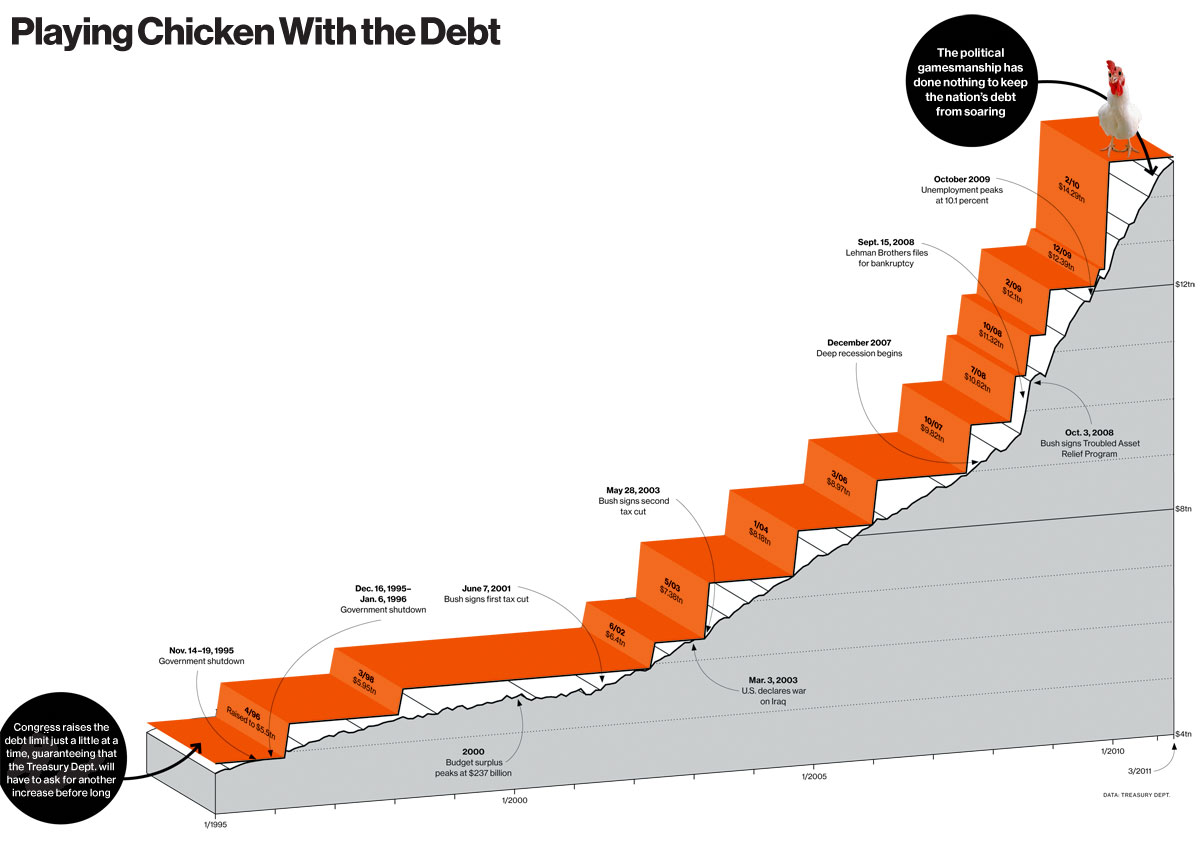
House Republicans will hold the national debt ceiling increase hostage until President Obama agrees to mandatory spending cuts to Social Security, Medicare, and Medicaid, the National Journalreports, and will seek to use the leverage of default to force Democrats to enact the policies in Rep. Paul Ryan’s (R-WI) budget.
Since slashing discretionary spending to historic lows — the discretionary side of the ledger has grown at a slower rate than inflation since 2007 and now makes up a smaller share of the economy than it did before the Great Recession — the GOP has shifted from demanding dollar-for-dollar immediate spending cuts and is now focusing on drafting a range of options to significantly restructure mandatory benefit programs.
The idea is to throw in the “kitchen sink” and allow Obama to pick and choose the cuts. “If what makes it easier to find the deal is to go in and pick and choose among a dozen different programs and just grab a little bit from all 12 — instead of a lot from one them — then that works just fine,” Rep. Rob Woodall (R-GA), who heads the Republican Study Committee’s budget and spending task force, told the Journal:
For a long-term deal, one that gives Treasury borrowing authority for three-and-a-half years, Obama would have to agree to premium support. The plan to privatize Medicare, perhaps the most controversial aspect of the Ryan budget, is the holy grail for conservatives who say major deficit-reduction can only be achieved by making this type of cut to mandatory spending. “If the president wants to go big, there’s a big idea,” said Rep. Steve Scalise, chairman of the Republican Study Committee.
For a medium-sized increase in the debt-limit, Republicans want Obama to agree to cut spending in the SNAP food stamp program, block-grant Medicaid, or tinker with chained CPI.
For a smaller increase, there is talk of means-testing Social Security, for example, or ending certain agricultural subsidies.
While the menu includes plenty of variables, the underlying strategic goal is to reduce mandatory spending — whatever the scope of the deal. Even at the smallest end of the spectrum — another months-long extension of debt-limit — there is talk of pushing back the eligibility age for Social Security by an equal number of months.
For 50 years, Congress routinely increased the debt ceiling as needed, including seven timesunder President George W. Bush. But in 2011, Republicans decided the debt ceiling was “a hostage worth ransoming. The brinksmanship caused the first-ever downgrade of the U.S. credit rating by Standard & Poor’s and cost the country a million jobs and $19 billion.
The Treasury Department has not yet said when the nation will hit its debt ceiling and has repeatedly moved back the deadline as a result of “lower spending levels and higher tax revenues.”

Nine Things We Won’t Miss About Rick Perry

By Josh Israel and Scott Keyes/Think Progress
With his announcement Monday that he will not seek an unprecedented fourth full term as Governor of Texas, Rick Perry (R) will retire from the office in January 2015. Sadly, he will leave behind a record of right-wing extremism that few could match.
Here are ten of the worst moments from his 13 years as governor and his “oops” 2012 presidential campaign:
1. He allowed Texas to become the nation’s worst polluter. Texas under Perry has led the nation in carbon dioxide emissions and is home to five of the tenworst mercury emitting power plants in the country. Rather than try to do something about this, Perry sued the federal government to try to avoid complying an EPA ruling that the state was in violation of the Clean Air Act. Aproud climate change denier, Perry called the 2010 BP oil spill an “act of God” while speaking at a trade association funded by BP. And his solution to the nation’s economic ills in 2011: more oil drilling.
2. He executed a likely innocent man and impeded an investigation into the matter. In 2004, Cameron Todd Willingham was executed in Huntsville, Texas after being convicted of arson and the murder of his three children. Despitesignificant evidence that arson had not caused the fire (thus exonerating Willingham), Perry refused to grant a stay of execution. Five years after Willingham was executed, a report from a Texas Forensic Science Commission investigator found that the fire could not have been arson. As the commission prepared to hear testimony from the investigator in October 2009, Perry fired and replaced three of its members, forcing an indefinite delay in the process. With a record of executing juveniles and mentally disabled, Perry said in a 2011 GOP presidential debate that he had “never struggled” at all with his decisions to administer the death penalty to more than 230 people.
3. He actively sought to dismantle Social Security, Medicare, and Medicaid.Perry argued that Texas and other states should be able to opt out of federal entitlements like Medicaid and Social Security — even though such a move would actually cost his own state’s economy billions of dollars. Despite their popularity and success, he called these programs and Medicare “Ponzi schemes,” and suggested they are actually unconstitutional.
4. He consistently backed legislation to restrict women’s reproductive rights.Perry has made news in recent weeks for his embarrassing attacks on State Senator Wendy Davis (D) and his efforts to ram through a likely unconstitutional bill to shut down the vast majority of Texas clinics that provide abortion. But his attacks on women’s reproductive choice are nothing new; in 2011 he pushed for and signed “emergency legislation” to require women to have unnecessary sonograms prior to abortions.
5. He demonized LGBT Texans and worked to increase legal discrimination against them. Perry was staunch defender of Texas’ unconstitutional anti-sodomy law which criminalized the private consensual sexual behavior of adults. After the U.S. Supreme Court’s 2003 ruling in Lawrence v. Texas, Perry called ban “appropriate,” and blasted the Court decision as the result of “nine oligarchs in robes.” As a presidential candidate, he ran a shockingly anti-gay ad, blasting open service by gay and lesbian members of the Armed Services as part of President Obama’s “war on religion.” He vocally opposed the Boy Scouts of America’s half-measure allowing openly gay Scouts but not leaders, claimingthe tiny step “contradicts generations of tradition in the name of political correctness.” Even in his speech Monday, he proudly boasted that Texas had defended “the sanctity of marriage” by writing discrimination into the state’s constitution.
6. He backed nullification of federal laws and even raised the prospect of secession. Perry rose to national prominence in 2009 when he threatened to have Texas secede from the United States. “If Washington continues to thumb their nose at the American people, you know, who knows what might come out of that,” Perry told reporters after a Tea Party event. He also signednullification legislation — a state law that portends to undo federal law, despite the Constitution’s clear guarantee of federal supremacy — as governor, the likes of which were used by secessionists in the 19th Century.
7. He refused to let the federal government provide healthcare for low-income Texans, despite the highest rate of uninsured residents in the country. Health care in Texas is abysmal. More than 25 percent of Texans — 6,234,900 people and growing — lack health coverage, the highest of any state in the country. However, when Obamacare was passed and offered millions of dollars in federal money to expand Medicaid and cover poor Texans, Perry rejected the offer even though it wouldn’t cost Texas a dime for at least three years. Despite his state’s awful track record on covering low-income residents, Perryclaimed that Texas has the “best health care in the country.”
8. He vetoed bipartisan Equal Pay legislation to protect Texas women. Though women, on average, continue to earn 77 cents for every dollar men make, Perry vetoed legislation that would have helped women fight discrimination. The bill, HB 950, which passed the Republican-held Texas legislature, would have built on the federal Lilly Ledbetter Act. Perry, worrying that the bill would lead to regulations, vetoed the measure.
9. He called for repeal of the 16th and 17th Amendments to the U.S. Constitution, to end popular election of Senators and the federal income tax.In his book Fed Up!, Perry said that both the 16th and 17th Amendments were “mistaken” and should be repealed. The 16th Amendment allows the federal government to collect income taxes and accounts for 45 percent of all revenue, while the 17th Amendment allows voters, rather than state legislatures, to choose their U.S. senators. Perry opposed both amendments, saying they were merely passed in “a fit of populist rage.”
In his announcement, Perry noted, “Our responsibility remains to the next generation of Texans, who will inherit a state of our making. We alone are responsible for the kind of Texas that will greet them.”

Monday, July 08, 2013

Sorry, Republicans, Your Own Investigation Proves No Dead People Voted In South Carolina

By Rebecca Leber/Think Progress
South Carolina never found a single dead voter in recent elections. At least, that is thefinal word from the State Election Commission investigation into whether 900 people voted using a dead person’s name, according to the Columbia Free Times.
The report found that whatever issues existed were usually due to human error, like a clerical mistake or scanning problem, and not because anyone intentionally impersonated a deceased person. For example, hundreds of errors were due to mistakes like confusing a father and son who share the same name.
When Attorney General Alan Wilson demanded the original investigation, he cited “an alarming number” of cases reported by the DMV that “clearly necessitates an investigation into criminal activity.” The initial report surveyed 200 “suspicious” names and found nothing, but Wilson insisted “no one in this state should issue any kind of clean bill of health in this matter” until officials “finished with their work.” Republicans, including Wilson, held up the initial claim that the voting rolls were packed with dead voters to argue for a voter ID law. Rep. Alan Clemmons (R) wrote at one point, “It is an unspoken truth in South Carolina that election fraud exists.”
Even though South Carolina has never found any election fraud, that will not prevent state Republicans from redoubling strict voter ID efforts, invigorated by the recent Supreme Court decision on the Voting Rights Act. In fact, Wilson celebrated the decision, calling the Voting Rights Act an “extraordinary intrusion” and pledging to implement voter ID “without some having to ask for permission or being required to jump through the extraordinary hoops demanded by federal bureaucracy.”

Bush-Appointed Judge Slams Decision Striking Voting Rights Act — Court’s Reasoning Was ‘Made Up’

By Ian Millhiser/Think Progress
If a leading conservative scholar and former judge were now on the Supreme Court instead of Chief Justice Roberts or Justice Alito, it is likely that the Voting Right Act would remain intact.
Judge Michael McConnell was a leading conservative law professor at the time President George W. Bush named him to the United States Court of Appeals for the Tenth Circuit in 2002 (he’s since left the bench to return to the legal academy at Stanford Law School). McConnell was also widely viewed as a possible Supreme Court nominee during the Bush Administration.
In an interview with NPR’s Nina Totenberg, McConnell has harsh words for the five conservative justices’ recent decision neutering much of the Voting Rights Act — labeling the reasoning that drove that decision “made up.”
Although the conservatives’ decision in Shelby County v. Holder never actually identifies the legal standard of review that led them to strike down the heart of America’s voting rights law, the opinion rests in large part on the fact that the Voting Rights Act applies some of its requirements “only to some States,” in what the Court labels as a “dramatic departure from the principle that all States enjoy equal sovereignty.”
As McConnell explains, however, “[t]here’s no requirement in the Constitution to treat all states the same,” adding that “[i]t might be an attractive principle, but it doesn’t seem to be in the Constitution.”
Judge McConnell is, of course, correct. The Fifteenth Amendment provides that “[t]he right of citizens of the United States to vote shall not be denied or abridged by the United States or by any State on account of race, color, or previous condition of servitude,” and it gives Congress “power to enforce this article by appropriate legislation.” One searches the Constitution in vain for language forbidding the Voting Rights Act application of some of its strongest medicine to jurisdictions judged to have the worst record of voter suppression.
Yet, while the legal assault on voting rights cannot be justified under the Constitution’s text, it has been quite a windfall for conservatives. At least six states are already moving forward with new voter suppression laws now that a key prong of the Voting Rights Act is no longer available to stop them. Texas announced that it would begin suppressing votes just two hours after the Supreme Court handed down its decision.

Wednesday, July 03, 2013

The GOP "Rebrand" Never Had A Chance

 SIMON MALOY/Media Matters For America


MSNBC political reporter Benjy Sarlin has written a sharp deconstructionof the Republican Party's evolving attitude towards Latino voters. The shock of Mitt Romney's 2012 loss and the resulting calls for Latino outreach from conservatives have given way to old habits: namely, consolidating the white vote and keep hoping that's enough to propel the GOP to electoral victory. Fox News' Sean Hannity, who memorably claimed the day after the election that he'd "evolved" on immigration reform, now rejects reform and the idea that Republicans need Latinos to win.
This shift in attitudes comes just a few months after the Republican National Committee (RNC) unveiled its surprisingly harsh 2012 post-mortem, which endorsed comprehensive immigration reform as a way to expand the party's appeal. "If we want ethnic minority voters to support Republicans, we have to engage them, and show our sincerity," the report counseled. As I wrote at the time, the RNC's ambition for party rebranding, whatever its merits, faced a daunting obstacle: Rush Limbaugh and the coterie of lesser radio hosts who form the rigid spine of the conservative media apparatus. And by all indications, Limbaugh is prevailing.
Even as Hannity and other conservatives (temporarily) fell prey to post-election demography panic, Limbaughnever budged. "I don't know that there's any stopping this," Limbaugh said of immigration reform shortly after Obama's reinauguration. "It's up to me and Fox News, and I don't think Fox News is that invested in this." Funnily enough, Limbaugh was on Fox News just this morning to talk politics, and afterward he disclosed on the radio that he "told the people at Fox that I wanted to talk about" immigration and the GOP, "and they wouldn't do it. They were not interested in bringing this subject up."
The schism among conservatives on how to approach immigration reform and Latino voters in general isn't going away, but the biggest guns are and always have been on the side of the status quo: do nothing policy-wise and continue stoking fears over "illegal immigration" to try and drive sufficient numbers of resentful white voters to the polls. It's worked for Republicans in the past and a big reason behind its success has been the enthusiastic efforts of Rush Limbaugh and right-wing radio. As Sarlin notes, the anti-immigration groups working to kill the reform legislation have the ears of talk radio hosts and are successfully promulgating the message that the Republican Party does not need Latino voters.
It's precisely the sort of closed off, self-reinforcing ideological loop the RNC warned against in its report: "We have become expert in how to provide ideological reinforcement to like-minded people, but devastatingly we have lost the ability to be persuasive with, or welcoming to, those who do not agree with us on every issue." But so long as anti-immigrant demagoguery keeps people tuning in to the AM radio dial, any attempt at Republican "rebranding" won't stand much of a chance.

New potential inconsistency in Zimmerman's trail


Visit NBCNews.com for breaking news, world news, and news about the economy

Trayvon Martin's Death Extends Sanford's Sordid Legacy

—By /Mother Jones
In some sense, it's history you could recount from many places in America: It could be Miami, where Trayvon Martin came up, and where rioters scorched the streets in the 1980s over black motorists killed by police. It could be Prince Edward County, Virginia, near where George Zimmerman grew up, and where the county board of supervisors once abolished public education rather than comply with integration. Or it could be southern Wisconsin, where not long ago a noose and racial threats turned up on a college campus, and where earlier this month another gun owner killed a black man allegedly in self-defense.
But when it comes to a history of fear, racism, and violence, Sanford, Florida, has a particularly fraught past, one that traces right up to the night a month ago when an unarmed black kid was shot dead on one of its streets, and his killer went free.
Long before the live oaks and Spanish moss gave way to interstate highways and box stores, Sanford began as a citrus town in the 1870s, conceived by a New England tycoon. Henry Shelton Sanford, who had ingratiated himself to Abraham Lincoln and served as Lincoln's ambassador to Belgium for eight years, had the town built by Swedish laborers. Though the citrus empire he dreamed of didn't exactly flourish, Sanford proved instrumental to promoting trade with the Belgian-controlled territory of Congo—which included his vision of promoting Congo as a place to ship 
America's freed blacks. The African locale, he said, represented an outlet "for the enterprise and ambition of our colored people in more congenial fields than politics." A Congo peopled with African Americans could be "the ground to draw the gathering electricity from that black cloud spreading over the Southern states."
The back-to-Congo movement never took off, but Sanford's Florida hamlet did. In 1911, it absorbed the town of Goldsborough, an autonomous black community. The merger was hostile, according to local historian Francis Oliver. "[Sanford] never paid restitution to the people who lost their jobs and asked for money because they...no longer [had] jobs," she said. "The mayor didn't have a job, City Council people didn't have a job, the postmistress didn't have a job, the jailers didn't have a job, the marshal didn't have a job."
That sense of alienation hung in the air for decades. Then Jackie Robinson entered the picture. Before he broke Major League Baseball's race barrier in 1947, Robinson played for a Dodgers farm team in Sanford—but only briefly. His presence in spring training that year so incensed white residents that they accosted the mayor and demanded Robinson's ouster. When the integrated team was physically prevented from taking the field, the Dodgers' owner moved Robinson out of town for his own good. "The Robinsons were run out of Sanford, Florida, with threats of violence," Robinson's daughter would later say.
Soon after, the Dodgers also left town, but the bitter feelings remained. Change came excruciatingly slow to Sanford. This was a community that held on to an archaic law ordering police "to shoot all pigeons on sight" until 1989, according to a St. Petersburg Times news capsule. "Over the years Sanford dug in its feet against change," a local newspaper editor told the New York Times in 1990. "It resisted integration, filling in the public pools rather than integrating them."
It may come as no surprise, then, that law and order in Sanford in recent years has been plagued by allegations of racial injustice, and a series of public missteps involving its police department. In 2006 two private security guards—one the son of a Sanford police officer, the other a volunteer for the department—killed a black teen with a gunshot in his back. Even though they admitted to never identifying themselves, the guards were released without charges. Then, in 2010, Justin Collison, the son of a Sanford PD lieutenant, sucker-punched a homeless black man outside a bar, and officers on the scene released Collison without charges. He eventually surrendered after video of the incident materialized online; the police chief at the time was ultimately forced into retirement. "Bottom line, we didn't do our job that night," a police department representative told local news station WFTV of the incident.
As it would turn out, the Sanford patrol sergeant in charge on the night of Collison's assault, Anthony Raimondo, would also be the first supervisor on the scene of Trayvon Martin's shooting death.
"There is no trust, there is no confidence," between African Americans and Sanford authorities, said local NAACP leader Turner Clayton. "It's at an all-time low." Even embattled city manager Norton Bonaparte—who oversees Sanford's police department and is African American—acknowledges this truth. "The trust that may have existed is gone," he said, "so we have to start from ground zero."
Or perhaps it was never really there: Reverend Harry Rucker, pastor of Sanford's First Shiloh Missionary Baptist Church, told crowds in the 1990s that integration was a mistake, and that anger was the best way to confront racism. "The worst thing that happened to us when they changed our schools [through desegregation], there went our leaders, there went our teachers," he said then. "We never asked for integration. We asked for equality." Rucker is still at First Shiloh today; he has been one of the organizers of the town's rallies for Trayvon Martin.
In those rallies, and in demonstrations around the country in recent days, Americans have been saying "We are Trayvon Martin." In some ways, Sanford's history is all of ours, as well—to be acknowledged, and hopefully to be left behind once and for all.