Whoopi Goldberg and co-host Jedediah Bila exchanged some words Wednesday morning on “The View,” when Goldberg cited Bill O’Reilly’s latest accusations that Hollywood is bullying President-elect Donald Trump and his famous supporters. The accusations come after the Trump Inauguration Committee has struggled to find anyone to perform at the Inauguration ceremonies.
“There’s reverse McCarthyism going on in the entertainment industry,” O’Reilly accused. “In the 1950s, Wisconsin Sen. Joseph McCarthy started accusing people in Hollywood of being communist, that led to a blacklist, where people weren’t hired because McCarthy smeared them. Today, it seems anti-Trump zealots might be doing the same thing. If you’re a Trump supporter, you’re a bad person. Some entertainers think their careers will be harmed by associating with Trump.”
Goldberg doubted O’Reilly’s claim, citing Ted Nugent as an example.
“If you don’t vote for people who don’t support you probably won’t get turned down as much,” she said. “I know that one of the people that supported Donald Trump was Ted Nugent. So, why isn’t Ted Nugent performing? He’s one of your big supporters. When you say things like, ‘We don’t need Beyonce to come out for us we got the people.’ That’s what you said, Donald Trump. Stop going after the lefties to come perform if you think it’s going to be an issue. Go after the people who supported you.”
Goldberg quickly cut in and said that it wasn’t the point at all. “If you want people to support you go after your supporters, don’t go after the people who clearly did not support you and label them as being bad,” she continued.
Co-host Joy Behar argued that the real sin of O’Reilly’s statements was to compare people not wanting to perform for Trump to “McCarthyism.”
“People’s lives were destroyed,” Behar said, as a reality check. “I don’t think anyone is going to commit suicide because Garth Brooks doesn’t want to strum on his guitar. I mean, people committed suicide. And by the way, he neglected to say that McCarthyism was directed to the left. To the liberals. This isn’t the same thing. Nobody’s life is being threatened.”
Goldberg asked if she would name someone and Bila refused. “You can’t make those kinds of statements!” she exclaimed. “Listen, Elisabeth Hasselbeck sat on this show for a thousand years. She took so much flak from people she stood strong and she stood up. This is BS! It’s BS.”
She cited conservatives like Kelsey Grammer, who has been a conservative forever and yet Grammer doesn’t work with Scott Baio, and the two of them are conservatives. People like Scott Baio don’t get work because of many many other reasons, but not because of politics.
Bila tried to claim that on awards shows you see the left on full display, but Goldberg again said that it wasn’t the point.
“That’s not the point!” Goldberg exclaimed. “What he’s saying is that people are afraid to come out and say — I’m telling you — that’s a different — to me that’s a very different thing. When you’re talking about people coming to do the inauguration which is what he’s talking about and when you say it’s like McCarthyism, I have to yell BS.”
Behar asked why O’Reilly couldn’t do a dramatic reading from Killing Lincoln if he’s so concerned about entertainers performing.
Goldberg explained that she knows people in the middle and on both sides and “if you’re not up for that specific job you’re not going to get it.” It has nothing to do with politics.
“We didn’t cut a deal with Trump,” the CEO said. “We did it for our business.”
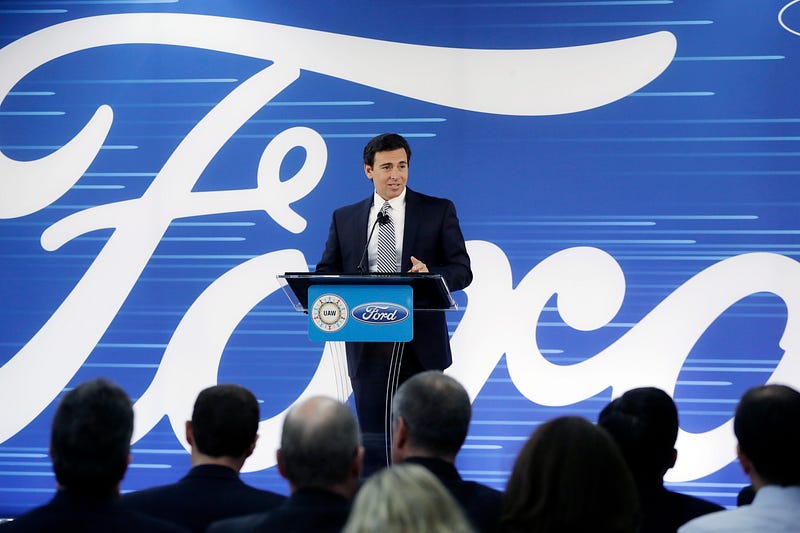
Ford CEO Mark Fields announcing its new plans on Tuesday. CREDIT: AP Photo/Carlos Osorio
On Tuesday, Ford announced that it would scrap plans to build a new factory in Mexico, and instead will invest $700 million in upgrades to an existing plant in Michigan. The company plans to create 700 jobs in the state in its quest to build more electric and self-driving cars.
The next morning, President-elect Donald Trump tweeted his thanks to the company.
He also appeared to take credit for the move in an earlier tweet.
Some in the media were quick to link Trump’s rhetoric about outsourcing to the company’s decision. “Chided by Trump, Ford scraps Mexico factory, adds Michigan jobs,” read a headline on Reuters, pointing to his earlier tweet criticizing GM for importing cars from Mexico — even though most of the cars in question are made in the U.S.
But Trump had very little to do with what happened.
Ford’s CEO, Mark Fields, was very clear about that point on Tuesday. “We didn’t cut a deal with Trump,” he said while talking about the decision on CNN. “We did it for our business.” He told Fox Business that the same decision would have been made even if Trump hadn’t won the election. And company sourcesindicated that there were no negotiations between Trump and the company ahead of the announcement; Fields called Trump to tell him about the announcement on Tuesday morning after it had been made.
Instead, Fields indicated that he expects to get incentives from Michigan to expand its plant in Flat Rock.
Meanwhile, increasing jobs to make electric vehicles in Michigan rather than Mexico makes far more business sense for Ford. As Danielle Paquette reported at the Washington Post, the engineers who design the cars in Dearborn will be much closer to those producing them, which will make the process easier. It also fits with the industry trend toward keeping innovation and cars that require more skills and computer literacy in the U.S.
The Focus, on the other hand, is still going to be produced in Mexico, just at an existing plant, not a new one. The company had already been publicabout the fact that it will no longer produce small cars in the United States thanks to declining sales and was therefore shifting the Focus to Mexico.
It was equally clear that the change didn’t endanger U.S. jobs because workers would be shifted to producing other vehicles, such as S.U.V.s and trucks, that sell better in this country. A new contract with the United Auto Workers also preserved the jobs in question.
Ford’s move to produce small cars in Mexico originally sparked Trump’s ire on the campaign trail. He called it an “absolute disgrace,” saying, “We shouldn’t allow it to happen. They’ll make their cars, they’ll employ thousands of people, not from this country, and they’ll sell their car across the border.” Trump had even promised that, if elected, he would levy large tariffs on the Ford vehicles produced in Mexico and imported to the United States.
Yet Ford’s Focus plans are not going to change.
While Fields said his decision this week was “a vote of confidence” in Trump’s policies and proposals, many companies appear to be eager to curry favor with the administration in this way in order to press for business-friendly tax and regulation reform. A number of companies have given Trump credit he couldn’t realistically claim for job expansions in a quest to stay out of his line of fire on Twitter and to press the case for their agendas, from tax cuts to leniency on mega mergers.
That doesn’t mean Fields is on board with everything Trump has discussed. Fields told BuzzFeed News that he will push the administration to keep the country’s “deep integration” with Mexico when it begins debating a revamp of NAFTA.
Johaunna Cromer never thought she would work at a fast food restaurant. A college graduate, trained psychologist, and former member of the Air Force, she said she used to believe fast food employees were mostly teenagers trying to supplement their allowance.
But in 2014, when her family moved to Asheville, North Carolina to be close to relatives, Cromer ended up taking a position as a manager at a Hardee’s restaurant near her home. Counseling jobs were hard to find, and she needed quick money to support her two children.
The position proved far more trying than she’d ever imagined.
“I learned how hard the work was,” she told ThinkProgress. “And I never thought they would treat people the way they treat people for fighting for what’s right.”
Almost immediately after starting the job, Cromer realized that her $7.25 an hour salary was not sufficient to pay her bills and support her children. She became active in the Fight for 15 movement — a national network of fast-food and other low-wage workers demanding a $15 an hour minimum wage and the right to form a union. She traveled across the country to participate in strikes and protests, gave televised interviews, and encouraged her coworkers to join the movement.
Eight months later, she was fired.
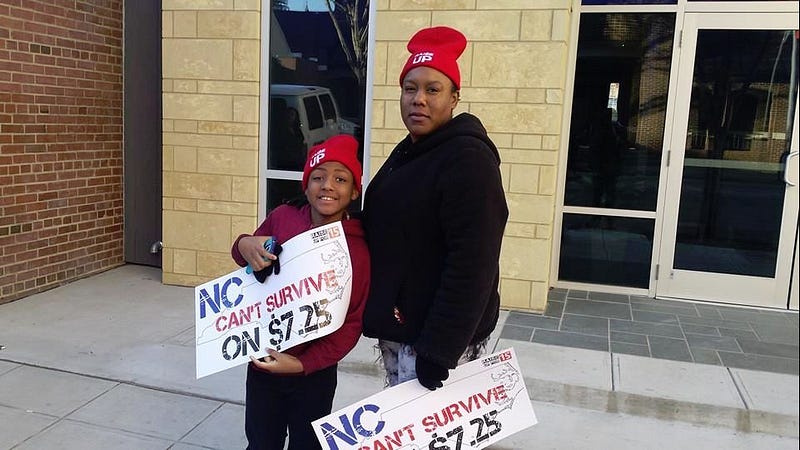
Cromer and her son protested the minimum wage in North Carolina. CREDIT: Johaunna Cromer
“I was making too much noise, and they were probably afraid of me putting Hardee’s name in a bad light,” she said, alleging that Hardee’s management pressured her coworkers into signing false statements about her workplace conduct.
Cromer says her termination is the product of an anti-union, anti-worker culture at CKE Restaurants, which operates Hardee’s and Carl’s Jr. and whose CEO Andy Puzder was recently nominated by President-elect Donald Trump to lead the U.S. Department of Labor.
Puzder has made his career on the backs of low-paid fast food workers like Cromer, and he has spent the last 16 years overseeing a fast food chain notorious for violating basic wage and hour laws. A review of federal and state court documents and Labor Department inspections paint a picture of a corporate culture that values profit over worker welfare.
People employed by Puzder have sued for discrimination, filed class action lawsuits over the denial of overtime pay, and alleged that they were fired for protesting the chain’s low wages.
Labor law experts have also spoken out against Puzder’s practices. Paul Secunda, director of the Labor and Employment Law Program at Marquette University, told ThinkProgress that Puzder has taken advantage of the fact that fast food workers are a vulnerable population that is easy to abuse.
“They are usually at the bottom of the pay scale, they usually don’t have the sophistication to know their rights under the law, and it’s hard for them to be collective in their approach because they’re moving around so much,” he said. “It’s really easy to manipulate them and exploit them, and that’s what we’ve seen.”
“It would be hard to pick someone who is more anti-labor than this guy for the Labor Department,” he added. And those with first-hand experience with his policies, like Cromer, believe he will lead the country’s workers in a terrifying direction.
“If he can’t even care for his own company, what makes you think he can care for anything else?” Cromer asked.
A thickburger of legal complaints
Cromer said she has filed legal action against the company for her termination, and the litigation remains pending. Many other workers and ex-workers have sued Puzder’s restaurants as well.
In 2009, in response to litigation, CKE Restaurants agreed to treat general managers like hourly, non-exempt employees, entitling them to overtime pay. But the restaurant chain refused to offer back pay to the thousands of workers who had been illegally denied overtime, prompting another class action lawsuit.
“Imagine if you worked for me for ten years and we said, ‘Oh we’ve gotten it wrong. It turns out you were entitled to overtime,’” said Andy Graves, a California attorney who’s representing the managers in two ongoing class actions. “And you said, ‘What about the last ten years?’ And I said, ‘Nah, we’re just changing it going forward.’”
Jose Cubias, who sued the company in 2010, worked at Carl’s Jr. branches around Los Angeles for nearly 30 years, including five years as a general manager. He says he and every other general manager in the state were denied back pay for hundreds of hours of overtime they worked between 2005 and 2009. The company also forced them to say they were on vacation on days they were actually working in order to meet the company’s labor budget, and made them work up to 12-hour shifts without legally-required meal and rest breaks.
“By deliberately failing to pay its employees wages to which they are entitled, CKE avoided substantial expenses and thereby enriched itself at the expense of its employees,” said Cubias’ lawsuit, filed in California state court.
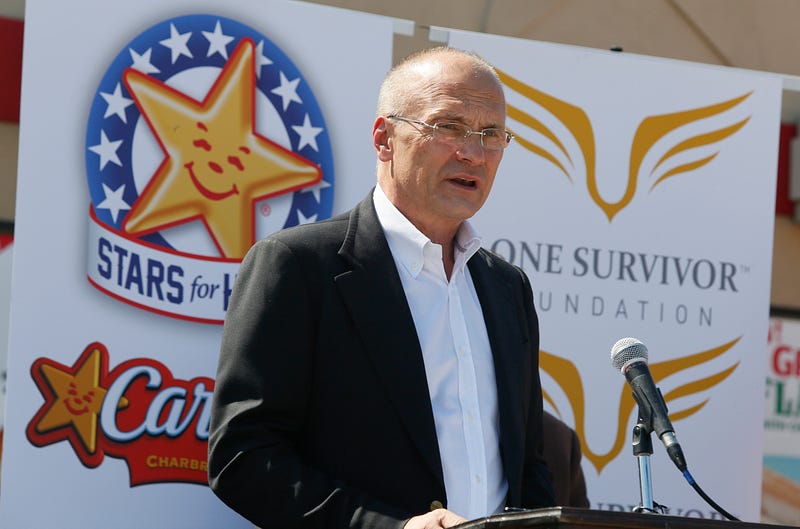
CKE Restaurants CEO Andy Puzder speaks at a news conference on Wednesday, August 6, 2014 in Austin, Texas. CREDIT: Jack Plunkett/AP Images
Even after the CKE-owned restaurants changed their policies and agreed to pay managers overtime, they continued to force them to perform unpaid, off-the-clock work outside the restaurant, like reporting to their superiors, tracking down missing employees, and making calls about equipment. Without litigation, Graves explained, many managers had no way to stand up for their rights under California labor law.
“These are people who have eighth-grade educations, they came to the U.S. as teenagers, they’ve done nothing but work for this fast food company for 30 years and the company kind of has them now,” he said. “They can’t do anything else. They’ve given their whole lives to learning how to run a Carl’s Jr., that’s what they do, so they’re exceptionally vulnerable in that way.”
CKE Restaurants did not respond to a request for comment about the ongoing litigation.
Direct liability in an already toxic industry
Graves, who represents fast food workers at several different chains, said the types of violations documented at CKE Restaurants are common in the industry. Though the records of the Labor Department’s inspections are not publicly available, a spokesperson for the Wage and Hour Division described to ThinkProgress some of the most egregious violations the agency documented at CKE-branded facilities.
In 2012, the department discovered that a Hardee’s franchise in Nashville, Tennessee required workers to punch out for breaks when they continued to work, and refused to pay them for those and other hours in violation of minimum wage and overtime laws. They were forced to pay more than $7,500 to 29 employees.
Another investigation of a Hardee’s franchise in Tallassee, Alabama in 2012 and 2013 found that the store failed to pay 19 employees for hours they worked beyond their scheduled hours. They were forced to pay them $2,400.
And while Puzder’s chains are frequent violators of workers’ rights, they don’t appear to be among the worst offenders. The government found violations of the Fair Labor Standards Act more than 60 percent of the times they inspected Carl’s Jr. and Hardee’s restaurants over the past seven years, according to a Bloomberg analysis of Labor Department data. Most national fast food chains had even higher violation rates, with only Jack in the Box, Pizza Hut, and Chick-fil-A ranking better than Puzder’s companies.
“CKE’s record of compliance on wage policies is among the best when compared to our industry peers,” boasted the company’s Executive Vice President & General Counsel in a statement to ThinkProgress. “Bloomberg BNA recently reported that CKE has a ‘fairly clean record’ following their exhaustive analysis.”
A man walks past a sign for a Carl’s Jr. restaurant in San Bruno, Calif., Wednesday, May 25, 2011. CREDIT: AP Photo/Jeff Chiu
Yet the Bloomberg study found that fast food franchises violate their workers’ rights at alarming rates — in part because they operate like small businesses but are held to the same standards as large corporations.
“The franchise system is almost designed to create labor code violations,” Graves said, explaining that franchises operate without corporate legal departments or a human resources departments, but are under pressure to comply with state and federal law.
Puzder is a vocal proponent of franchising. A board member of the International Franchise Association, he has claimed that he and other CKE executives should not be held accountable for violations that occur at their franchises. This view has brought him into conflict with the Obama administration, which has pushed for joint-employer liability — a policy that makes CEOs like Puzder take responsibility for the actions of his franchises.
What makes Hardee’s and Carl’s Jr. stand out is where the abuses occur. The violations did not only happen at franchises, where the company has less liability, but they also happened at sites CKE directly owns.
“The problems in the CKE cases are unusual,” Graves said about his ongoing overtime class action lawsuits. “Usually the reason we see poor treatment of workers has to do with franchisees, and not the actual company… The only thing that stands out about Carl’s Jr. is that the home office did it.”
A Labor Department investigation of corporate-owned branches in St. Louis, Missouri in 2006 and 2007 found that the company failed to properly calculate overtime pay for 456 workers, stiffing them a total of $58,001, which they had to pay in back wages.
A smaller investigation of a Hardee’s-owned location in Birmingham, Alabama between 2013 and 2015 found that the employer made illegal deductions that dropped employees below the minimum wage. They had to pay 20 employees a total of $2,000.
The fox in the hen house
The official mission of the Labor Department is to “improve working conditions; advance opportunities for profitable employment; and assure work-related benefits and rights.” But if Puzder is confirmed to run the agency, he will be in charge of enforcing a host of laws his own company has broken, in addition to other policies he has publicly opposed.
While presiding over a company that has been repeatedly fined and sued for violating existing minimum wage and overtime laws, Puzder has written op-eds and given countless interviews criticizing efforts to expand these benefits.
“Increasing the minimum wage is not the best solution,” he said on Fox News in May. “If we are going to increase the minimum wage at all, we’ve got to keep a lower minimum wage for entry-level workers, or these people are just going to be shut out of the workforce.” Even as a growing number of states and cities increase their minimum wages to $15 an hour, he said he believes it should be no higher than $9.
After President Obama signed an executive order making an additional 4.2 million workers eligible for overtime pay, Puzder wrote a scathing guest postfor Forbes calling the new rule a “harsh reality” for businesses.
“As with the Obama Administration’s other efforts to regulate their way to economic prosperity, it will not deliver as promised,” he said. “In practice, this means reduced opportunities, bonuses, benefits, perks and promotions.”
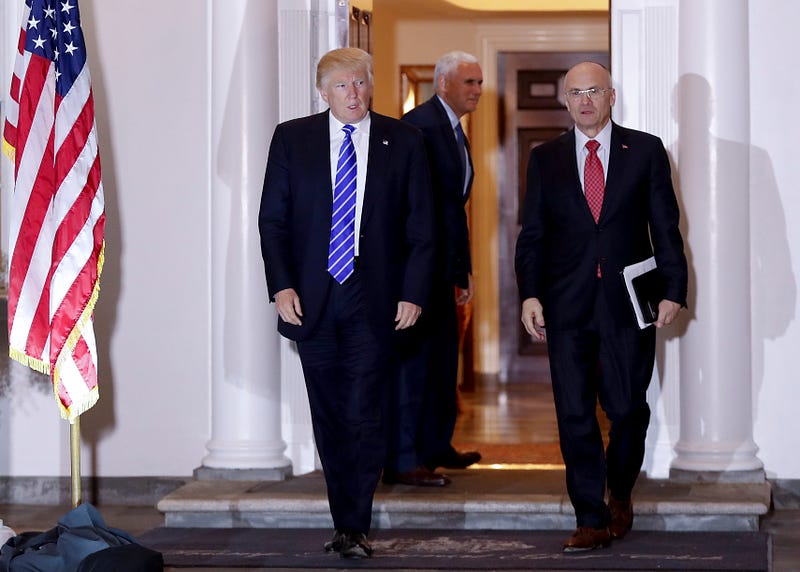
President-elect Donald Trump and Andy Puzder, chief executive of CKE Restaurants, walk from Trump National Golf Club Bedminster clubhouse in Bedminster, N.J., Saturday, Nov. 19, 2016. CREDIT: AP Photo/Carolyn Kaster
Puzder has also railed against President Obama’s joint-employer doctrine, which holds CEOs like him accountable for labor abuses committed by franchisees or contractors. He warned it would create “a lose-lose scenario” and “essentially destroy the business model.”
Graves, among others, has a cynical view of Puzder’s appointment. “It’s like putting the fox in charge of the hen house,” he said. “From our point of view, its very concerning.”
As Labor Secretary, Puzder could make sweeping changes impacting the nation’s workforce without ever having to go through Congress. He could scale back the department’s investigations into wage theft and other workplace violations, and ramp up investigations into union activity. He could make it more difficult for laid-off workers to collect unemployment insurance. He could weigh in against workers in lawsuits before the National Labor Relations Board or any federal court in the nation. He could change the government’s official view on who is classified as an employee versus who is an independent contractor, with widespread implications for workplace rights. He could change how many immigrants on temporary work visas are allowed into the United States.
Ironically, many of these changes would adversely impact the very people who voted Trump into office, Secunda predicted.
“The white working class who elected Trump are about to get screwed to a degree that is hard to fathom.”
A new report reveals the breathtaking scope of Trump’s conflicts of interest.
CREDIT: AP Photo/Charles Krupa
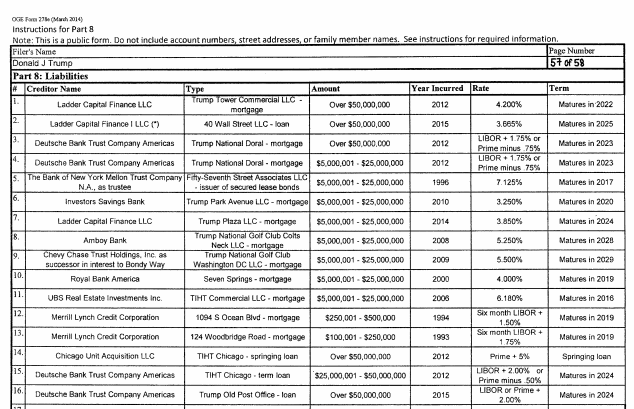
Trump filed documents with the FEC over the summer that revealed he owed at least $315 million to ten entities. This debt, some of which is personally guaranteed by him, was a clear conflict. As president, Trump will be responsible for regulating entities that he also owes money to. Worse, these debts are frequently renegotiated, giving these companies leverage over Trump in the regulatory process.
From Trump’s 2016 FEC financial disclosure form
A report this afternoon from the Wall Street Journal, however, revealed that Trump’s disclosure was the tip of the iceberg. The FEC required Trump only to report debt from entities he fully controls. The disclosure left out “more than $1.5 billion lent to partnerships that are 30%-owned by him.” That debt has been securitized and is owed to at least 150 financial entities.
These financial institutions include many firms that are under the scrutiny of the federal agencies that Trump will soon control. Wells Fargo, for example, which services over $900 million in loans connected to Trump, “is currently facing scrutiny from federal regulators surrounding its fraudulent sales practices and other issues.”
Trump will soon appoint the top regulators who will be responsible for scrutinizing the bank’s conduct.
A press conference that was scheduled to address Trump’s numerous conflict of interest was scheduled for December and then canceled. Another press conference has been scheduled for January 11, although it appears not to be exclusively focused on his business activities.
Thus far, Trump has pledged to retain full ownership over his business empire. His plan to simply hand control over to his sons has been derided as glaringly insufficient. The Office of Government Ethics and other ethics experts have said that the only way for Trump to avoid conflicts is to sell his businesses and place the proceeds in a blind trust.
One I decided to come back to Blogspot because I felt more comfortable here than WordPress. One of the big reasons I went to WordPress is because I was tried trying to link to my blog on Facebook and I kept getting hit that that Spam nonsense. Two as part of coming back I'm going to add more of my own personal thoughts on what's going along with trying to provide information that helps you defeat the wingnut in your life.