Showing posts with label 2016 elections. Show all posts

Thursday, September 22, 2016

The myth of Gary Johnson

Judd Legum/Think Progress
There are a lot of people planning to vote for Gary Johnson for president.
He doesn’t have quite enough supporters to qualify him for the upcoming presidential debates. But recent polls show Johnson, the Libertarian Party nominee, attracting between 7 and 13 percent of voters.
You might think that Johnson, a former Republican governor of New Mexico who ran for president as a Republican in 2012, would be attracting most of his support from Republicans.
You would be wrong.
A Quinnipiac Poll released earlier this month found Johnson drawing roughly equally from Republicans and Democrats.
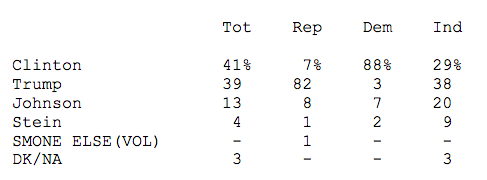
Quinnipiac University National Poll, September 8–13
Diving deeper, Johnson’s support comes disproportionately from young Democrats and Independents who supported Bernie Sanders in the primary. He’s running ahead of Trump and about even with Clinton with this group.
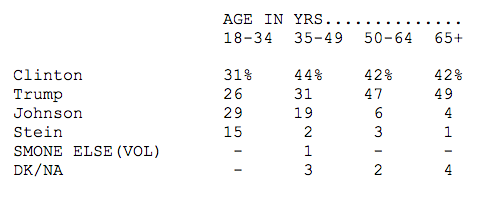
Quinnipiac University National Poll, September 8–13
On the surface, this makes a bit of sense. Johnson embraces a few Millennial-friendly positions like marijuana legalization, reproductive rights, and a non-interventionist foreign policy.
But dive just a little deeper and the case for former members of Bernie’s revolution to support Johnson falls apart.

People power versus corporate power

At the core of Sanders’ campaign was the idea that corporate power is completely out of control. His revolution, at its heart, is a quest to take power away from corporations and return it to the people.
Sanders’ motivation was probably best expressed in this rousing speech he delivered at an ABC Democratic primary debate, when he talked about how much corporations would loathe a Sanders presidency.
“The greed of the billionaire class, the greed of Wall Street, is destroying this economy. And it’s destroying the lives of millions of Americans,” he said.
If you went into a lab and created a candidate who has the opposite view of corporate power as Bernie Sanders, he would look a lot like Gary Johnson.
Johnson is a strong supporter of Citizen’s United and believes corporations should be able to spend unlimited funds to influence elections.
Johnson wants to reduce the corporate income tax from 35 percent to 0 percent.
Johnson opposes additional regulation or restrictions on corporations and would take a “hands-off” approach.
Johnson wants to eliminate the income tax and replace it with a national sales tax. This would effectively be a massive tax cut for billionaires and a tax hike for the poor and middle class.

Down with TPP

The gulf between these two candidates extends to other issues that animated the Sanders campaign.
For instance, Sanders vocally opposed the TPP and is credited with helping push Hillary Clinton to clarify her own opposition to the trade pact.
“Behind this legislation is all of corporate America…behind this legislation is Wall Street. Behind this legislation is the pharmaceutical industry,” Sanders said at a campaign event in June.
Sanders said it was imperative to oppose the TPP to “stand with working people and not with the big money interests.”
Johnson, however, supports the TPP, saying the trade deal would “move the ball forward.”

Let it burn

Another core tenet of Sanders’ platform was an extremely aggressive plan to combat climate change that included phasing out of fossil fuels completely, eliminating of oil industry tax breaks, opposing fracking, and supporting a carbon tax.
Gary Johnson does, to his credit, acknowledge climate change is occurring.
But asked this summer if he actually has a plan to do anything about it, Johnson said “no.”
Johnson recently said he was a “skeptic” that any government policy could address climate change.
A couple of years ago, he suggested it was pointless to address climate change because, eventually, the sun will swallow the earth.
The Libertarian Party platform, which Johnson is running on, would eliminate all government regulation of the energy industry.

Tear down the nets

There has been a lot of talk in recent years about cutting Social Security and Medicare to save money.
Bernie Sanders took the opposite approach. He wants to expand Social Security. He even made a whole campaign ad about it.
Bernie’s advocacy achieved a measure of success when the expansion of Social Security became an official part of the Democratic Party platform.
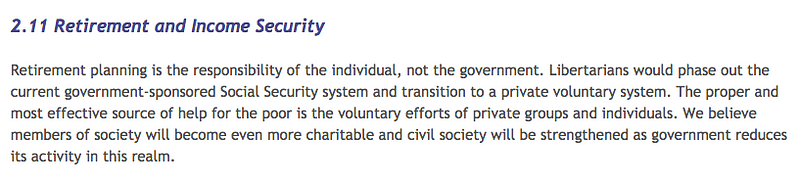
The Libertarian Party platform, however, calls for the abolition of Social Security. It would be replaced with nothing.
The opposite of free

Bernie Sanders attracted scores of young people to his campaign. One of his popular policies among this demographic: Free college tuition.
Hillary Clinton adopted a version of this policy prior to securing Sanders’ endorsement, promising free college tuition for families earning under $125,000 per year.
Gary Johnson, meanwhile, would eliminate the Department of Education — the agency that administers the Pell Grant program, which enables millions of students to attend college each year.
Johnson also appears deeply confused about the student loans but wants toeliminate government support for college students.
The Libertarian Party platform calls for the elimination of public schools.

A $15 difference

Bernie Sanders proudly campaigned on a national $15 minimum wage, which has become a rallying cry among workers around the country seeking a living wage.
This policy was also eventually included in the Democratic Party platform.
Gary Johnson would repeal the current federal minimum wage of $7.25 and let corporations offer even lower wages.

Medicare for none

Bernie Sanders advocates a single-payer health care system that essentially opens up Medicare to all Americans.
Hillary Clinton takes somewhat of a more incremental approach to health care reform. She wants to build on Obamacare and add a public option.
Gary Johnson, on the other hand, would eliminate the federal Medicare program and just provide a block grant to the states.

On a fundamental level, Gary Johnson is proposing the creation of an America that would make Bernie Sanders’ vision impossible.
In 2012, Johnson proposed a 43 percent cut to federal government spending. (This year he says he can balance the budget with a 20 percent cut to federal government spending. It’s unclear why he doesn’t need that other 23 percent anymore, but it’s still a massive reduction that would likely plunge the U.S. economy into a recession.)
This effectively means the government taking a massive step back and letting corporations fill the gap. In Johnson’s America, corporations will be completely in charge of the environment, health care, retirement, trade and wages.
This should not be appealing to former Bernie Sanders supporters. But, up until now, it has been. And whether it remains that way could have a big impact on the outcome of the 2016 election.
Motor City Sidebar: It's clear young white liberals don't know anything about the people they're supporting.

Tuesday, June 09, 2015

Former GOP Senator Trashes Party’s Presidential Field: ‘Scares Me To Death,’ ‘Not Ready For Primetime’

BY SCOTT KEYES/Think Progress
Regardless of their actual feelings, politicians tend to praise their colleagues in public as a matter of decorum, especially those in the same political party.
That’s why it was so surprising when former Sen. Tom Coburn (R-OK), who served 10 years in the Senate and 6 years in the House of Representatives before retiring in January 2015, offered up candidly negative comments about the 2016 Republican presidential field.
In an interview with conservative commentator Andrew Wilkow last week, Coburn trashed nearly every GOPer running for president, calling them “not ready for primetime,” lacking “integrity,” not “capable,” and saying he wouldn’t support one of them even if he won the nomination. Wilkow acknowledged the impact of Coburn’s words, noting that “once you retire, you can speak your mind in a way that might be different than if you were still sitting in the Senate.”
Listen to the interview, with the relevant portion beginning at 5:43:
Here are Coburn’s individual takes on the Republican presidential candidates (emphases added):
Rand Paul“Scares me to death on international foreign policy. Know him well, very smart. Think he was totally wrong on NSA. Didn’t speak truthfully about what was actually the facts. Would not vote for him for president.”
Marco Rubio: “Of all that are out there right now, probably my favorite.”
Scott Walker“Not ready for primetime, in my opinion. You look at what happened in Wisconsin in terms of him beating the recall and everything else, he didn’t do that. The Republicans around the country did it for him. They pulled him out of the fire. I just don’t think he’s quite ready for primetime, in my opinion.”
Ben Carson“I have a personal bone to pick with him on integrity that I witnessed. He made a commitment at the Prayer Breakfast not to attack the president. The speech was nothing but an attack on the president. The people who organized the Prayer Breakfast asked him not to do that. He said he would not, and then he went out and did it.”
George Pataki: “Probably smart enough, but would never encounter the votes. Nor does he have the conservative fiscal credentials or other credentials he would need to have a coalition behind him, in my opinion.”
Rick Perry: “Good guy. I don’t think he’s capable at that level.”
Lindsey Graham: “Love him, but he’s right in the middle, so I don’t see how he builds a coalition. I think his effort is try to talk about foreign policy and that’s what he ought to stick to.”
Carly Fiorina: “Smart lady. I helped her in her Senate campaign of which she was ultimately unsuccessful, but it’s because she could never get into good debates. Smart, savvy, experienced. Knows the issues that I’ve been talking about. Presents well. Doesn’t have a voting record. They’ll trash her bigtime because of her Hewlett-Packard experience.”
Ted Cruz“Not ready for primetime.”
Mike Huckabee: “Possibility. Good guy, well-rounded. Could fit in the middle and could attract votes from both sides.”
Rick Santorum: “Love him as a man. I think he feels called to try to do this. I don’t think it’s within his reach.”
Chris Christie: “Don’t know. I haven’t followed him well. I saw his tollgate problems. I like the fact that he answers questions correctly, which very few candidates do. I like the fact that he’ll take a risk and give you an answer that’s not politically popular.”
Jeb Bush“I don’t think America will elect another Bush president. I talk to a lot of liberals all the time. They still loathe George Bush. And so you shut out 47 percent of the electorate with that nomination. So you only get to lose three or four percent. I just don’t think it’s a possibility.”
Coburn has also called out his own party for its relentless quest to defund Obamacare, saying it took them “away from the larger picture.” He also dismissed 2013 legislation designed to defund health care reform as “dishonest” and “hype.” Said Coburn, “It’s a terribly dangerous and not successful strategy.”
Still, lest he come off as a milquetoast conservative, Coburn is still the same man who warned of “rampant lesbianism” in Oklahoma schools, said that breaching the debt ceiling wouldn’t result in a default, believed doctors who perform abortions should be executed, and thought the Second Amendment should allow people to buy bazookas.

Thursday, October 31, 2013

How 2016 Could Be An Even Bigger Democratic Blowout Than 2008

BY RUY TEIXEIRA/Think Progress
It’s widely acknowledged that the Democrats have a heavy lift going into the 2014 election, despite the continued decline in Republican Party favorability brought on by the shutdown, their extreme rhetoric and their single-minded devotion to undermining effective governance. However, regardless of the outcome in 2014, it seems likely that the GOP will be increasingly burdened by warfare between its totally intransigent Tea Party faction and “establishment”, business-oriented Republicans in and around Washington.
That’s a recipe for increased unpopularity going into the 2016 Presidential cycle. But a new poll suggests it might be more significant than that: an opportunity for the Democrats to make historic, devastating inroads into the Republican base.
How bad could 2016 be for Republicans? Pretty bad. Start with the likelihoodthat minorities, who voted 80 percent for Obama, will increase by 2 points to 30 percent of voters. Add to that the continued growth of heavily Democratic Millennial generation voters within the electorate, whose numbers will increase by about 4 million a year. By the 2016 election, Millennials should be about 36 percent of eligible voters and roughly a third of actual voters. That’s quite a tail wind for whomever the Democratic nominee may be.
But what about white voters? That’s where Obama was weakest, especially among white working class voters, whom he lost by 25 points. Won’t those kind of margins prevent a truly crushing defeat for the GOP in 2016?
Not necessarily.
The increasingly extreme and factionalized Republican party is suffering image erosion across the board, including among white voters. It’s also scaring white seniors and white working class voters, in particular, with its aggressive calls for cutting entitlements. This will likely lead a considerable number of white voters who backed Romney in 2012 to consider switching sides in 2016.
Will the Democrats be able to take advantage of this opening? We can’t say for sure, but consider that Hillary Clinton, the most likely nominee at this point, has a track record of appealing to white working class voters and in early pollshas been cutting Obama’s deficit among whites nationally and in key states. That raises the possibility that Democrats could make progress in 2016 toward a decades-long aspiration: a Bobby Kennedy-style coalition that unites minorities, young people, and educated liberals with working class whites.
That progress would not have to be large-scale to create a lop-sided loss for the GOP. If Hillary Clinton simply matched Obama’s modest performance among working class whites (an 18 point deficit) that, combined with expected levels of demographic change, would be enough for her to exceed Obama’s overall victory margin in 2008. And if Clinton could match Obama’s 2008 performance among college-educated white women (a 5 point advantage), for whom her candidacy should have special appeal, she would triumph by 10 points, a huge gap in Presidential elections and the largest margin since Ronald Reagan’s re-election in 1984.
One reaction to this scenario might be: college-educated white women, sure, but how can a Democrat, even Hillary Clinton, reach a white working class split from the increasingly diverse Democratic party by ethnic and class divisions? As it turns out, most of the white working class is much more open-minded than many think.
Take a look at the results from a new survey by CAP and PolicyLink on Americans’ reactions to rising diversity. The poll found that, by and large, positive sentiments about opportunities from rising diversity tended to outweigh negative concerns about rising diversity — even among working class whites.
As the table below shows, Americans overall expressed majority agreement with six of eight statements about these opportunities, though there was considerable demographic variation in level of agreement. But despite this variation, it is nevertheless striking that white working class (non-college) respondents also agreed with every one of those six statements:
opps2
Almost two-thirds (64 percent) of the white working class agreed that “Americans will learn more from one another and be enriched by exposure to many different cultures.” The same number agreed that “Aabigger, more diverse workforce will lead to more economic growth.” 62 percent agreed that “diverse workplaces and schools will help make American businesses more innovative and competitive.” 58 percent agreed that “people will become more accepting of their differences and more willing to find common ground.” 57 percent agreed that “with more diverse people working and living together, discrimination will decrease.” Finally, 52 percent agreed that “the entry of new people into the American workforce will increase our tax base and help support our retiree population”.
This does not sound like a demographic whose future lies with the lily-white Tea Party. The point becomes especially clear when you look at younger whites; white working class Millennials are significantly more open to rising diversity than the white working class as a whole. For example, 75 percent of white working class Millennials think Americans will be enriched by exposure to many cultures and 73 percent believe a bigger, more diverse workforce will lead to more economic growth.
These data indicate that there is real potential for a breakthrough among the white working class in 2016. Whether Hillary Clinton (or any other Democrat) can realize that potential remains to be seen. But if they can do so, the GOP could suffer an historic defeat.

Tuesday, June 18, 2013

House Republicans Do Their Part to Elect Hillary Clinton in 2016 By Passing Abortion Ban

By: Jason Easley/politicususa
House Republicans continued to blaze a path for their party to lose the 2016 election by passing a bill that would ban abortions after 20 weeks.
Republicans tried to soften Rep. Trent Franks’ bill by quietly adding an exception in case of rape, incest, or to protect the life of the mother, but this bill was clearly designed as a play to their anti-choice base. The bill really is a self inflicted wound, and a thumb in the eye the millions of women who supported President Obama in 2012.
The final vote was 228-196 with 6 Republicans voting no, and 6 Democrats voting yes.
Instead of reaching out to pro-choice women voters, House Republicans chose to antagonize them. So far, Republicans have ignored the advice of their own rebrand by voting to raise interest rates on student loans, threatening to kill immigration reform, and passing a federal abortion ban. In three simple steps, House Republicans have managed to alienate key parts of the constituency that has powered Barack Obama to two presidential election victories.
These votes are also paving the path for Hillary Clinton to win the White House in 2016. Republicans keep blaming the candidate at the top of the ticket, when the real problem is that the right wing zealots in the House are destroying the party’s brand. House Republicans have placed their party on a path to hand the 2016 election to Hillary Clinton.
By continuing to be anti-young person, anti-immigrant, and anti-women, the GOP is setting up a scenario where all Hillary Clinton, or any other Democrat will have to do is hold the Obama coalition together, and they will win. The great irony is that the glue that’s binding these people together is the actions of the Republican Party.
The House Republicans delivered the message to women that in their America, conservative men control their bodies. This message always plays well with the GOP rank and file, but it is absolute political suicide for future elections.
Today’s vote was an obvious political move to fire up the Republican base ahead of 2014, but that motivation could cut both ways. For men and women who truly care about liberty, and don’t want big government conservatism making our medical decisions for us, this vote should serve as motivation to get to the polls in 2014. House Republicans are setting the table for Hillary Clinton in 2016, but the message can be sent in 2014 that this sort of blatant contempt for women will not go unpunished.

Friday, November 09, 2012

Ohio’s GOP Secretary of State Already Has A Plan To Rig The 2016 Election For Republicans

By Ian Millhiser and Josh Israel/Think Progress

Last year, Pennsylvania’s Republican Gov. Tom Corbett proposed rigging the Electoral College vote in his state through a plan that would have given the majority of the state’s electors to Romney even after President Obama carried the state. Under Corbett’s plan, the winner of each congressional district within Pennsylvania would receive a single electoral vote, and the overall winner of the state would receive an additional two electoral votes. Had this plan been in place last Tuesday, Mitt Romney would likely have won 13 of the state’s 20 electoral votes, despite losing the state overall by more than five points.
Corbett’s election-rigging plan died, largely because Republican members of Congress in Pennsylvania feared that it would cause the Obama campaign to shift resources into their districts and endanger their own chances of being reelected. Now, however, Ohio Secretary of State Jon Husted (R)– who spent much of 2012 inventing ways to prevent pro-Obama votes from being cast or counted — wants to revive this election rigging scheme. According to the Ohio political blog Plunderbund,
Husted’s solution to this perceived problem of Democrats and the national media picking on him? He says we should make Ohio less important in the election by dividing up our electoral votes by Congressional district.
This is huge and should raise giant red flags. Under the current winner-take-all system, Obama won all 18 of Ohio’s electoral votes. Under Husted’s plan, 12 of those 18 electoral votes would be handed to Mitt Romney, the popular vote loser.
As in Pennsylvania, Republicans gerrymandered Ohio within an inch of its life. Even though Obama won Ohio, Republicans carried 12 of 16 seats in Ohio’s House delegation. This gerrymander would have all but ensured that Romney carried the overwhelming majority of Ohio’s electoral votes, regardless of how he performed in the state overall.
Indeed, if the Corbett/Husted plan to rig the Electoral College had been law in several key Republican-controlled states that President Obama won last Tuesday, America would now be looking at a very different future. Assuming that Mitt Romney won every congressional district that elected a Republican House candidate in these key states, the Corbett/Husted plan would have given Romney 17 electoral votes in Florida9 in Michigan12 in Ohio13 in Pennsylvania8 in Virginia, and 5 in Wisconsin — for a total of 64 additional electoral votes.
Add those 64 votes to the 206 votes Romney won legitimately, and it adds up to exactly 270 — the amount he needed to win the White House.