Judd Legum/Think Progress
There are a lot of people planning to vote for Gary Johnson for president.
He doesn’t have quite enough supporters to qualify him for the upcoming presidential debates. But recent polls show Johnson, the Libertarian Party nominee, attracting between 7 and 13 percent of voters.
You might think that Johnson, a former Republican governor of New Mexico who ran for president as a Republican in 2012, would be attracting most of his support from Republicans.
You would be wrong.
A Quinnipiac Poll released earlier this month found Johnson drawing roughly equally from Republicans and Democrats.
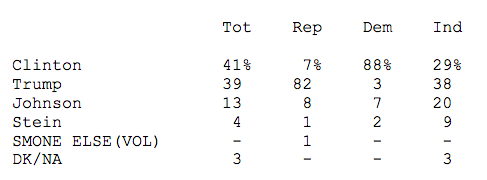
Diving deeper, Johnson’s support comes disproportionately from young Democrats and Independents who supported Bernie Sanders in the primary. He’s running ahead of Trump and about even with Clinton with this group.
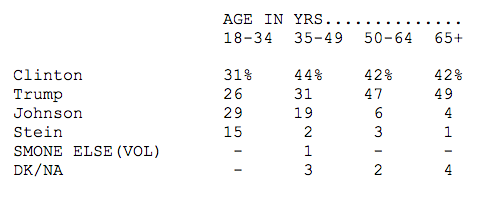
On the surface, this makes a bit of sense. Johnson embraces a few Millennial-friendly positions like marijuana legalization, reproductive rights, and a non-interventionist foreign policy.
But dive just a little deeper and the case for former members of Bernie’s revolution to support Johnson falls apart.
People power versus corporate power
At the core of Sanders’ campaign was the idea that corporate power is completely out of control. His revolution, at its heart, is a quest to take power away from corporations and return it to the people.
Sanders’ motivation was probably best expressed in this rousing speech he delivered at an ABC Democratic primary debate, when he talked about how much corporations would loathe a Sanders presidency.
“The greed of the billionaire class, the greed of Wall Street, is destroying this economy. And it’s destroying the lives of millions of Americans,” he said.
If you went into a lab and created a candidate who has the opposite view of corporate power as Bernie Sanders, he would look a lot like Gary Johnson.
Johnson is a strong supporter of Citizen’s United and believes corporations should be able to spend unlimited funds to influence elections.
Johnson wants to reduce the corporate income tax from 35 percent to 0 percent.
Johnson opposes additional regulation or restrictions on corporations and would take a “hands-off” approach.
Johnson wants to eliminate the income tax and replace it with a national sales tax. This would effectively be a massive tax cut for billionaires and a tax hike for the poor and middle class.
Down with TPP
The gulf between these two candidates extends to other issues that animated the Sanders campaign.
For instance, Sanders vocally opposed the TPP and is credited with helping push Hillary Clinton to clarify her own opposition to the trade pact.
“Behind this legislation is all of corporate America…behind this legislation is Wall Street. Behind this legislation is the pharmaceutical industry,” Sanders said at a campaign event in June.
Sanders said it was imperative to oppose the TPP to “stand with working people and not with the big money interests.”
Johnson, however, supports the TPP, saying the trade deal would “move the ball forward.”
Let it burn
Another core tenet of Sanders’ platform was an extremely aggressive plan to combat climate change that included phasing out of fossil fuels completely, eliminating of oil industry tax breaks, opposing fracking, and supporting a carbon tax.
Gary Johnson does, to his credit, acknowledge climate change is occurring.
But asked this summer if he actually has a plan to do anything about it, Johnson said “no.”
Johnson recently said he was a “skeptic” that any government policy could address climate change.
A couple of years ago, he suggested it was pointless to address climate change because, eventually, the sun will swallow the earth.
The Libertarian Party platform, which Johnson is running on, would eliminate all government regulation of the energy industry.
Tear down the nets
There has been a lot of talk in recent years about cutting Social Security and Medicare to save money.
Bernie Sanders took the opposite approach. He wants to expand Social Security. He even made a whole campaign ad about it.
Bernie’s advocacy achieved a measure of success when the expansion of Social Security became an official part of the Democratic Party platform.
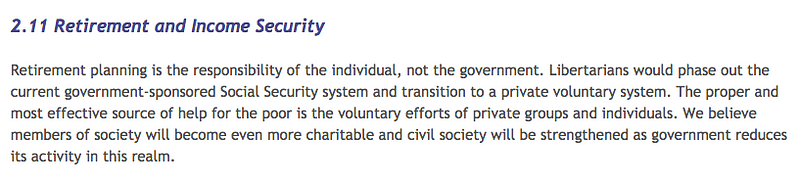
The Libertarian Party platform, however, calls for the abolition of Social Security. It would be replaced with nothing.
The opposite of free
Bernie Sanders attracted scores of young people to his campaign. One of his popular policies among this demographic: Free college tuition.
Hillary Clinton adopted a version of this policy prior to securing Sanders’ endorsement, promising free college tuition for families earning under $125,000 per year.
Gary Johnson, meanwhile, would eliminate the Department of Education — the agency that administers the Pell Grant program, which enables millions of students to attend college each year.
Johnson also appears deeply confused about the student loans but wants toeliminate government support for college students.
The Libertarian Party platform calls for the elimination of public schools.
A $15 difference
Bernie Sanders proudly campaigned on a national $15 minimum wage, which has become a rallying cry among workers around the country seeking a living wage.
This policy was also eventually included in the Democratic Party platform.
Gary Johnson would repeal the current federal minimum wage of $7.25 and let corporations offer even lower wages.
Medicare for none
Bernie Sanders advocates a single-payer health care system that essentially opens up Medicare to all Americans.
Hillary Clinton takes somewhat of a more incremental approach to health care reform. She wants to build on Obamacare and add a public option.
Gary Johnson, on the other hand, would eliminate the federal Medicare program and just provide a block grant to the states.
On a fundamental level, Gary Johnson is proposing the creation of an America that would make Bernie Sanders’ vision impossible.
In 2012, Johnson proposed a 43 percent cut to federal government spending. (This year he says he can balance the budget with a 20 percent cut to federal government spending. It’s unclear why he doesn’t need that other 23 percent anymore, but it’s still a massive reduction that would likely plunge the U.S. economy into a recession.)
This effectively means the government taking a massive step back and letting corporations fill the gap. In Johnson’s America, corporations will be completely in charge of the environment, health care, retirement, trade and wages.
This should not be appealing to former Bernie Sanders supporters. But, up until now, it has been. And whether it remains that way could have a big impact on the outcome of the 2016 election.
Motor City Sidebar: It's clear young white liberals don't know anything about the people they're supporting.

