Showing posts with label white liberals. Show all posts

Thursday, September 22, 2016

The myth of Gary Johnson

Judd Legum/Think Progress
There are a lot of people planning to vote for Gary Johnson for president.
He doesn’t have quite enough supporters to qualify him for the upcoming presidential debates. But recent polls show Johnson, the Libertarian Party nominee, attracting between 7 and 13 percent of voters.
You might think that Johnson, a former Republican governor of New Mexico who ran for president as a Republican in 2012, would be attracting most of his support from Republicans.
You would be wrong.
A Quinnipiac Poll released earlier this month found Johnson drawing roughly equally from Republicans and Democrats.
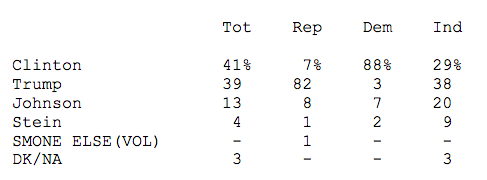
Quinnipiac University National Poll, September 8–13
Diving deeper, Johnson’s support comes disproportionately from young Democrats and Independents who supported Bernie Sanders in the primary. He’s running ahead of Trump and about even with Clinton with this group.
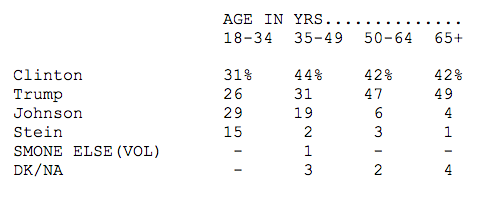
Quinnipiac University National Poll, September 8–13
On the surface, this makes a bit of sense. Johnson embraces a few Millennial-friendly positions like marijuana legalization, reproductive rights, and a non-interventionist foreign policy.
But dive just a little deeper and the case for former members of Bernie’s revolution to support Johnson falls apart.

People power versus corporate power

At the core of Sanders’ campaign was the idea that corporate power is completely out of control. His revolution, at its heart, is a quest to take power away from corporations and return it to the people.
Sanders’ motivation was probably best expressed in this rousing speech he delivered at an ABC Democratic primary debate, when he talked about how much corporations would loathe a Sanders presidency.
“The greed of the billionaire class, the greed of Wall Street, is destroying this economy. And it’s destroying the lives of millions of Americans,” he said.
If you went into a lab and created a candidate who has the opposite view of corporate power as Bernie Sanders, he would look a lot like Gary Johnson.
Johnson is a strong supporter of Citizen’s United and believes corporations should be able to spend unlimited funds to influence elections.
Johnson wants to reduce the corporate income tax from 35 percent to 0 percent.
Johnson opposes additional regulation or restrictions on corporations and would take a “hands-off” approach.
Johnson wants to eliminate the income tax and replace it with a national sales tax. This would effectively be a massive tax cut for billionaires and a tax hike for the poor and middle class.

Down with TPP

The gulf between these two candidates extends to other issues that animated the Sanders campaign.
For instance, Sanders vocally opposed the TPP and is credited with helping push Hillary Clinton to clarify her own opposition to the trade pact.
“Behind this legislation is all of corporate America…behind this legislation is Wall Street. Behind this legislation is the pharmaceutical industry,” Sanders said at a campaign event in June.
Sanders said it was imperative to oppose the TPP to “stand with working people and not with the big money interests.”
Johnson, however, supports the TPP, saying the trade deal would “move the ball forward.”

Let it burn

Another core tenet of Sanders’ platform was an extremely aggressive plan to combat climate change that included phasing out of fossil fuels completely, eliminating of oil industry tax breaks, opposing fracking, and supporting a carbon tax.
Gary Johnson does, to his credit, acknowledge climate change is occurring.
But asked this summer if he actually has a plan to do anything about it, Johnson said “no.”
Johnson recently said he was a “skeptic” that any government policy could address climate change.
A couple of years ago, he suggested it was pointless to address climate change because, eventually, the sun will swallow the earth.
The Libertarian Party platform, which Johnson is running on, would eliminate all government regulation of the energy industry.

Tear down the nets

There has been a lot of talk in recent years about cutting Social Security and Medicare to save money.
Bernie Sanders took the opposite approach. He wants to expand Social Security. He even made a whole campaign ad about it.
Bernie’s advocacy achieved a measure of success when the expansion of Social Security became an official part of the Democratic Party platform.
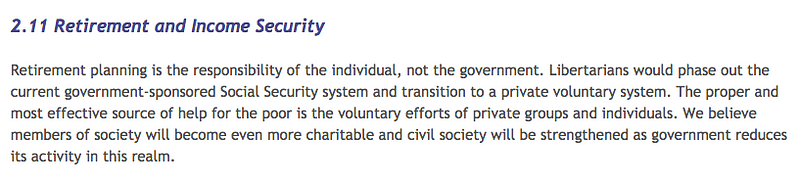
The Libertarian Party platform, however, calls for the abolition of Social Security. It would be replaced with nothing.
The opposite of free

Bernie Sanders attracted scores of young people to his campaign. One of his popular policies among this demographic: Free college tuition.
Hillary Clinton adopted a version of this policy prior to securing Sanders’ endorsement, promising free college tuition for families earning under $125,000 per year.
Gary Johnson, meanwhile, would eliminate the Department of Education — the agency that administers the Pell Grant program, which enables millions of students to attend college each year.
Johnson also appears deeply confused about the student loans but wants toeliminate government support for college students.
The Libertarian Party platform calls for the elimination of public schools.

A $15 difference

Bernie Sanders proudly campaigned on a national $15 minimum wage, which has become a rallying cry among workers around the country seeking a living wage.
This policy was also eventually included in the Democratic Party platform.
Gary Johnson would repeal the current federal minimum wage of $7.25 and let corporations offer even lower wages.

Medicare for none

Bernie Sanders advocates a single-payer health care system that essentially opens up Medicare to all Americans.
Hillary Clinton takes somewhat of a more incremental approach to health care reform. She wants to build on Obamacare and add a public option.
Gary Johnson, on the other hand, would eliminate the federal Medicare program and just provide a block grant to the states.

On a fundamental level, Gary Johnson is proposing the creation of an America that would make Bernie Sanders’ vision impossible.
In 2012, Johnson proposed a 43 percent cut to federal government spending. (This year he says he can balance the budget with a 20 percent cut to federal government spending. It’s unclear why he doesn’t need that other 23 percent anymore, but it’s still a massive reduction that would likely plunge the U.S. economy into a recession.)
This effectively means the government taking a massive step back and letting corporations fill the gap. In Johnson’s America, corporations will be completely in charge of the environment, health care, retirement, trade and wages.
This should not be appealing to former Bernie Sanders supporters. But, up until now, it has been. And whether it remains that way could have a big impact on the outcome of the 2016 election.
Motor City Sidebar: It's clear young white liberals don't know anything about the people they're supporting.

Monday, September 26, 2011

The Epistemology of Race Talk

Melissa Harris-Perry/The Nation

I logged onto Twitter on Sunday night and discovered that my recent article for The Nation was causing a bit of a stir. Some members of the white liberal political community are appalled and angry that I suggested racial bias maybe responsible for the President’s declining support among white Americans. I found some responses to my piece to be fair and important, others to be silly and nonresponsive, and still others to be offensive personal attacks. But those categories are par for the course.
I make it a practice not to defend my public writings. Because I often write about provocative topics like race, gender, sexual orientation and reproductive rights, if I defended every piece I wrote against critics I would find little time to sleep. But the responses to this recent article have been revealing in ways that I find typical of our contemporary epistemology of race. Often, those of us who attempt to talk about historical and continuing racial bias in America encounter a few common discursive strategies that are meant to discredit our perspectives. Some of them are in play here.
1. Prove it!
The first is a common strategy of asking any person of color who identifies a racist practice or pattern to “prove” that racism is indeed the causal factor. This is typically demanded by those who are certain of their own purity of racial motivation. The implication is if one cannot produce irrefutable evidence of clear, blatant and intentional bias, then racism must be banned as a possibility. But this is both silly as an intellectual claim and dangerous as a policy standard. 
In a nation with the racial history of the United States I am baffled by the idea that non-racism would be the presumption and that it is racial bias which must be proved beyond reasonable doubt. More than 100 years of philosophical, psychological and sociological research that begins, at least, with the work of W.E.B. Du Bois has mapped the deeply entrenched realities of racial bias on the American consciousness. If anything, racial bias, not racial innocence is the better presumption when approaching American political decision-making. Just fifty years ago, nearly all white Democrats in the US South shifted parties rather than continuing to affiliate with the party of civil rights. No one can prove that this decision was made on the basis of racial bias, but the historical trend is so clear as to require mental gymnastics to imagine this was a choice not motivated by race.
Progressives and liberals should be particularly careful when they demand proof of intentionality rather than evidence of disparate impact in conversations about racism. Recall that initially the 1964 Civil Rights Act made “disparate impact” a sufficient evidentiary claim for racial bias. In other words, a plaintiff did not need to prove that anyone was harboring racial animus in their hearts, they just needed to show that the effects of a supposedly race neutral policy actually had a discernible, disparate impact on people of color. The doctrine of disparate impact helped to clear many discriminatory housing and employment policies off the books.
Michelle Alexander brilliantly demonstrates in The New Jim Crow, the pernicious effect of the Supreme Court moving away from disparate impact as a standard to forcing plaintiffs to demonstrate racist intention. This new standard has encouraged the explosive growth of incarceration of African-Americans, turning a blind eye to disparate impact while it demands “proof” of racial bias.
I believe we must be careful and judicious in our conversations about racism. But I also believe that those who demand proof of interpersonal intention to create a racist outcome are missing the point about how racism works. Racism is not exclusively about hooded Klansmen; it is also about the structures of bias and culture of privilege that infect the left as well.
2. I have black friends
Which brings us to a second common strategy of argument about one’s racial innocence: the “I have black friends” claim. I was shocked and angered when Salon’s Joan Walsh used this strategy in her criticism of my piece. Although I disagree with her, I have no problem with Walsh’s decision to take on the claims in my piece. I consider it a sign of respect to publicly engage those with whom you disagree. I was taken aback that Walsh emphasized the extent of our friendship. Walsh and I have been professionally friendly. We’ve eaten a few meals. I invited her to speak at Princeton and I introduced her to my literary agent. We are not friends. Friendship is a deep and lasting relationship based on shared sacrifice and joys. We are not intimates in that way. Watching Walsh deploy our professional familiarity as a shield against claims of her own bias is very troubling. In fact, it is one of the very real barriers to true interracial friendship and intimacy.
Interracial friendship should, ideally, encourage the desire to investigate one’s own racial privilege and bias, not to use the identity of one’s friends against any claim that such bias even exists. As an ally in LGBT struggles, I have learned this lesson repeatedly. As an ally my role is to speak up for LGBT issues when in heteronormative environments and to shut up when being spoken to by gay and transgendered persons. I was harshly criticized for my failure to account for trans-phobia and trans-hatred and trans-violence in my discussions of “don’t ask, don’t tell” and marriage equality. My critics were absolutely right. My cis-privilege had blinded me to the ways that power was operating very differently for trans-citizens.
Friends certainly criticize friends, but allies also pause to listen. It is completely possible that I am absolutely wrong about white racial bias on the left against President Obama. Certainly, it wouldn’t be the first time I was wrong in my political analysis. But listen to this for a moment white allies: many African-Americans (not all, but many) feel that the attacks on President Obama are racialized on both the right and the left. This feeling has meaningful implications for the quality of our national, political fabric. When we tell you that the attacks are racially troubling, painful, we would like you to take our concerns seriously rather than working to simply defend yourself against the claims.
Along with several colleagues I conducted a national survey in 2005 measuring how Americans felt in the aftermath of the Hurricane Katrina disaster. The racial gap in how black and white Americans saw the event was striking. A strong majority of white Americans believed the government response has little or nothing to do with race, while an overwhelming number of black Americans believed the response was racialized. No one can “prove” which perception is accurate. But that is beside the point. If more than two-thirds of black citizens believe that their government will allow them to drown and dehydrate and die on national television because of their race, then there is something here worth discussing. And the discussion cannot be about how black people are just too sensitive.
3. Who made you an expert?
This brings me to a final point about racial discourse. It is common for my interlocutors to question my professional, intellectual and personal credentials. It is as though my very identity as an African-American woman makes me unqualified to speak on issues of race and gender; as though I could only be arguing out of personal interest or opinion rather than from decades of research, publication and university teaching.
But this is not personal. In fact, I suspect that those who tell me “I hope you die” or “you are a racist” or “you are a hack” actually know almost nothing about me at all. Rather this is standard strategy used to scorn the study of race as an illegitimate intellectual pursuit. Taking race and gender seriously as objects of academic inquiry is widely maligned, particularly in a social and political world that sees itself through the rose-colored lenses of self-congratulatory post-racialism. A French scholar of the French Revolution could easily write 1,000 words about American Francophone relations without being asked to produce a bibliography of citations, but the same courtesy of professional credibility is pretty regularly denied to black scholars of American racial politics.
This blog is against my better judgment in many ways. Reading it over again, it feels defensive. I am fully aware that I have benefitted from a hugely transformed public space. The struggles of generations of scholars, activists and writers who went before me have cleared unimaginable room for me and so many others to pursue public discourse on topics that were previously silenced, often violently. I am grateful to have readers who take me seriously enough to argue with me and opponents who believe my words are important enough that they make the effort to belittle them.
Further, I am grateful to live in a time when white Americans are furious about anyone suggesting that they are racist. I much prefer to live in a country and at a moment where the idea of being racist is distasteful rather than commonplace. In many ways the angry reaction about even the suggestion of racial bias is a kind of racial progress.